Bitcoin To $125,000: Arthur Hayes Says The Setup Is Turning BullishArthur Hayes says Bitcoin’s macro setup is turning bullish again, arguing that wartime spending, US fiscal deficits and bank-led credit creation could outweigh fears of a smaller Federal Reserve balance sheet. Speaking at the Bitcoin 2026 conference in Las Vegas, the BitMEX co-founder said Bitcoin is increasingly trading as a response to “wartime inflation,” not just the artificial intelligence cycle.
Hayes framed the recent shift around a simple premise: governments are openly preparing to spend more on defense, and that spending ultimately has to be financed. In his view, that puts Bitcoin back in familiar territory as a liquidity-sensitive asset with a hard-money narrative.
“Since the war has started, Bitcoin has outperformed,” Hayes said. “It outperformed NASDAQ and outperformed the SaaS stocks. And basically, I think that Bitcoin is now focusing on wartime inflation.”
The core of Hayes’ argument was not that the Fed will suddenly return to explicit quantitative easing. Instead, he focused on what he described as a likely balance-sheet reshuffling between the Fed and the commercial banking system, one that could allow officials to claim the Fed is shrinking while leaving the broader dollar liquidity picture largely intact.
Bitcoin Vs. The Hawkish Fed Narrative
Hayes addressed market concerns around Kevin Warsh, whom he said investors have viewed as a potentially hawkish Fed chair because of his criticism of the central bank’s large balance sheet. Hayes said those fears miss the practical constraints facing monetary officials when the US government is still issuing massive amounts of debt.
“If the market believes that there’s going to be less dollar liquidity floating around the system because of what Warsh will do with the Fed, then they’ll be bearish on Bitcoin and other risk assets,” Hayes said. “This is what we’ve seen in the media talking about sort of this hawkish Fed that’s going to come into place after May when Warsh takes over. Now, I don’t believe that’s the case.”
According to Hayes, Warsh would be constrained by the Treasury’s need to keep the bond market functioning. He argued that the Fed cannot pursue balance-sheet reduction in a vacuum when the US government must continue funding large deficits.
“At the end of the day, when you’ve issued $38 trillion of debt and you need to fund the government, the Federal Reserve will do what it’s asked to do, which is make sure the market is orderly so that people can buy this debt,” Hayes said.
The Bank Balance Sheet Trade
Hayes’ central mechanism is a swap: commercial banks reduce their holdings of Fed reserves and replace them with Treasuries and repos. In that scenario, the Fed’s balance sheet can become smaller on paper, while the banking system absorbs more government debt.
“The point of all this is that the net effect on dollar liquidity is neutral,” Hayes said. “There’s nothing being sold, there’s nothing being bought. It’s just a swap. It’s purely regulatory fiction in terms of who is allowed to hold what.”
That distinction matters for Bitcoin because Hayes says investors should care less about the stated size of the Fed’s balance sheet and more about whether the overall system is creating or destroying dollar liquidity. If debt simply migrates from the Fed to regulated bank balance sheets, the impact may be far less restrictive than markets fear.
Hayes linked that transition to US banking deregulation and specifically cited changes to the Enhanced Supplementary Leverage Ratio, which he said went live on April 1. In his telling, the rule change allows large banks such as JPMorgan and Citibank to absorb more Treasuries and repos, while smaller banks can expand construction and industrial lending.
He also cited an S&P Global estimate that the ESLR balance-sheet reduction could generate $1.3 trillion of new loans.
Wartime Spending Becomes The Demand Engine
Hayes argued that the demand side of the lending cycle is already visible. Defense spending, critical resource production and AI infrastructure are all becoming national-security priorities, he said, creating borrowers with government-backed demand and therefore more attractive credit profiles for banks.
“Why will banks have demand for loans? One of the criticisms about this analysis from some of my other macro-fans is that they claim the banking system is not creating enough loans or there’s not enough demand,” Hayes said. “Well, we have a great source of demand that is the US Department of War.”
He said banks would lend to defense suppliers, resource miners and hyperscalers as AI capital expenditure becomes part of the national-security framework. Hayes described bank lending as especially important because, in his view, it carries a higher multiplier than central bank lending, estimating that around $4 trillion in credit could ultimately be created.
That is the basis for his renewed bullishness. Hayes said his liquidity chart bottomed in November of last year, roughly around the same time as Bitcoin, and argued that after a period of war-driven uncertainty, the market may now be ready to move higher.
“I think we’ve had a bit of a chop. We’ve had a bit of a war. Now it’s time to break out,” Hayes said. “And that’s why I believe Bitcoin is going higher. I think my end of year choice target is like $125,000, whatever, it doesn’t fucking matter, I’m wrong anyways.”
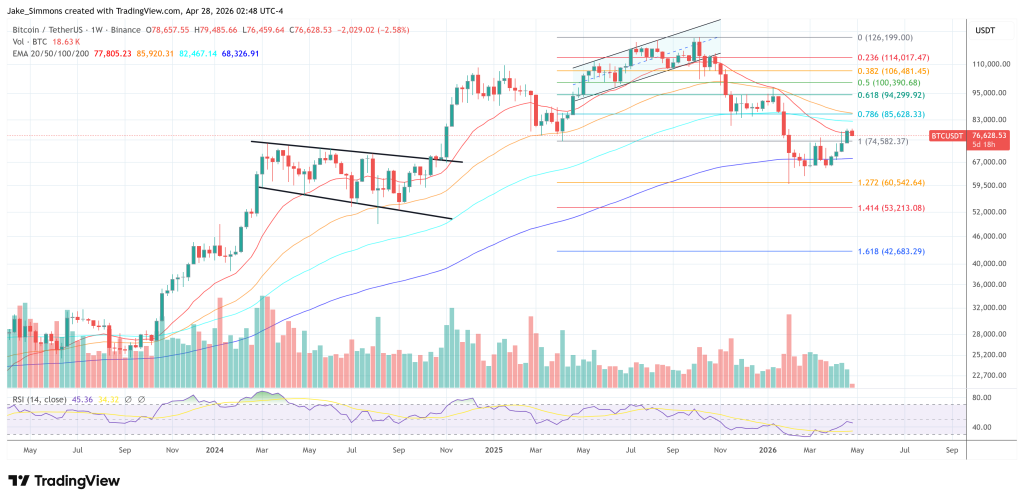
At press time, Bitcoin traded at $76,628.
read the full story
Arthur Hayes says Bitcoin’s macro setup is turning bullish again, arguing that wartime spending, US fiscal deficits and bank-led credit creation could outweigh fears of a smaller Federal Reserve balance sheet. Speaking at the Bitcoin 2026 conference in Las Vegas, the BitMEX co-founder said Bitcoin is increasingly trading as a response to “wartime inflation,” not just the artificial intelligence cycle.
Hayes framed the recent shift around a simple premise: governments are openly preparing to spend more on defense, and that spending ultimately has to be financed. In his view, that puts Bitcoin back in familiar territory as a liquidity-sensitive asset with a hard-money narrative.
“Since the war has started, Bitcoin has outperformed,” Hayes said. “It outperformed NASDAQ and outperformed the SaaS stocks. And basically, I think that Bitcoin is now focusing on wartime inflation.”
The core of Hayes’ argument was not that the Fed will suddenly return to explicit quantitative easing. Instead, he focused on what he described as a likely balance-sheet reshuffling between the Fed and the commercial banking system, one that could allow officials to claim the Fed is shrinking while leaving the broader dollar liquidity picture largely intact.
Bitcoin Vs. The Hawkish Fed Narrative
Hayes addressed market concerns around Kevin Warsh, whom he said investors have viewed as a potentially hawkish Fed chair because of his criticism of the central bank’s large balance sheet. Hayes said those fears miss the practical constraints facing monetary officials when the US government is still issuing massive amounts of debt.
“If the market believes that there’s going to be less dollar liquidity floating around the system because of what Warsh will do with the Fed, then they’ll be bearish on Bitcoin and other risk assets,” Hayes said. “This is what we’ve seen in the media talking about sort of this hawkish Fed that’s going to come into place after May when Warsh takes over. Now, I don’t believe that’s the case.”
According to Hayes, Warsh would be constrained by the Treasury’s need to keep the bond market functioning. He argued that the Fed cannot pursue balance-sheet reduction in a vacuum when the US government must continue funding large deficits.
“At the end of the day, when you’ve issued $38 trillion of debt and you need to fund the government, the Federal Reserve will do what it’s asked to do, which is make sure the market is orderly so that people can buy this debt,” Hayes said.
The Bank Balance Sheet Trade
Hayes’ central mechanism is a swap: commercial banks reduce their holdings of Fed reserves and replace them with Treasuries and repos. In that scenario, the Fed’s balance sheet can become smaller on paper, while the banking system absorbs more government debt.
“The point of all this is that the net effect on dollar liquidity is neutral,” Hayes said. “There’s nothing being sold, there’s nothing being bought. It’s just a swap. It’s purely regulatory fiction in terms of who is allowed to hold what.”
That distinction matters for Bitcoin because Hayes says investors should care less about the stated size of the Fed’s balance sheet and more about whether the overall system is creating or destroying dollar liquidity. If debt simply migrates from the Fed to regulated bank balance sheets, the impact may be far less restrictive than markets fear.
Hayes linked that transition to US banking deregulation and specifically cited changes to the Enhanced Supplementary Leverage Ratio, which he said went live on April 1. In his telling, the rule change allows large banks such as JPMorgan and Citibank to absorb more Treasuries and repos, while smaller banks can expand construction and industrial lending.
He also cited an S&P Global estimate that the ESLR balance-sheet reduction could generate $1.3 trillion of new loans.
Wartime Spending Becomes The Demand Engine
Hayes argued that the demand side of the lending cycle is already visible. Defense spending, critical resource production and AI infrastructure are all becoming national-security priorities, he said, creating borrowers with government-backed demand and therefore more attractive credit profiles for banks.
“Why will banks have demand for loans? One of the criticisms about this analysis from some of my other macro-fans is that they claim the banking system is not creating enough loans or there’s not enough demand,” Hayes said. “Well, we have a great source of demand that is the US Department of War.”
He said banks would lend to defense suppliers, resource miners and hyperscalers as AI capital expenditure becomes part of the national-security framework. Hayes described bank lending as especially important because, in his view, it carries a higher multiplier than central bank lending, estimating that around $4 trillion in credit could ultimately be created.
That is the basis for his renewed bullishness. Hayes said his liquidity chart bottomed in November of last year, roughly around the same time as Bitcoin, and argued that after a period of war-driven uncertainty, the market may now be ready to move higher.
“I think we’ve had a bit of a chop. We’ve had a bit of a war. Now it’s time to break out,” Hayes said. “And that’s why I believe Bitcoin is going higher. I think my end of year choice target is like $125,000, whatever, it doesn’t fucking matter, I’m wrong anyways.”
At press time, Bitcoin traded at $76,628.

Would Satoshi say? Director of the FBI appears at Bitcoin 2026 – Victory or capture?
Bitcoin 2026 opened at The Venetian on April 27 with the Director of the FBI in the program for a…

UAE Quits OPEC After 59 Years, BTC Slides Below $76K Amid Hormuz Supply Shock
The United Arab Emirates officially withdrew from OPEC and the broader OPEC+ alliance on April 28,…


Bitcoin Slumps Below $77,000 as Oil Price Spikes Amid Stalled Iran Peace Talks
Bitcoin fell below $77,000 as rising oil prices and growing uncertainty around U.S.-Iran relations…

Bitcoin Price Analysis: What Does the $80K Rejection Mean for BTC’s Short-Term Future?
Bitcoin is trading around $76k as April draws to a close. It is sitting at one of the most…

Amboss Activates RailsX, Enabling Self-Custody Stablecoin Trading on Bitcoin Lightning
Amboss' RailsX goes live with USDT-L and USDC-L, bringing peer-to-peer, self-custodial stablecoin…

Stablecoin Giant Tether Reveals Plans for Modular Bitcoin Mining Hardware
Leading stablecoin issuer Tether has teamed with Canaan and ACME Swisstech to develop customizable,…

Riot extends $200 million Coinbase credit facility, and bitcoin weakness could mean more sales
The miner locked in fixed borrowing costs and extended maturity, but a shrinking BTC treasury and…

Bitcoin’s $80k test should be decided by the bond market this week
Everyone watching Bitcoin this week is watching the Federal Reserve, while the more important tell…
$82K CME Gap Becomes Bitcoin’s Battleground With Big Tech Earnings Pressuring Risk Appetite
TL;DR Technical Setup: Bitcoin’s recovery hinges on closing above the $82K CME gap, with negative…

Bitcoin price hits one-week low as $100 oil sparks fresh Asia crisis fears
Bitcoin price downside returned to send BTC to one-week lows thanks to renewed concerns over global…

Canadian Billionaire Ridicules Saylor's Quest for 1 Million BTC
Canadian billionaire Frank Giustra is pouring cold water on MicroStrategy's race to accumulate one…

Iran poised to table new peace proposal as markets weigh risk premium for bitcoin, ether
Iran expected to submit revised peace proposal, compressing war premium in oil markets and lifting…

Varntix Research Shows Holding BTC Might Not Be Enough Anymore
Bitcoin’s bull score index has just moved into neutral territory for the first time since BTC…
Bitcoin price drops below $76K as onchain data sends mixed signals
Bitcoin failed to break $80,000 resistance amid weak onchain fundamentals, but rising spot CVD could…
'Crypto Godfather' says bitcoin has not reached its bottom and a new all-time high is off the table for 2026
The early bitcoin investor and author of Bitcoin Supercycle says bitcoin needs to drop to about…
Why Bitcoin Suddenly Fell Below $76,000: CryptoQuant
Bitcoin has dropped so far this week after recent upward momentum, and on-chain analysis has sought…
Can Bitcoin hit $250K this year? Traders say it may be time to ‘sell in May’
Veteran trader Peter Brandt and other analysts question the $250,000 Bitcoin target, warning the…