Bitplanet’s Antalpha mining deal tests whether Bitcoin treasuries can grow without constant buyingAsia Bitcoin company, Bitplanet, is trying to convert its Bitcoin treasury from a balance-sheet position into a source of mined BTC revenue.
The South Korean company said in a June 24 release that it signed a strategic memorandum of understanding with Nasdaq-listed Antalpha and mining ecosystem partners.
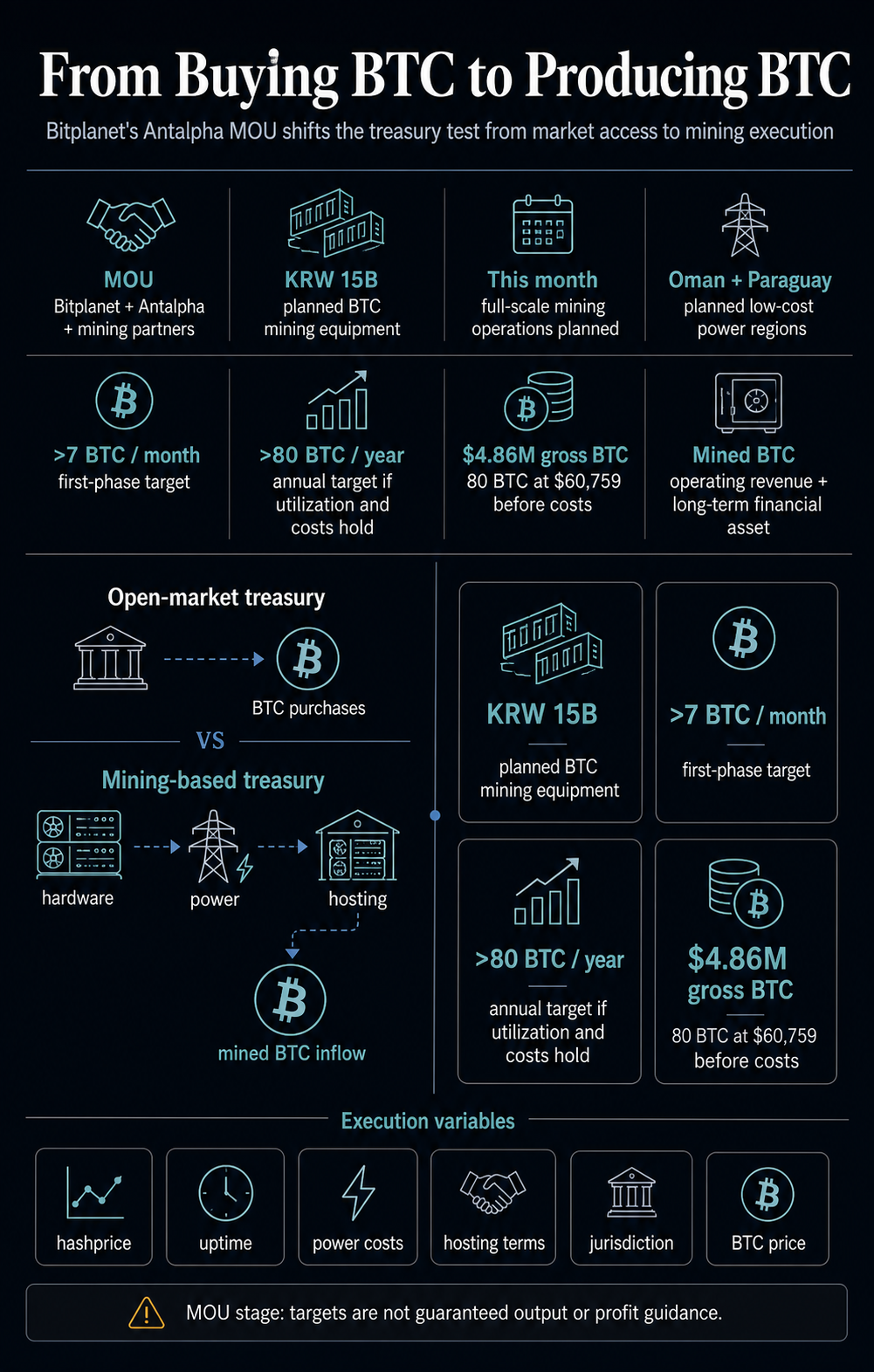
Under the MOU, Bitplanet plans to introduce KRW 15 billion in BTC mining equipment and begin full-scale mining operations this month.
The change pushes Bitplanet beyond the familiar corporate treasury playbook of raising capital, buying BTC, and letting the balance sheet carry the exposure.
A mining-based treasury is exposed to a different operating stack: hashrate, hosting contracts, power prices, equipment uptime, local execution, and whether mined coins are retained, sold, or pledged as collateral.
Bitplanet is presenting that second model as the next step for its corporate Bitcoin strategy. The company said mined BTC will be recognized as operating revenue and managed as a long-term financial asset across liquidity reserves, risk-hedging funds, and reinvestment capital.
Treasury Strategy Turns Operational
Bitplanet's announcement extends the company's earlier treasury accumulation. CryptoSlate previously covered Bitplanet's SGA acquisition and its ambition to become one of the largest corporate Bitcoin holders, then later covered its daily Bitcoin accumulation push.
That earlier model was familiar: raise capital, buy BTC, and let the balance sheet reflect Bitcoin exposure.
The Antalpha deal points at a different question. Can a treasury company build a recurring Bitcoin production loop, where hardware, low-cost power, and hosting infrastructure feed coins into the balance sheet over time?
Bitplanet said the first-phase equipment is expected to target more than 7 BTC per month and over 80 BTC annually, subject to equipment utilization and power costs.
Using a Bitcoin price near $61,000, 80 BTC would represent about $4.9 million of gross BTC output before electricity, hosting, financing, repairs, taxes, and corporate overhead.
That math gives investors a scale marker rather than profit guidance. It also leaves open the question of whether the company can retain the mined BTC, reinvest it, or use it as collateral without weakening its broader treasury thesis.
Model
What Adds BTC
Main Dependency
Key Risk
Open-market treasury accumulation
Purchases funded by cash, equity, debt, or other financing
Capital-market access and BTC price
Dilution, debt cost, or forced pauses in buying
Mining-based BTC inflow
ASIC equipment, hosting, power, and operating execution
Hashprice, uptime, power terms, and deployment quality
Mining margin compression or lower coin retention
Antalpha brings more than a name to the announcement. The company priced its IPO in May 2025 and trades on Nasdaq under ANTA.
Its public materials describe a business built around Bitcoin mining finance, including mining-machine loans, hashrate loans, supply-chain credit, and margin-lending services through Antalpha Prime.
Antalpha's IPO prospectus described lending products tied to rigs, hosting, maintenance, and mining operating expenses. Its Antalpha Prime materials add the operating link, describing financing arrangements in which mined BTC can be used as collateral for hosting, repair, and other service costs.
That creates the operating challenge for Bitplanet because mining is capital-intensive before it produces anything. Equipment has to be purchased or financed, shipped, installed, hosted, powered, maintained, and pointed at the network.
When a treasury company announces a target in BTC terms, the real test is whether the operating stack can produce coins at a cost below the value Bitplanet assigns to holding them.
Antalpha's own results add a constraint to that story. The company reported a first-quarter 2026 total value of loans facilitated down 3% year over year and supply-chain TVL down 25%, even as revenue rose 52%.
That makes the Bitplanet MOU a test of execution inside a lending market that still has softer pockets.
Planned Power Markets Carry The Risk
Bitplanet said equipment is expected to be deployed in overseas regions with competitive electricity costs and stable power environments, including Oman and Paraguay.
It also described an overseas colocation model that combines outsourced operations and joint ventures.
That structure is central to the thesis and the risk. Mining margins can be won or lost on power terms, curtailment risk, hosting reliability, repair turnaround, and the share of mined BTC that leaves the company to cover costs.
A deployment in a low-cost power market can make sense on paper, but only if the contracts, uptime, customs, taxes, and counterparties hold up in practice.
The current mining backdrop makes that scrutiny necessary. Hashrate Index recently showed Bitcoin hashprice around $30.72 per PH per day.
In its May 2026 lookback, it noted hashprice averaged $36.60 and faded to $33.58 by month-end as difficulty rose.
VanEck's mid-June Bitcoin ChainCheck estimated May 2026 miner revenue at about $1.12 billion, down 26% year over year, and noted that miners were selling BTC and moving into AI and high-performance computing.
Bitplanet is entering mining at a time when public-market investors are already differentiating among companies that own BTC, companies that can produce BTC, and companies that can convert power infrastructure into another revenue stream.
CryptoSlate's recent coverage of miner AI infrastructure shows how quickly the market can reprice power assets before the operating buildout is complete.
Mining, therefore, changes what investors have to measure. The question shifts from how much BTC Bitplanet can buy to whether it can operate, finance, and retain the BTC it mines through a full cost cycle.
Those variables make Bitplanet's next disclosures more important than the headline production target, since the economics will be set by contracts, machine performance, and coin retention after costs.
The Investor Test Is Coin Retention
The timing also lands during a more stressful phase for Bitcoin treasury companies.
CryptoSlate recently analyzed how Strategy's STRC pressure can force tradeoffs between cash, BTC purchases, and dilution.
The same broad tension applies across the sector: a treasury strategy that relies primarily on external capital becomes harder to scale as financing terms worsen.
Mining offers a possible answer with clear tradeoffs. If Bitplanet can mine BTC at an attractive cost and retain enough of it, the company could supplement purchases with organic coin production.
If hashprice weakens, power costs rise, uptime disappoints, or hosting terms absorb too much output, the same mining program could become another capital-intensive burden.
The comparison with operating miners is also sobering. CryptoSlate recently reported that Bitdeer mined 921 BTC in May, while the market was still assessing how much of that production translated into a stronger retained treasury.
Bitplanet's target of over 80 BTC annually is much smaller, but the same question applies: mined coins only improve a treasury model if enough of the value survives the costs of operations and balance-sheet demands.
South Korea's corporate crypto backdrop adds one more layer. The Financial Services Commission said in 2025 that corporate virtual-asset transactions had been restricted in principle since 2017 and were being reopened in stages.
Bitplanet is therefore testing how a Korean-listed company can connect its Bitcoin treasury strategy, operating revenue, and overseas infrastructure without turning the model into a simple BTC-buying proxy.
The next signal is evidence of deployment: signed hosting or joint-venture terms, equipment hashrate, power-cost disclosures, monthly BTC production, and the amount of mined BTC remaining on Bitplanet's balance sheet after expenses.
The post appeared first on CryptoSlate.
read the full story
Asia Bitcoin company, Bitplanet, is trying to convert its Bitcoin treasury from a balance-sheet position into a source of mined BTC revenue.
The South Korean company said in a June 24 release that it signed a strategic memorandum of understanding with Nasdaq-listed Antalpha and mining ecosystem partners.
Under the MOU, Bitplanet plans to introduce KRW 15 billion in BTC mining equipment and begin full-scale mining operations this month.
The change pushes Bitplanet beyond the familiar corporate treasury playbook of raising capital, buying BTC, and letting the balance sheet carry the exposure.
A mining-based treasury is exposed to a different operating stack: hashrate, hosting contracts, power prices, equipment uptime, local execution, and whether mined coins are retained, sold, or pledged as collateral.
Bitplanet is presenting that second model as the next step for its corporate Bitcoin strategy. The company said mined BTC will be recognized as operating revenue and managed as a long-term financial asset across liquidity reserves, risk-hedging funds, and reinvestment capital.
Treasury Strategy Turns Operational
Bitplanet's announcement extends the company's earlier treasury accumulation. CryptoSlate previously covered Bitplanet's SGA acquisition and its ambition to become one of the largest corporate Bitcoin holders, then later covered its daily Bitcoin accumulation push.

That earlier model was familiar: raise capital, buy BTC, and let the balance sheet reflect Bitcoin exposure.
The Antalpha deal points at a different question. Can a treasury company build a recurring Bitcoin production loop, where hardware, low-cost power, and hosting infrastructure feed coins into the balance sheet over time?
Bitplanet said the first-phase equipment is expected to target more than 7 BTC per month and over 80 BTC annually, subject to equipment utilization and power costs.
Using a Bitcoin price near $61,000, 80 BTC would represent about $4.9 million of gross BTC output before electricity, hosting, financing, repairs, taxes, and corporate overhead.
That math gives investors a scale marker rather than profit guidance. It also leaves open the question of whether the company can retain the mined BTC, reinvest it, or use it as collateral without weakening its broader treasury thesis.
| Model | What Adds BTC | Main Dependency | Key Risk |
|---|---|---|---|
| Open-market treasury accumulation | Purchases funded by cash, equity, debt, or other financing | Capital-market access and BTC price | Dilution, debt cost, or forced pauses in buying |
| Mining-based BTC inflow | ASIC equipment, hosting, power, and operating execution | Hashprice, uptime, power terms, and deployment quality | Mining margin compression or lower coin retention |
Antalpha brings more than a name to the announcement. The company priced its IPO in May 2025 and trades on Nasdaq under ANTA.
Its public materials describe a business built around Bitcoin mining finance, including mining-machine loans, hashrate loans, supply-chain credit, and margin-lending services through Antalpha Prime.
Antalpha's IPO prospectus described lending products tied to rigs, hosting, maintenance, and mining operating expenses. Its Antalpha Prime materials add the operating link, describing financing arrangements in which mined BTC can be used as collateral for hosting, repair, and other service costs.
That creates the operating challenge for Bitplanet because mining is capital-intensive before it produces anything. Equipment has to be purchased or financed, shipped, installed, hosted, powered, maintained, and pointed at the network.
When a treasury company announces a target in BTC terms, the real test is whether the operating stack can produce coins at a cost below the value Bitplanet assigns to holding them.
Antalpha's own results add a constraint to that story. The company reported a first-quarter 2026 total value of loans facilitated down 3% year over year and supply-chain TVL down 25%, even as revenue rose 52%.
That makes the Bitplanet MOU a test of execution inside a lending market that still has softer pockets.
Planned Power Markets Carry The Risk
Bitplanet said equipment is expected to be deployed in overseas regions with competitive electricity costs and stable power environments, including Oman and Paraguay.
It also described an overseas colocation model that combines outsourced operations and joint ventures.
That structure is central to the thesis and the risk. Mining margins can be won or lost on power terms, curtailment risk, hosting reliability, repair turnaround, and the share of mined BTC that leaves the company to cover costs.
A deployment in a low-cost power market can make sense on paper, but only if the contracts, uptime, customs, taxes, and counterparties hold up in practice.
The current mining backdrop makes that scrutiny necessary. Hashrate Index recently showed Bitcoin hashprice around $30.72 per PH per day.
In its May 2026 lookback, it noted hashprice averaged $36.60 and faded to $33.58 by month-end as difficulty rose.
VanEck's mid-June Bitcoin ChainCheck estimated May 2026 miner revenue at about $1.12 billion, down 26% year over year, and noted that miners were selling BTC and moving into AI and high-performance computing.
Bitplanet is entering mining at a time when public-market investors are already differentiating among companies that own BTC, companies that can produce BTC, and companies that can convert power infrastructure into another revenue stream.
CryptoSlate's recent coverage of miner AI infrastructure shows how quickly the market can reprice power assets before the operating buildout is complete.
Mining, therefore, changes what investors have to measure. The question shifts from how much BTC Bitplanet can buy to whether it can operate, finance, and retain the BTC it mines through a full cost cycle.
Those variables make Bitplanet's next disclosures more important than the headline production target, since the economics will be set by contracts, machine performance, and coin retention after costs.
The Investor Test Is Coin Retention
The timing also lands during a more stressful phase for Bitcoin treasury companies.
CryptoSlate recently analyzed how Strategy's STRC pressure can force tradeoffs between cash, BTC purchases, and dilution.

The same broad tension applies across the sector: a treasury strategy that relies primarily on external capital becomes harder to scale as financing terms worsen.
Mining offers a possible answer with clear tradeoffs. If Bitplanet can mine BTC at an attractive cost and retain enough of it, the company could supplement purchases with organic coin production.
If hashprice weakens, power costs rise, uptime disappoints, or hosting terms absorb too much output, the same mining program could become another capital-intensive burden.
The comparison with operating miners is also sobering. CryptoSlate recently reported that Bitdeer mined 921 BTC in May, while the market was still assessing how much of that production translated into a stronger retained treasury.
Bitplanet's target of over 80 BTC annually is much smaller, but the same question applies: mined coins only improve a treasury model if enough of the value survives the costs of operations and balance-sheet demands.
South Korea's corporate crypto backdrop adds one more layer. The Financial Services Commission said in 2025 that corporate virtual-asset transactions had been restricted in principle since 2017 and were being reopened in stages.
Bitplanet is therefore testing how a Korean-listed company can connect its Bitcoin treasury strategy, operating revenue, and overseas infrastructure without turning the model into a simple BTC-buying proxy.
The next signal is evidence of deployment: signed hosting or joint-venture terms, equipment hashrate, power-cost disclosures, monthly BTC production, and the amount of mined BTC remaining on Bitplanet's balance sheet after expenses.
The post appeared first on CryptoSlate.
read the full story
Ripple CTO David Schwartz Clarifies XRP And Bitcoin Origins In Timeline Debate
Ripple CTO Emeritus David Schwartz pushed back on claims that XRP predates Bitcoin, separating…

Fed Official Kashkari Gives Rate Hike Warning: How Will US Stocks and Bitcoin React?
The Kashkari rate hike call for 2026 and a sticky services inflation warning weigh on US stocks and…

'Just a Matter of Time': Bloomberg Predicts Tether Will Flip Bitcoin
Bloomberg Intelligence senior macro strategist Mike McGlone is convinced that it is "just a matter…


Bitcoin makes first sub-$60K close since Q3 2024 as tech stocks enter ‘deep bear market’
Bitcoin risked turning $60,000 into resistance as BTC price weakness persisted following another…

Bitcoin Slips Below $59,000 Following May PCE Inflation Report
Bitcoin slipped below $59,000 after May PCE inflation came in at 4.1% year-over-year, with market…
Crypto Markets Erase $120B as Bitcoin Tanks to $58K Amid Growing Strategy FUD: Weekly Recap
It was another paiful weeks for the crypto bulls but the worst might still not be over.

Strategy's Saylor Acknowledges 'Volatility Test' as STRC Hits New Low on Bitcoin Weakness
Strategy’s flagship preferred stock tumbled again when U.S. markets opened, setting another record…

BitGo Cuts Nearly 15% of Staff Six Months After IPO, Refocuses on Stablecoins and AI
Crypto custodian BitGo is cutting approximately 15% of its workforce, CEO Mike Belshe announced…

Bitcoin Tests $59K as ETFs Shed $692M, Options Expiry Looms
Bitcoin fell to around $59,400 as $691 million fled spot ETFs, the most since May, ahead of Friday's…
Bitcoin ETFs Lose $696 Million as Blackrock and Fidelity Lead Broad Crypto Selloff
Crypto ETF flows deteriorated sharply on Thursday, June 25, as bitcoin ETFs posted a sixth straight…

Bitcoin 25-Delta Put-Call Skew Widens Amid Market Consolidation
Bitcoin options skew points to defensive trader positioning as put demand rises and the market…
Bitcoin Drops to $58,570, Lowest Level Since September 2024
Bitcoin fell below $60,000 this Friday, hitting $58,570 — a level not seen since September 2024.…

Bitcoin Price Analysis: Is Another Leg Lower Coming After the $58K Drop?
Bitcoin remains under pressure despite another strong reaction from the $58K to $60K demand zone.…
Oman Launches Mandatory National Bitcoin Mining Pool In State-Backed Push
Oman has launched Omanhash.om, a mandatory national Bitcoin mining pool for licensed miners, with…
Bitcoin Clings to Crucial Support After Rebounding From Its Weakest Level Since 2024
TL;DR: Bitcoin hit its lowest level since September 2024, dropping to $58,100, before bouncing back…

Michael Saylor Reaffirms Bitcoin Bet Amid Strategy Legal Pressure
Saylor reaffirms Strategy's Bitcoin focus on X as Rosen Law Firm probes MSTR and preferred…
Tether’s USDT Flips Ether in Market Cap as Stablecoin Climbs to $186 Billion
Tether’s USDT stablecoin briefly overtook ether to become the second-largest cryptocurrency by…
Bitcoin nearly loses $58K as ETF outflows decide whether inflation relief holds
Bitcoin registered an intraday low of $58,189 on June 25 before clawing back toward $60,100 as of…