Bitwise Research Shows How Much Loss Your Bitcoin Incurs Depending On How Long You HoldBitwise Research has shed light on how holding durations can impact the ROI and outcomes of Bitcoin (BTC) investments, revealing a major distinction between short-term risk and long-term performance. The data shows that while short holding periods carry significant chances of loss, extended investment timeframes dramatically reduce downside risks. The findings are drawing significant attention in the crypto community as investors reassess their strategy in the ongoing bear market.
Why Holding Bitcoin For Long Carries Less Risk
New research compiled by Bitwise and shared by crypto analyst Bitcoin Archive indicates that the probability of incurring losses on Bitcoin declines as the holding period increases, based on historical performance spanning more than a decade. The chart, sourced from Glassnode, shows that short-term exposure to BTC carries the highest level of uncertainty and the greatest likelihood of loss.
The numbers on the chart highlight just how unstable the Bitcoin price can be in the near term. If someone buys and sells within a day, their chances of losing money increase substantially. Even holding for a month does not improve things much, suggesting that short term price movements are largely unpredictable and driven by noise, speculation, and rapid sentiment shifts.
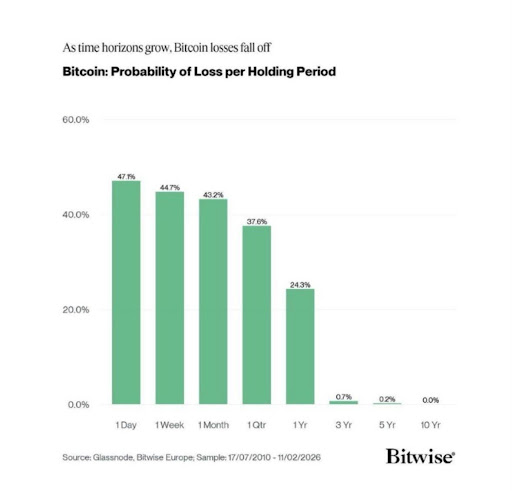
Looking at the chart’s numbers, a one-day holding period has a 47.1% chance of loss, while a one-week period shows a similar risk of 44.7%. Even at monthly intervals, the probability of loss stays elevated, reflecting the risks faced by active traders. Bitwise shows that holding BTC for just one month results in a marginal decline to 43.2%, underscoring the strong volatility across shorter timeframes.
However, as the holding period increases, the risk begins to decline noticeably. By the time an investor holds Bitcoin for several months or up to a year, the probability of loss drops, but remains significant. The chart shows that at the quarterly level, the probability of loss decreases to 37.6%. For over a year, the likelihood of loss drops further to 24.3%, highlighting a clear contrast when holding for just a day.
Bitcoin Loss Probability During Multi-Year Holds
Most success stories and outsized returns in the crypto market typically come from whales or investors who have held BTC for 5 to more than 10 years. The profit margins of these investors are significantly larger than those of short-term traders who move in and out of positions based on market conditions and short-term hype.
Bitwise research data confirms this trend, showing that meaningful reductions in loss probability only appear over multi-year holding periods. Investors who hold BTC for over three years see their probability of loss fall sharply to 0.7%, while holding for beyond five years reduces it further to 0.2%. Across the ten-year range covered by the data, there were no recorded instances of investors selling at a loss, indicating that all observed holding periods of that length resulted in gains.
The findings suggest that while Bitcoin remains highly unpredictable in the short term, its long-term performance has consistently and historically favored patient investors.

read the full story
Bitwise Research has shed light on how holding durations can impact the ROI and outcomes of Bitcoin (BTC) investments, revealing a major distinction between short-term risk and long-term performance. The data shows that while short holding periods carry significant chances of loss, extended investment timeframes dramatically reduce downside risks. The findings are drawing significant attention in the crypto community as investors reassess their strategy in the ongoing bear market.
Why Holding Bitcoin For Long Carries Less Risk
New research compiled by Bitwise and shared by crypto analyst Bitcoin Archive indicates that the probability of incurring losses on Bitcoin declines as the holding period increases, based on historical performance spanning more than a decade. The chart, sourced from Glassnode, shows that short-term exposure to BTC carries the highest level of uncertainty and the greatest likelihood of loss.
The numbers on the chart highlight just how unstable the Bitcoin price can be in the near term. If someone buys and sells within a day, their chances of losing money increase substantially. Even holding for a month does not improve things much, suggesting that short term price movements are largely unpredictable and driven by noise, speculation, and rapid sentiment shifts.
Looking at the chart’s numbers, a one-day holding period has a 47.1% chance of loss, while a one-week period shows a similar risk of 44.7%. Even at monthly intervals, the probability of loss stays elevated, reflecting the risks faced by active traders. Bitwise shows that holding BTC for just one month results in a marginal decline to 43.2%, underscoring the strong volatility across shorter timeframes.
However, as the holding period increases, the risk begins to decline noticeably. By the time an investor holds Bitcoin for several months or up to a year, the probability of loss drops, but remains significant. The chart shows that at the quarterly level, the probability of loss decreases to 37.6%. For over a year, the likelihood of loss drops further to 24.3%, highlighting a clear contrast when holding for just a day.
Bitcoin Loss Probability During Multi-Year Holds
Most success stories and outsized returns in the crypto market typically come from whales or investors who have held BTC for 5 to more than 10 years. The profit margins of these investors are significantly larger than those of short-term traders who move in and out of positions based on market conditions and short-term hype.
Bitwise research data confirms this trend, showing that meaningful reductions in loss probability only appear over multi-year holding periods. Investors who hold BTC for over three years see their probability of loss fall sharply to 0.7%, while holding for beyond five years reduces it further to 0.2%. Across the ten-year range covered by the data, there were no recorded instances of investors selling at a loss, indicating that all observed holding periods of that length resulted in gains.
The findings suggest that while Bitcoin remains highly unpredictable in the short term, its long-term performance has consistently and historically favored patient investors.

Pi Network’s PI Token Tanks Hard, Bitcoin Drops $3K From Local Peak: Weekend Watch
Aside from PI, the other big losers over the past 24 hours are M, AAVE, WLD, and PUMP.

Bitcoin Sentiment Remains At Extreme Low Despite Price Surge Above $77K
The price of Bitcoin has been on a tear in the past week, drawing positive momentum from the…

Peter Schiff Warns MicroStrategy's Bitcoin Spree Could Lead to Share Dilution
Vocal Bitcoin critic Peter Schiff and billionaire Frank Giustra are sounding the alarm on…

Morgan Stanley crosses $100mln in Bitcoin holdings – Why impact on BTC limited?
MSBT’s BTC accumulation raises questions about whether institutional ETF inflows can counter…

‘I was wrong’ about Bitcoin’s 4-year cycle, expert James Lavish admits
Here's why Bitcoin could make another ATH in 2026.
Arthur Hayes Warns Bitcoin May Stall Until Liquidity Returns
Bitcoin’s path higher may hinge more on fiat liquidity than interest rates as macro stress builds.…

Morgan Stanley’s MSBT Bitcoin ETF Wallets Now Publicly Trackable via Arkham
Blockchain analytics firm Arkham Intelligence has located and publicly labeled the custodian wallets…
Bitcoin faces quantum threat: Over 6 million BTC may be frozen
BIP-361 arrives in April 2026. This isn’t just a casual discussion. The proposal aims to…

Bitcoin mining difficulty falls, but projected to rise in next adjustment
The average block time at publication is about 9.8 minutes, falling slightly short of the 10-minute…

Iran views BTC as a strategic asset, but USDt still dominates oil tolls: BPI
The Iranian government chose Bitcoin as a payment method for oil tolls due to its…
Bitcoin Breakout Confirmed, But Is It Real Or A Bull Trap?
Bitcoin has confirmed a breakout from its macro downtrend on the linear chart, signaling a potential…
Bitcoin ETFs Add $664 Million as Assets Top $100 Billion Again
Crypto exchange-traded funds (ETFs) capped the week with a powerful surge, led by bitcoin’s…
Bitcoin Traders Load Up on Downside Protection as Futures Interest Drops 4.2%
Bitcoin sits around $76,185 right now. Not moving much. But the derivatives market tells a different…
Strategy Shares Rocket 12% Higher as Bitcoin Blows Past $77,000 Mark
Strategy shares shot up more than 12% today. Bitcoin broke through $77,000, and the company’s…
Coinbase Says MicroStrategy’s Bitcoin Buying Tightens Supply More Than Market Expects
Coinbase Institutional argues Strategy's BTC buying tightens supply as digital asset treasuries…

Can Bitcoin Buyers Join The Breakout Party? Analyst Says Not Yet
Bitcoin seems to have finally broken out of weeks of stagnation with an 11% rally, signaling a…
Bitcoin CME Options Open Interest Stays Put-Heavy as Price Stalls Around $76,000
Bitcoin futures open interest across all exchanges slid 4.2% over the past 24 hours to $58.44…
Why Kevin Warsh should become Bitcoin’s most impactful Fed chair yet
Kevin Warsh is set to become the first Federal Reserve chair with disclosed crypto holdings, and the…

Wall Street’s Biggest Wealth Manager Now Has a Public Bitcoin Wallet
Arkham Intelligence identified Morgan Stanley's MSBT Bitcoin ETF wallets, enabling real-time…
Did Michael Saylor & Strategy Just TRIGGER a Bitcoin STAMPEDE?
Bitcoin just hit $78K and the signals are impossible to ignore. Institutions are deploying billions,…
