Circle wants wrapped Bitcoin to look bank grade before institutions trust it as collateralCircle has launched cirBTC on Ethereum, but the larger play is to make wrapped Bitcoin look like collateral infrastructure institutions can route through DeFi, OTC desks, lending markets, treasury systems, market makers, and settlement flows.
cirBTC is live on Ethereum and backed 1:1 by native BTC, according to Circle's launch materials. The company says the underlying Bitcoin is held through a Circle entity, segregated from corporate assets, and designed for onchain reserve visibility.
The product also sits inside Circle's existing stack. Circle is positioning cirBTC around Circle Mint, USDC workflows, Ethereum DeFi, and planned support for Arc and other chains.
This moves wrapped Bitcoin into an issue of trust. BTC itself does not move natively through Ethereum contracts, so any wrapped version asks users to trust a claim on Bitcoin held somewhere else.
For retail DeFi users, that can be a bridge decision. For institutions, it is a collateral decision: who holds the keys, how reserves are checked, what happens during redemption, and whether the operational process can survive internal risk review.
Circle is selling custody before yield
Circle's cirBTC pitch starts with the same basic promise as other wrapped Bitcoin products: one token for one BTC. The difference is the operating package around that promise.
Its materials say cirBTC is backed by native BTC, reserves are separated from corporate assets, and counterparties can verify reserves onchain. Circle also ties the product to the same institutional interface many firms already use for USDC issuance and redemption.
A desk that already moves USDC through Circle Mint could, in theory, add BTC collateral to the same account-and-settlement relationship instead of stitching together a separate custodian, wrapper, exchange, bridge, and DeFi access point.
The proof-of-reserve component supports that positioning. Proof of Reserve systems can help tokenized assets and DeFi protocols monitor backing data onchain and build safeguards around undercollateralization.
For cirBTC, the next live signal is the reserve feed or dashboard counterparties can use for the token itself.
That leaves counterparty trust in place. cirBTC still depends on custody, redemption, reserve controls, and user confidence in Circle's process.
The institutional pitch is that those assumptions can be packaged in a cleaner way, with the BTC claim, reserve visibility, and Circle account relationship pointing in the same direction.
The comparison is clearest against cbBTC and WBTC.
Coinbase's cbBTC is also a 1:1 BTC-backed wrapped asset, held in Coinbase custody and available across Base, Ethereum, Solana, and Arbitrum.
Coinbase also maintains a proof-of-reserves page, giving users a public reserve and supply reference for the product. Availability and terms can vary by jurisdiction.
WBTC remains the incumbent Bitcoin wrapper in Ethereum DeFi. Its own site presents WBTC as backed 1:1 by Bitcoin, with a public reserve dashboard and proof-of-reserve context.
Circle's opportunity sits in the trust bundle it can offer: the USDC issuer, Circle Mint, reserve transparency, Ethereum access, and future Arc support under one institutional brand.
Product
Main trust promise
What is known now
Open test
cirBTC
Circle-backed BTC collateral for institutional workflows
Live on Ethereum, backed 1:1 by native BTC, with Circle stating reserve segregation and onchain visibility
Whether liquidity, protocol listings, and reserve feeds make it usable as collateral at scale
cbBTC
Coinbase custody and exchange-account workflows
Backed 1:1 by BTC held by Coinbase, with listed support across Base, Ethereum, Solana, and Arbitrum
Whether Circle can compete with Coinbase distribution and Base-native lending activity
WBTC
Incumbent DeFi collateral with public reserves
Backed 1:1 by BTC with a public reserve dashboard and proof-of-reserve context
Whether institutions prefer an incumbent DeFi asset or a Circle-controlled operating model
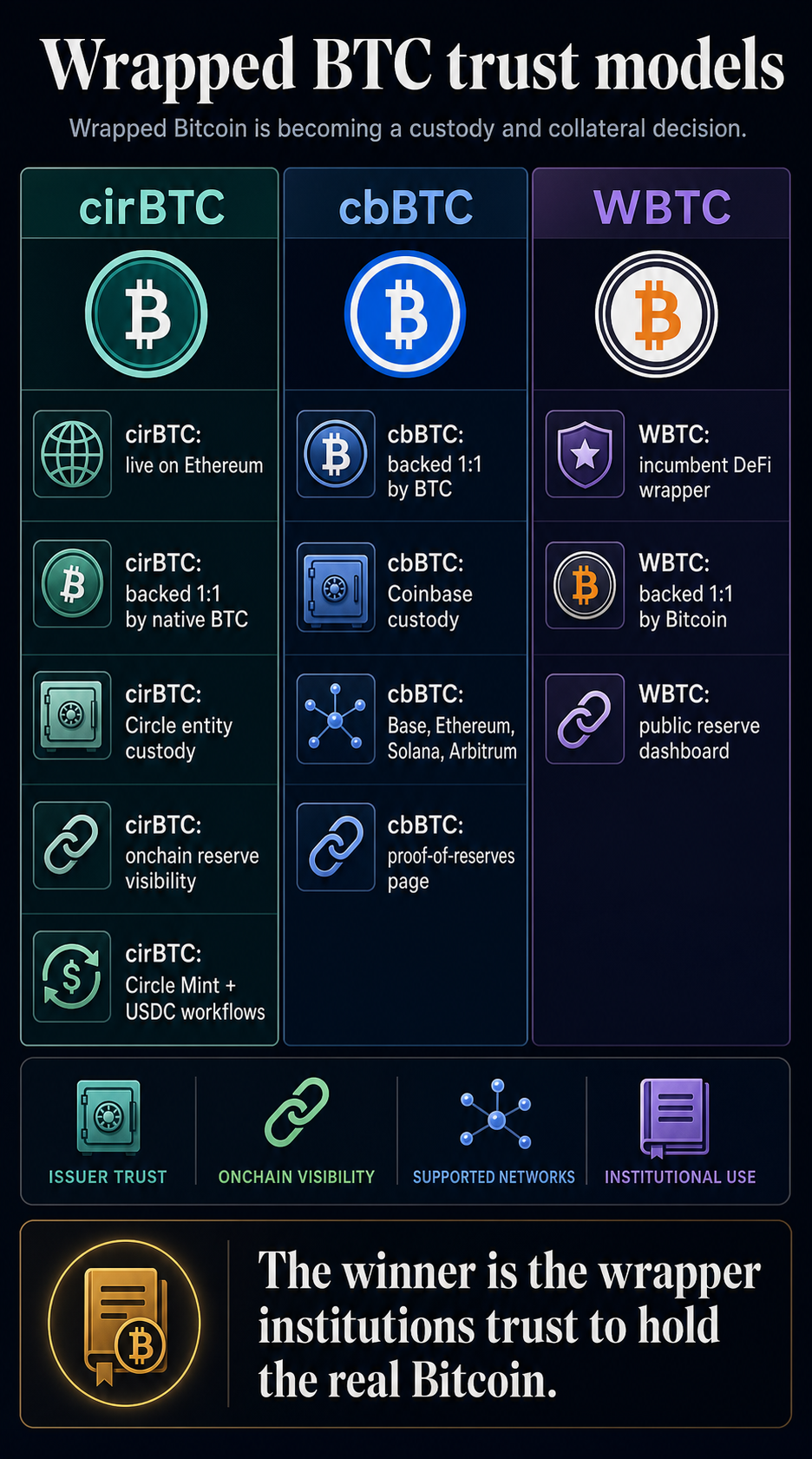
The comparison shows why cirBTC is more than a token launch. Wrapped Bitcoin products increasingly compete on the legal and operational identity of the issuer, the visibility of reserves, and the pathways by which collateral enters lending markets.
Coinbase has already tied cbBTC to lending through Base. CryptoSlate reported that Coinbase and Morpho introduced Bitcoin-backed loans on Base, using cbBTC and USDC in a consumer-facing borrowing flow.
That comparison shows the distribution Circle has to challenge if cirBTC is to become more than another Ethereum asset.
Arc gives cirBTC a bigger role
Circle's Arc ambitions give cirBTC a second layer of meaning.
Arc is being pitched as infrastructure for stablecoin finance, with USDC fees, settlement tooling, privacy controls, and institutional use cases around payments, foreign exchange, tokenized assets, and capital markets.
Circle has described Arc as a chain purpose-built for stablecoin finance, and CryptoSlate has previously reported how the network pushes Circle deeper into territory also occupied by Coinbase and Base.
In that context, cirBTC could become the Bitcoin leg of a broader Circle stack. USDC provides the dollar asset. Circle Mint provides issuance and redemption access. Ethereum provides current DeFi reach.
Arc, if it develops as planned, could give Circle a venue where tokenized dollars, BTC collateral, and settlement workflows operate with fewer handoffs.
The record remains early. Circle says cirBTC is live on Ethereum and points to planned Arc and multichain support. Its launch materials stop short of showing broad DeFi protocol adoption, live Arc usage for cirBTC, or a supply figure that would show market depth.
A token can be fully backed and still fail to become preferred collateral.
Institutions and DeFi protocols still need liquidity, risk parameters, redemption confidence, oracle support, and a clear reason to add another BTC wrapper beside existing options.
The broader market context is already moving in that direction. CryptoSlate recently framed a Morgan Stanley and Galaxy arrangement as part of Bitcoin's next institutional test in lending collateral.
The cirBTC launch fits that same issue: Bitcoin can become useful collateral for institutions when the custody and risk controls around the token are strong enough to satisfy the people managing the real BTC.
Arc also gives the Coinbase comparison more weight. Coinbase can route cbBTC through Base and its own account system; Circle is trying to offer a parallel route built around USDC, Mint, and Arc.
The adoption contest centers on which issuer can turn custody relationships into liquidity.
Acceptance decides whether the wrapper becomes infrastructure
Circle has the right ingredients for a bank-grade wrapper: a known issuer, reserve language, onchain verification, institutional access, USDC proximity, and an Arc roadmap.
Collateral infrastructure comes later, when counterparties use those ingredients in production.
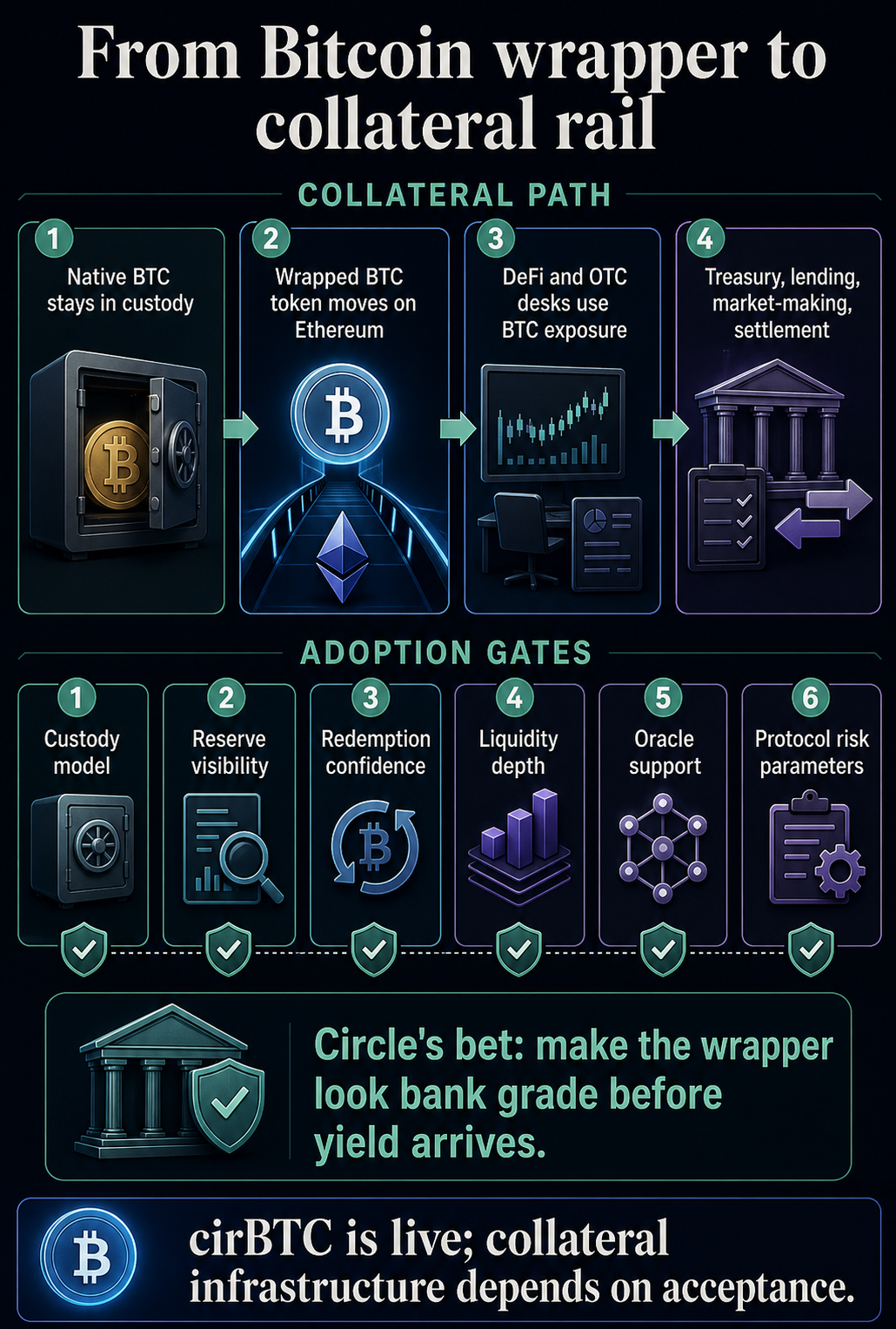
That means lenders need to accept the asset, market makers need to quote it, treasury teams need clean redemption, DeFi protocols need collateral parameters, and risk desks need confidence in the reserve process.
Users also need to move between BTC exposure and dollar liquidity without wondering where the real Bitcoin sits.
That is where cirBTC will face WBTC and cbBTC. WBTC has incumbent DeFi familiarity. Coinbase has distribution, custody, and Base workflows.
Circle has USDC, Mint, compliance credibility, and an ambition to own more of the settlement stack through Arc.
Circle can turn wrapped Bitcoin into institutional collateral infrastructure if cirBTC becomes the wrapper institutions choose because the custody, reserve, and redemption model lowers operational friction.
If liquidity stays elsewhere and Arc remains future context, cirBTC will still read as a product launch rather than infrastructure.
For now, Circle has changed the frame around wrapped BTC. The debate now centers on who institutions trust to hold the Bitcoin while the token moves through programmable finance.
The post appeared first on CryptoSlate.
read the full story
Circle has launched cirBTC on Ethereum, but the larger play is to make wrapped Bitcoin look like collateral infrastructure institutions can route through DeFi, OTC desks, lending markets, treasury systems, market makers, and settlement flows.
cirBTC is live on Ethereum and backed 1:1 by native BTC, according to Circle's launch materials. The company says the underlying Bitcoin is held through a Circle entity, segregated from corporate assets, and designed for onchain reserve visibility.
The product also sits inside Circle's existing stack. Circle is positioning cirBTC around Circle Mint, USDC workflows, Ethereum DeFi, and planned support for Arc and other chains.
This moves wrapped Bitcoin into an issue of trust. BTC itself does not move natively through Ethereum contracts, so any wrapped version asks users to trust a claim on Bitcoin held somewhere else.
For retail DeFi users, that can be a bridge decision. For institutions, it is a collateral decision: who holds the keys, how reserves are checked, what happens during redemption, and whether the operational process can survive internal risk review.
Circle is selling custody before yield
Circle's cirBTC pitch starts with the same basic promise as other wrapped Bitcoin products: one token for one BTC. The difference is the operating package around that promise.
Its materials say cirBTC is backed by native BTC, reserves are separated from corporate assets, and counterparties can verify reserves onchain. Circle also ties the product to the same institutional interface many firms already use for USDC issuance and redemption.
A desk that already moves USDC through Circle Mint could, in theory, add BTC collateral to the same account-and-settlement relationship instead of stitching together a separate custodian, wrapper, exchange, bridge, and DeFi access point.
The proof-of-reserve component supports that positioning. Proof of Reserve systems can help tokenized assets and DeFi protocols monitor backing data onchain and build safeguards around undercollateralization.
For cirBTC, the next live signal is the reserve feed or dashboard counterparties can use for the token itself.
That leaves counterparty trust in place. cirBTC still depends on custody, redemption, reserve controls, and user confidence in Circle's process.
The institutional pitch is that those assumptions can be packaged in a cleaner way, with the BTC claim, reserve visibility, and Circle account relationship pointing in the same direction.
The comparison is clearest against cbBTC and WBTC.
Coinbase's cbBTC is also a 1:1 BTC-backed wrapped asset, held in Coinbase custody and available across Base, Ethereum, Solana, and Arbitrum.
Coinbase also maintains a proof-of-reserves page, giving users a public reserve and supply reference for the product. Availability and terms can vary by jurisdiction.
WBTC remains the incumbent Bitcoin wrapper in Ethereum DeFi. Its own site presents WBTC as backed 1:1 by Bitcoin, with a public reserve dashboard and proof-of-reserve context.
Circle's opportunity sits in the trust bundle it can offer: the USDC issuer, Circle Mint, reserve transparency, Ethereum access, and future Arc support under one institutional brand.
| Product | Main trust promise | What is known now | Open test |
|---|---|---|---|
| cirBTC | Circle-backed BTC collateral for institutional workflows | Live on Ethereum, backed 1:1 by native BTC, with Circle stating reserve segregation and onchain visibility | Whether liquidity, protocol listings, and reserve feeds make it usable as collateral at scale |
| cbBTC | Coinbase custody and exchange-account workflows | Backed 1:1 by BTC held by Coinbase, with listed support across Base, Ethereum, Solana, and Arbitrum | Whether Circle can compete with Coinbase distribution and Base-native lending activity |
| WBTC | Incumbent DeFi collateral with public reserves | Backed 1:1 by BTC with a public reserve dashboard and proof-of-reserve context | Whether institutions prefer an incumbent DeFi asset or a Circle-controlled operating model |
The comparison shows why cirBTC is more than a token launch. Wrapped Bitcoin products increasingly compete on the legal and operational identity of the issuer, the visibility of reserves, and the pathways by which collateral enters lending markets.
Coinbase has already tied cbBTC to lending through Base. CryptoSlate reported that Coinbase and Morpho introduced Bitcoin-backed loans on Base, using cbBTC and USDC in a consumer-facing borrowing flow.
That comparison shows the distribution Circle has to challenge if cirBTC is to become more than another Ethereum asset.

Arc gives cirBTC a bigger role
Circle's Arc ambitions give cirBTC a second layer of meaning.
Arc is being pitched as infrastructure for stablecoin finance, with USDC fees, settlement tooling, privacy controls, and institutional use cases around payments, foreign exchange, tokenized assets, and capital markets.
Circle has described Arc as a chain purpose-built for stablecoin finance, and CryptoSlate has previously reported how the network pushes Circle deeper into territory also occupied by Coinbase and Base.

In that context, cirBTC could become the Bitcoin leg of a broader Circle stack. USDC provides the dollar asset. Circle Mint provides issuance and redemption access. Ethereum provides current DeFi reach.
Arc, if it develops as planned, could give Circle a venue where tokenized dollars, BTC collateral, and settlement workflows operate with fewer handoffs.
The record remains early. Circle says cirBTC is live on Ethereum and points to planned Arc and multichain support. Its launch materials stop short of showing broad DeFi protocol adoption, live Arc usage for cirBTC, or a supply figure that would show market depth.
A token can be fully backed and still fail to become preferred collateral.
Institutions and DeFi protocols still need liquidity, risk parameters, redemption confidence, oracle support, and a clear reason to add another BTC wrapper beside existing options.

The broader market context is already moving in that direction. CryptoSlate recently framed a Morgan Stanley and Galaxy arrangement as part of Bitcoin's next institutional test in lending collateral.
The cirBTC launch fits that same issue: Bitcoin can become useful collateral for institutions when the custody and risk controls around the token are strong enough to satisfy the people managing the real BTC.
Arc also gives the Coinbase comparison more weight. Coinbase can route cbBTC through Base and its own account system; Circle is trying to offer a parallel route built around USDC, Mint, and Arc.
The adoption contest centers on which issuer can turn custody relationships into liquidity.
Acceptance decides whether the wrapper becomes infrastructure
Circle has the right ingredients for a bank-grade wrapper: a known issuer, reserve language, onchain verification, institutional access, USDC proximity, and an Arc roadmap.
Collateral infrastructure comes later, when counterparties use those ingredients in production.
That means lenders need to accept the asset, market makers need to quote it, treasury teams need clean redemption, DeFi protocols need collateral parameters, and risk desks need confidence in the reserve process.
Users also need to move between BTC exposure and dollar liquidity without wondering where the real Bitcoin sits.
That is where cirBTC will face WBTC and cbBTC. WBTC has incumbent DeFi familiarity. Coinbase has distribution, custody, and Base workflows.
Circle has USDC, Mint, compliance credibility, and an ambition to own more of the settlement stack through Arc.
Circle can turn wrapped Bitcoin into institutional collateral infrastructure if cirBTC becomes the wrapper institutions choose because the custody, reserve, and redemption model lowers operational friction.
If liquidity stays elsewhere and Arc remains future context, cirBTC will still read as a product launch rather than infrastructure.
For now, Circle has changed the frame around wrapped BTC. The debate now centers on who institutions trust to hold the Bitcoin while the token moves through programmable finance.
The post appeared first on CryptoSlate.
read the full story
Bitcoin Whales Scoop $700 Million Into the Same Setup That Sparked a 24% Rally
Bitcoin (BTC) has rebounded to near $65,800 after an on-chain bottom signal flashed for the second…

Coins.ph Adds Bitcoin and Ethereum to National QR Ph, Reaching 700,000 Philippine Merchants
Coins.ph integrated bitcoin and ethereum into the Philippines’ national QR Ph network, allowing…

What could move crypto and Bitcoin markets this week
Crypto markets watch the Fed, Kevin Warsh and Iran peace deal news as Bitcoin rebounds above $65K…

Bitcoin Mining Difficulty Falls 10% in 11th-Largest Drop on Record
Bitcoin’s mining difficulty just dropped 10%. That’s the eleventh-largest downward…

Bitcoin nears $66K as Trump says US has peace deal with Iran
US President Donald Trump says the US and Iran have a deal for a “toll-free opening of the Strait…

Trump Paid UFC Fighters in His Stablecoin Despite Probe Over UAE Ties
Trump's crypto venture World Liberty Financial paid $250,000 in USD1 stablecoin bonuses at a White…
Bitcoin Price Reclaims $65,000 With Conviction—Is A Bigger Rally Next?
Bitcoin price started a fresh increase and cleared the $64,500 zone. BTC is consolidating and might…

Bitcoin traders have a reason to watch Tuesday's BOJ rate decision. Yen shorts are at a nine-year high
A large build-up of speculative short positions in the yen raises the risk of a sharp short squeeze…

Bitcoin price climbs above $65K after U.S.-Iran peace deal lifts markets
Bitcoin rose above $65,500 after a U.S.-Iran deal eased oil fears, while ETF outflows and technical…
'Never as Bad as It Seems': Coinbase CEO Remains Bullish on Bitcoin
Coinbase CEO Brian Armstrong has doubled down on his long-term conviction for Bitcoin.

Massive Bitcoin Theft Case Draws Guilty Plea in Violent Kidnapping Plot
Federal prosecutors detailed a guilty plea in a violent kidnapping plot tied to an attempted bitcoin…
Traders Bet $16.4M on Bitcoin Staying Below $75K Through June — Here’s the Full Breakdown
Across Polymarket and Kalshi, traders have deployed more than $78 million in bitcoin price…
Live markets: Bitcoin not fully out of danger as Trump warns of further Iran strikes
A ceasefire in April collapsed, and US strikes broke a second truce on June 9 with bitcoin giving…
Cardano’s 1,096 BTC dispute grows after Hoskinson AMA
Braziel presses for records after Hoskinson linked Cardano’s 1,096 BTC to audit costs tied to…
Bitcoin mining difficulty drops 10% in 11th largest downward adjustment
Bitcoin mining difficulty has undergone its second-largest downward difficulty adjustment this year,…
Trump Declares Iran Deal Done, Reopens Strait of Hormuz — Bitcoin Climbs Past $65K
President Donald Trump declared a deal with Iran complete on Sunday, immediately authorizing the…
Bitcoin hits a two-week high above $65,500 as the US-Iran deal sends oil sliding
A peace agreement that reopens the Strait of Hormuz pulled the geopolitical premium out of oil and…
Standard Chartered’s Geoff Kendrick Calls Bitcoin Cycle Low as Strategy Update Looms
Geoff Kendrick said it plainly. The analyst at Standard Chartered put out a call that the crypto…
$16.4 Million Rides on Bitcoin Staying Below $75K Before July
Traders are putting real money behind Bitcoin skepticism. A combined $16.4 million has landed on…
Bitcoin shoots higher on Iran peace deal, with Strait of Hormuz set to open
The price of crude oil is tumbling, and U.S. stock futures are moving higher.