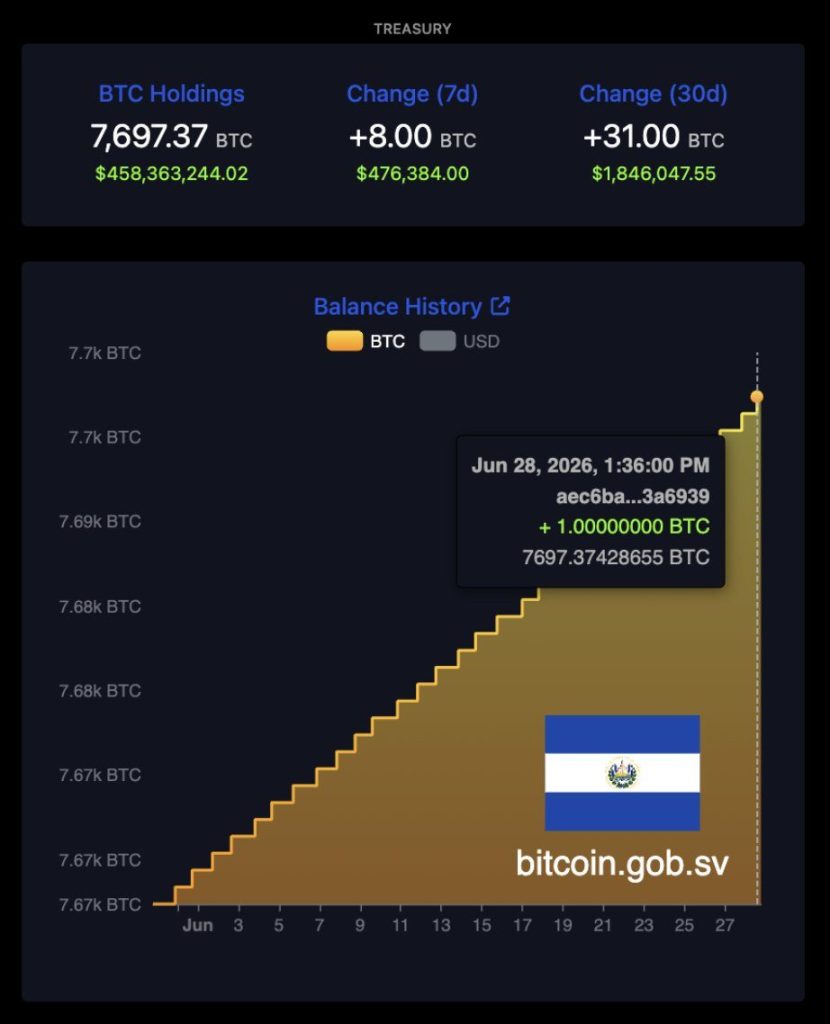
Bitcoin News: El Salvador’s Bitcoin reserve stands at 7,696 BTC, worth approximately $460M as of June 28, but the number is doing more political work than the accounting behind it can cleanly support.
President Nayib Bukele’s government continues to publicly promote a one-BTC-per-day BTC accumulation strategy, even as the country operates under a $1.4Bn Extended Fund Facility with the IMF that imposes a hard zero ceiling on voluntary public-sector Bitcoin purchases.
That gap between public messaging and loan conditionality is the central tension the next IMF review will force into the open.
Bitcoin was trading in the $59,000 to $60,000 range at the time of publication, down roughly 19% over 30 days. That drawdown matters here because it compounds the fiscal optics: at the reserve’s peak valuation near $800M in early 2026, the strategy looked like a winning sovereign bet.
The country occupies a unique position in the history of sovereign Bitcoin. It made BTC legal tender in September 2021, built the state-run Chivo wallet infrastructure to support public adoption, and turned BTC purchases into a national brand. That era is now constrained by the terms of the IMF deal, which it needed to stabilize public finances.
Bitcoin News: The IMF Ceiling Is Precise. The Reserve Growth Is Not.
The IMF’s Extended Fund Facility, approved by the Fund’s Executive Board in early 2025, includes a continuous quantitative performance criterion with a zero ceiling on voluntary BTC accumulation by the public sector.
A parallel ceiling covers public-sector BTC-denominated or BTC-indexed debt and tokenized instruments. These are not aspirational targets; they are performance criteria tied to disbursement. Missing them has consequences.
Turns out the IMF did in fact make El Salvador stop Bitcoin purchases in order to get a fiat loan.
Footnote #9 states they have just been making it appear as if they have been continuing to buy but in fact have just been consolidating multi government wallets.
The complication is that El Salvador’s reported holdings have risen since the program began. Official data showed 5,968 BTC at the program’s December 2024 start; BitcoinTreasuries now lists 7,696 BTC as of late June 2026. On its face, that trajectory contradicts a no-accumulation pledge.
The IMF’s explanation, confirmed by spokesperson Julie Kozack, is that increases in the Strategic Bitcoin Reserve Fund reflect consolidation of BTC across various government-owned wallets, notably from a BANDESAL cold-storage address, rather than net new market purchases by the public sector. The total BTC controlled across all government wallets, the IMF says, has remained unchanged.
That distinction is technically defensible under international public-sector accounting standards, which treat all government-controlled wallets as a consolidated position.
But it is not self-evident from the public-facing reserve tracker, and it leaves El Salvador’s one-BTC-a-day narrative in a structurally ambiguous place: the claim may describe internal wallet movements rather than fresh sovereign accumulation, or it may not.
Bukele’s Bitcoin Brand Versus the Loan’s Hard Conditions
The political logic of Bukele’s sovereign Bitcoin strategy was always layered. BTC purchases were simultaneously a hedge against dollar dependency, a brand-building exercise for international Bitcoin audiences, and a domestic political signal.
The one-BTC-a-day narrative still travels effectively on social media and still positions El Salvador as the flagship experiment in crypto regulation by adoption rather than restriction. None of that political value disappears under IMF oversight.
What changes is the accountability structure. The IMF program required El Salvador to report all public-sector hot and cold wallet addresses and corresponding BTC balances, with deadlines at the end of March 2025, the end of June 2025, and the end of December 2025.
It also required the government to exit its public involvement in the Chivo wallet by July 2025, to liquidate the Fidebitcoin trust, and to publish audited financial reports for all Bitcoin-linked public entities. The Fund’s stated position is that “efforts will continue” to ensure El Salvador does not accumulate additional BTC, phrasing that signals ongoing scrutiny rather than a settled compliance verdict.
El Salvador has no equivalent exit mechanism. Its reserve must coexist with budget targets, IMF disbursement conditions, and public accounting requirements simultaneously. That is a different kind of constraint than a corporate treasury or an ETF sponsor faces.
 Bitcoin (BTC)
24h7d30d1yAll time
Bitcoin (BTC)
24h7d30d1yAll time