Lamborghini Bitcoin carjacking puts crypto’s wrench-attack crisis in a US courtroomA Missouri man has pleaded guilty in Hartford federal court to a robbery conspiracy tied to an attempted Bitcoin theft, a Lamborghini Urus carjacking, and the kidnapping of two people in Danbury, Connecticut.
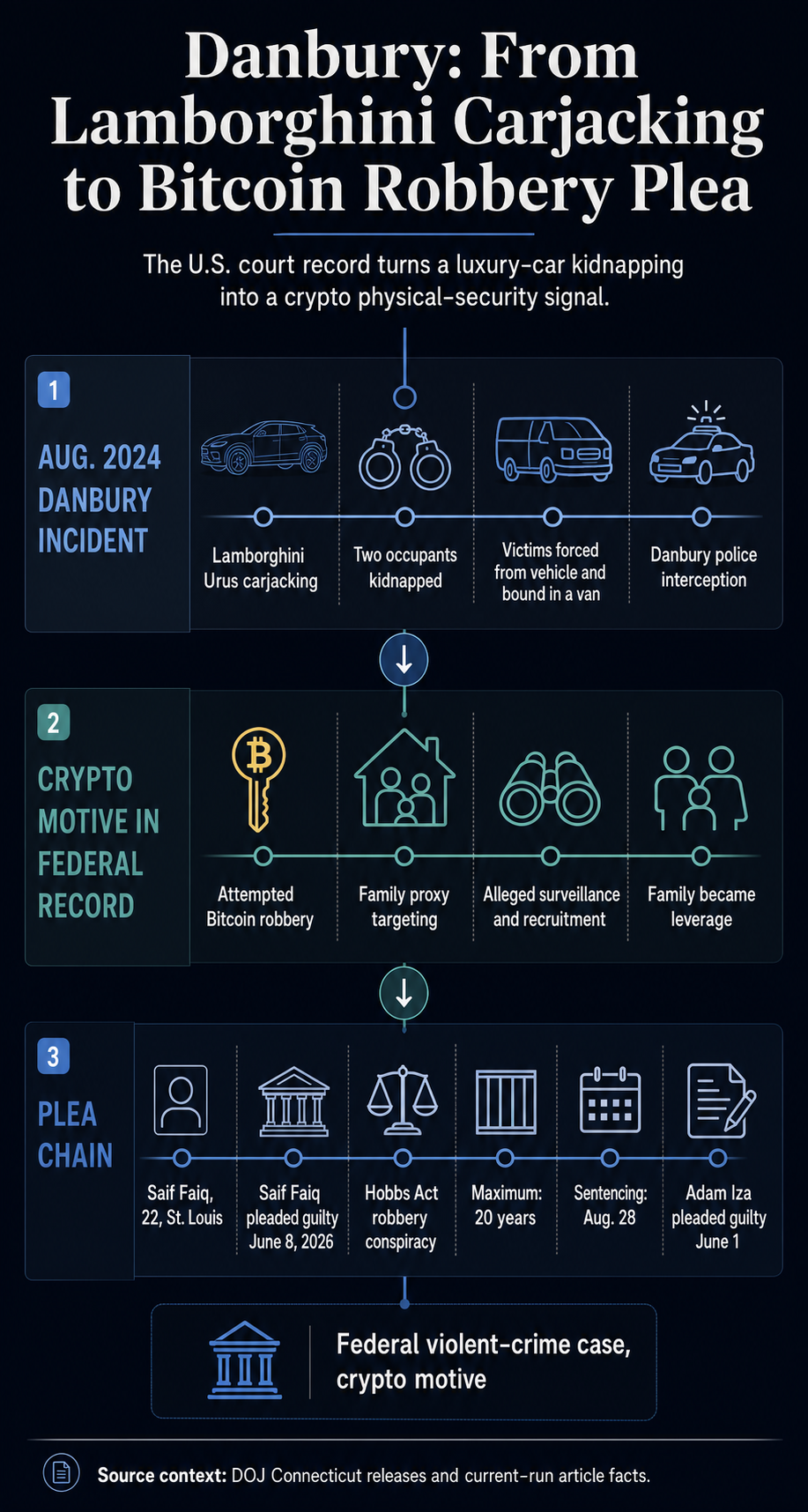
Saif Faiq, 22, of St. Louis, pleaded guilty on June 8 to conspiracy to interfere with commerce by robbery. Prosecutors said the case stemmed from an August 2024 plan to steal Bitcoin from a family connected to a separate theft involving hundreds of millions of dollars in BTC.
The charge carries a statutory maximum of 20 years in prison, and Faiq is scheduled to be sentenced on August 28.
Prosecutors said the kidnapping victims were the parents of an individual who participated in the Bitcoin theft, and that Faiq helped recruit participants, coordinate with Adam Iza, and conduct surveillance on the victims.
The Danbury case is another example of the growing physical threat around crypto wealth. Prosecutors tied the plea to relatives, surveillance, a luxury vehicle, and an alleged attempt to reach Bitcoin through human leverage.
Prior CryptoSlate coverage has shown a stark increase in identity exposure and family targeting in France. The Danbury record shows a similar threat now surfacing in a U.S. federal case.
A US court record for a physical crypto threat
In September 2024, prosecutors charged six Florida residents after Danbury police responded to a carjacking and kidnapping involving a Lamborghini Urus. According to that release, the victims were forced from the vehicle and bound in a van before police intercepted the alleged kidnappers.
DOJ's June 2026 releases state that six other individuals charged in connection with the carjacking and kidnapping have all pleaded guilty.
Faiq is not the only alleged coordinator whose case has reached the plea stage. Adam Iza, identified by DOJ as Faiq's brother, pleaded guilty on June 1 to the same Hobbs Act robbery conspiracy charge related to the attempted Bitcoin robbery and Danbury kidnapping.
Prosecutors said Iza communicated with some of the kidnappers through cellphone and encrypted messaging apps, directed logistics, and provided funding.
The federal case is built around familiar violent-crime allegations: recruitment, funding, surveillance, carjacking, kidnapping, and robbery conspiracy. The crypto link comes from the alleged attempt to force access to Bitcoin through people close to the suspected holder.
The plea puts crypto-linked physical coercion inside a U.S. federal violent-crime case.
For holders, the practical warning is blunt: perceived access to Bitcoin can make family members, vehicles, addresses, or public wealth signals part of a criminal target list.
The same pressure point appears across the wider wrench-attack record.
The Lamborghini detail matters because it is a visible wealth signal in a case prosecutors now connect to an attempted Bitcoin robbery.
In that context, a familiar luxury image becomes a security warning about assumptions, proximity, and access.
The attack surface is the person
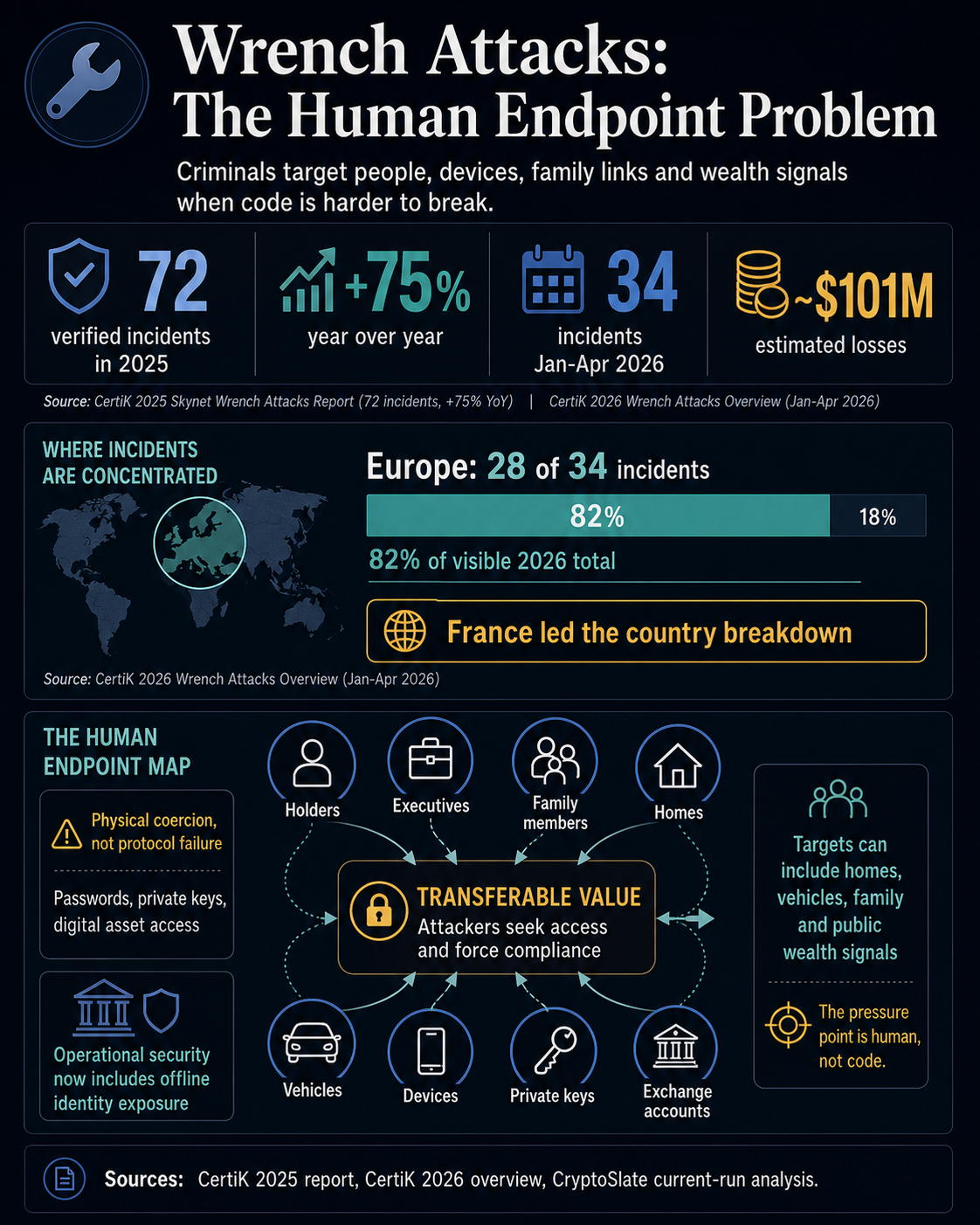
Security researchers use the term wrench attack for physical coercion that forces a victim to surrender passwords, private keys, or access to digital assets.
CertiK's 2025 Skynet Wrench Attacks Report described the category as an attack on the human endpoint and documented 72 verified incidents in 2025, up 75% year over year.
That distinction is important for Bitcoin holders because protocol security and personal security are separate problems. Bitcoin can be hard to seize through code, yet still vulnerable to the people presumed to control it.
A hardware wallet, seed phrase, exchange account, mobile device, or family member can become a pressure point if attackers believe it leads to transferable value.
In the Danbury case, the alleged target path ran through relatives. DOJ did not say the kidnapping victims themselves stole Bitcoin.
It said they were the parents of an individual who participated in the theft of hundreds of millions of dollars in Bitcoin. That makes the case a proxy-targeting case as well as a robbery case.
The pattern unfolding in France indicates this is a wider physical-security problem. In March, prior coverage described French crypto holders being violently targeted beyond the insider and executive class, with the target pool shifting from visible founders and relatives of crypto figures toward private individuals and homes.
Earlier reporting on a botched France home invasion tied the trend to organized target selection, executive exposure, and identity data.
The Danbury case brings that pattern into a U.S. court file. The visible signal was a Lamborghini. The alleged leverage point was family. The intended asset was Bitcoin.
The alleged target path ran through a person who could be pressured.
Danbury shows how a family proxy can become part of a crypto-crime record. France shows what happens when similar targeting is repeated often enough to reshape public-safety guidance, executive behavior, and holders' self-protection.

Europe is still the clearest concentration
Aside from the Danbury plea, available data points to Europe as the current center of wrench attacks.
CertiK's 2026 Wrench Attacks Overview said it recorded 34 verified incidents from January through April, with estimated losses of roughly $101 million.
Europe accounted for 28 of the 34 incidents, or 82% of the visible total, and France led the country breakdown.
CryptoSlate's May wrench-attack overview reached the same broad conclusion: the physical-extortion wave was accelerating, with the clearest concentration still in Europe, especially France.
The Danbury case shows how the same targeting model can become a matter for U.S. courts and prosecutors.
The courtroom record shows how crypto's physical-security problem can enter ordinary violent-crime enforcement. It includes recruitment, travel logistics, surveillance, family targeting, a luxury vehicle, and an alleged attempt to reach Bitcoin through human leverage.
For holders and companies, operational security now includes phishing, wallet drainers, exchange compromises, smart-contract exploits, and physical exposure around identity, home addresses, devices, and relatives.
The next legal signal is sentencing. Faiq's hearing on August 28 will show how the federal court treats his admitted role in the conspiracy.
More broadly, the cases to watch are the ones that connect crypto wealth to relatives, homes, cars, public profiles, and other offline identifiers. That is where a France-heavy security trend can become a wider law-enforcement problem, one U.S. docket at a time.
The post appeared first on CryptoSlate.
read the full story
A Missouri man has pleaded guilty in Hartford federal court to a robbery conspiracy tied to an attempted Bitcoin theft, a Lamborghini Urus carjacking, and the kidnapping of two people in Danbury, Connecticut.
Saif Faiq, 22, of St. Louis, pleaded guilty on June 8 to conspiracy to interfere with commerce by robbery. Prosecutors said the case stemmed from an August 2024 plan to steal Bitcoin from a family connected to a separate theft involving hundreds of millions of dollars in BTC.
The charge carries a statutory maximum of 20 years in prison, and Faiq is scheduled to be sentenced on August 28.
Prosecutors said the kidnapping victims were the parents of an individual who participated in the Bitcoin theft, and that Faiq helped recruit participants, coordinate with Adam Iza, and conduct surveillance on the victims.
The Danbury case is another example of the growing physical threat around crypto wealth. Prosecutors tied the plea to relatives, surveillance, a luxury vehicle, and an alleged attempt to reach Bitcoin through human leverage.
Prior CryptoSlate coverage has shown a stark increase in identity exposure and family targeting in France. The Danbury record shows a similar threat now surfacing in a U.S. federal case.
A US court record for a physical crypto threat
In September 2024, prosecutors charged six Florida residents after Danbury police responded to a carjacking and kidnapping involving a Lamborghini Urus. According to that release, the victims were forced from the vehicle and bound in a van before police intercepted the alleged kidnappers.
DOJ's June 2026 releases state that six other individuals charged in connection with the carjacking and kidnapping have all pleaded guilty.
Faiq is not the only alleged coordinator whose case has reached the plea stage. Adam Iza, identified by DOJ as Faiq's brother, pleaded guilty on June 1 to the same Hobbs Act robbery conspiracy charge related to the attempted Bitcoin robbery and Danbury kidnapping.
Prosecutors said Iza communicated with some of the kidnappers through cellphone and encrypted messaging apps, directed logistics, and provided funding.
The federal case is built around familiar violent-crime allegations: recruitment, funding, surveillance, carjacking, kidnapping, and robbery conspiracy. The crypto link comes from the alleged attempt to force access to Bitcoin through people close to the suspected holder.
The plea puts crypto-linked physical coercion inside a U.S. federal violent-crime case.
For holders, the practical warning is blunt: perceived access to Bitcoin can make family members, vehicles, addresses, or public wealth signals part of a criminal target list.
The same pressure point appears across the wider wrench-attack record.
The Lamborghini detail matters because it is a visible wealth signal in a case prosecutors now connect to an attempted Bitcoin robbery.
In that context, a familiar luxury image becomes a security warning about assumptions, proximity, and access.
The attack surface is the person
Security researchers use the term wrench attack for physical coercion that forces a victim to surrender passwords, private keys, or access to digital assets.
CertiK's 2025 Skynet Wrench Attacks Report described the category as an attack on the human endpoint and documented 72 verified incidents in 2025, up 75% year over year.
That distinction is important for Bitcoin holders because protocol security and personal security are separate problems. Bitcoin can be hard to seize through code, yet still vulnerable to the people presumed to control it.
A hardware wallet, seed phrase, exchange account, mobile device, or family member can become a pressure point if attackers believe it leads to transferable value.
In the Danbury case, the alleged target path ran through relatives. DOJ did not say the kidnapping victims themselves stole Bitcoin.
It said they were the parents of an individual who participated in the theft of hundreds of millions of dollars in Bitcoin. That makes the case a proxy-targeting case as well as a robbery case.
The pattern unfolding in France indicates this is a wider physical-security problem. In March, prior coverage described French crypto holders being violently targeted beyond the insider and executive class, with the target pool shifting from visible founders and relatives of crypto figures toward private individuals and homes.

Earlier reporting on a botched France home invasion tied the trend to organized target selection, executive exposure, and identity data.

The Danbury case brings that pattern into a U.S. court file. The visible signal was a Lamborghini. The alleged leverage point was family. The intended asset was Bitcoin.
The alleged target path ran through a person who could be pressured.
Danbury shows how a family proxy can become part of a crypto-crime record. France shows what happens when similar targeting is repeated often enough to reshape public-safety guidance, executive behavior, and holders' self-protection.

Europe is still the clearest concentration
Aside from the Danbury plea, available data points to Europe as the current center of wrench attacks.
CertiK's 2026 Wrench Attacks Overview said it recorded 34 verified incidents from January through April, with estimated losses of roughly $101 million.
Europe accounted for 28 of the 34 incidents, or 82% of the visible total, and France led the country breakdown.
CryptoSlate's May wrench-attack overview reached the same broad conclusion: the physical-extortion wave was accelerating, with the clearest concentration still in Europe, especially France.

The Danbury case shows how the same targeting model can become a matter for U.S. courts and prosecutors.
The courtroom record shows how crypto's physical-security problem can enter ordinary violent-crime enforcement. It includes recruitment, travel logistics, surveillance, family targeting, a luxury vehicle, and an alleged attempt to reach Bitcoin through human leverage.
For holders and companies, operational security now includes phishing, wallet drainers, exchange compromises, smart-contract exploits, and physical exposure around identity, home addresses, devices, and relatives.
The next legal signal is sentencing. Faiq's hearing on August 28 will show how the federal court treats his admitted role in the conspiracy.
More broadly, the cases to watch are the ones that connect crypto wealth to relatives, homes, cars, public profiles, and other offline identifiers. That is where a France-heavy security trend can become a wider law-enforcement problem, one U.S. docket at a time.
The post appeared first on CryptoSlate.
read the full story
Bitcoin Whales Scoop $700 Million Into the Same Setup That Sparked a 24% Rally
Bitcoin (BTC) has rebounded to near $65,800 after an on-chain bottom signal flashed for the second…

Coins.ph Adds Bitcoin and Ethereum to National QR Ph, Reaching 700,000 Philippine Merchants
Coins.ph integrated bitcoin and ethereum into the Philippines’ national QR Ph network, allowing…

What could move crypto and Bitcoin markets this week
Crypto markets watch the Fed, Kevin Warsh and Iran peace deal news as Bitcoin rebounds above $65K…

Bitcoin Mining Difficulty Falls 10% in 11th-Largest Drop on Record
Bitcoin’s mining difficulty just dropped 10%. That’s the eleventh-largest downward…

Bitcoin nears $66K as Trump says US has peace deal with Iran
US President Donald Trump says the US and Iran have a deal for a “toll-free opening of the Strait…

Trump Paid UFC Fighters in His Stablecoin Despite Probe Over UAE Ties
Trump's crypto venture World Liberty Financial paid $250,000 in USD1 stablecoin bonuses at a White…
Bitcoin Price Reclaims $65,000 With Conviction—Is A Bigger Rally Next?
Bitcoin price started a fresh increase and cleared the $64,500 zone. BTC is consolidating and might…

Bitcoin traders have a reason to watch Tuesday's BOJ rate decision. Yen shorts are at a nine-year high
A large build-up of speculative short positions in the yen raises the risk of a sharp short squeeze…

Bitcoin price climbs above $65K after U.S.-Iran peace deal lifts markets
Bitcoin rose above $65,500 after a U.S.-Iran deal eased oil fears, while ETF outflows and technical…
'Never as Bad as It Seems': Coinbase CEO Remains Bullish on Bitcoin
Coinbase CEO Brian Armstrong has doubled down on his long-term conviction for Bitcoin.

Massive Bitcoin Theft Case Draws Guilty Plea in Violent Kidnapping Plot
Federal prosecutors detailed a guilty plea in a violent kidnapping plot tied to an attempted bitcoin…
Traders Bet $16.4M on Bitcoin Staying Below $75K Through June — Here’s the Full Breakdown
Across Polymarket and Kalshi, traders have deployed more than $78 million in bitcoin price…
Live markets: Bitcoin not fully out of danger as Trump warns of further Iran strikes
A ceasefire in April collapsed, and US strikes broke a second truce on June 9 with bitcoin giving…
Cardano’s 1,096 BTC dispute grows after Hoskinson AMA
Braziel presses for records after Hoskinson linked Cardano’s 1,096 BTC to audit costs tied to…
Bitcoin mining difficulty drops 10% in 11th largest downward adjustment
Bitcoin mining difficulty has undergone its second-largest downward difficulty adjustment this year,…
Trump Declares Iran Deal Done, Reopens Strait of Hormuz — Bitcoin Climbs Past $65K
President Donald Trump declared a deal with Iran complete on Sunday, immediately authorizing the…
Bitcoin hits a two-week high above $65,500 as the US-Iran deal sends oil sliding
A peace agreement that reopens the Strait of Hormuz pulled the geopolitical premium out of oil and…
Standard Chartered’s Geoff Kendrick Calls Bitcoin Cycle Low as Strategy Update Looms
Geoff Kendrick said it plainly. The analyst at Standard Chartered put out a call that the crypto…
$16.4 Million Rides on Bitcoin Staying Below $75K Before July
Traders are putting real money behind Bitcoin skepticism. A combined $16.4 million has landed on…
Bitcoin shoots higher on Iran peace deal, with Strait of Hormuz set to open
The price of crude oil is tumbling, and U.S. stock futures are moving higher.