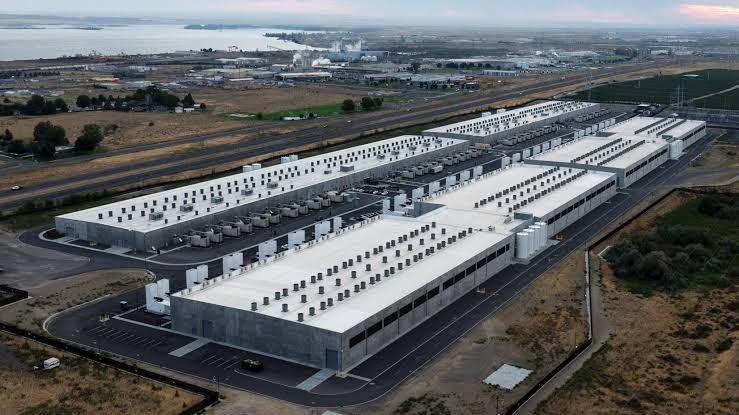
TeraWulf has signed a 20-year lease with Anthropic for a 401 MW AI data center campus at its Justified Data site in Hawesville, Kentucky, locking in approximately $19 billion in contracted revenue, a figure that exceeds the bitcoin miner’s entire current market cap of roughly $12 billion.
The deal forces a straightforward question onto the table: at what point does WULF stop trading as a BTC proxy and start pricing as an infrastructure REIT?
Shares jumped as much as 19% intraday on July 6 before settling to around a 4% gain at the close. That compression from intraday high to close is worth noting, it suggests the market is discounting execution risk even as it prices in the headline value, which is the correct reflex given the multi-year buildout ahead.
Today, TeraWulf announced two strategic transactions that significantly advance our AI infrastructure strategy:
A 20-year lease with @AnthropicAI at our Justified Data Campus The sale of our 50.1% ownership interest in the Abernathy Joint Venture to an investor group led…
TeraWulf CEO Paul Prager told CNBC: “The Anthropic lease validates our strategy and establishes a long-duration revenue stream with one of the world’s leading AI companies.” The Wall Street Journal reported the agreement is underpinned by Anthropic’s strong investment-grade credit rating, which matters structurally, long-duration revenue anchored to investment-grade paper is a fundamentally different asset than hashrate-dependent block rewards.
What the Kentucky Deal With Anthropic Actually Commits TeraWulf To
The Kentucky data center campus will deliver approximately 401 MW of critical IT load for Anthropic’s Claude AI infrastructure in phases, with initial capacity expected online in H2 2027 and full build-out targeted by early 2028.
The Justified Data site sits on a former Century Aluminum facility, giving TeraWulf an existing large-power footprint with roughly 480 MW of available capacity and room to expand. That kind of shovel-ready power access is precisely what AI labs cannot easily replicate on their own timeline.
At an industry-standard capex figure of approximately $8–$10 million per MW for HPC-grade infrastructure, the 401 MW buildout implies a capital requirement in the range of $3.2 billion to $4 billion.
That number is not in the headline, the $19 billion contracted revenue figure is, but it is the variable that will determine whether this deal creates or destroys equity value over the next 24 months. TeraWulf has not yet specified its full financing structure for the Kentucky campus.
Anthropic is not the only AI lab moving this aggressively on power. Reports says the company has locked up approximately 3.5 GW of AI compute capacity across multiple deals, and Benzinga notes that IREN has also signed with Anthropic, framing TeraWulf as part of a growing cohort of former Bitcoin miner operators now serving as dedicated AI infrastructure landlords.
Running parallel to the Anthropic announcement, TeraWulf confirmed it will sell its 50.1% ownership interest in the Abernathy Joint Venture, a 168 MW AI data center project in Texas formed in 2025, to an investor group led by Fluidstack.
The company said the transaction monetizes its approximately $450 million investment at a premium to invested capital, according to Reuters. That is not a trivial data point: it means TeraWulf is already realizing gains on its crypto mining pivot before a single rack goes live in Kentucky.
Compass Point raises Terawulf $WULF PT to $40 on Anthropic deal (Buy)
— Emmanuel – Big Tech & AI Investor (@EmmanuelInvest) July 7, 2026
The logic of the Abernathy exit is clean. Rather than hold a minority stake in a joint venture it does not control, TeraWulf is recycling capital into wholly owned infrastructure where it captures the full margin profile.
CoinShares has estimated that up to 70% of listed miners’ revenue could eventually come from AI hosting for those that secure long-term agreements, a shift that changes the entire valuation framework for companies like TeraWulf.
The 20-year lease structure itself is the most significant element beyond the dollar figure. For investors previously using WULF as a leveraged bet on bitcoin price cycles, that tenure represents a genuine change in the underlying business.
Long-duration, fixed-revenue infrastructure produces a very different earnings profile than mining, more predictable, less volatile, and increasingly comparable to a data center operator rather than a commodity producer. That is the risk miners like TeraWulf are explicitly choosing to trade away from: direct exposure to BTC price swings and hashprice compression following the halving.
 A 20-year lease with @AnthropicAI at our Justified Data Campus