Why Did Bitcoin Crash? On-Chain Data Points To One Missing IngredientBitcoin is struggling as the price tests $62,000 as support — a level that would represent a significant extension of the correction from the cycle highs and a test of the structural foundation that bulls have been pointing to throughout the decline. The weakness is real and the selling pressure is persistent — and XWIN Research Japan has published an analysis that cuts through the competing macro narratives to identify what the on-chain data suggests is the actual driver of the current correction.
The explanations circulating in the market range from geopolitical tensions to Federal Reserve policy to Strategy’s recent small Bitcoin sale. XWIN Research Japan’s CryptoQuant analysis suggests a simpler and more fundamental explanation: buyers disappeared.
The engine that powered Bitcoin’s 2024 to 2025 rally was not leverage, not retail momentum, and not speculative excess. It was consistent and sustained inflows into US spot Bitcoin ETFs — a structural demand source that absorbed supply methodically and provided the bid that supported progressively higher prices. In 2026, that engine reversed. ETF outflows increased while the Coinbase Premium remained negative for an extended period. Confirming that US institutional demand, the most durable and most significant category of buyer the market has ever seen, withdrew from active accumulation.

The Realized Cap data quantifies the consequence. Bitcoin’s Realized Cap declined from approximately $1.12 trillion to $1.08 trillion — a reduction that represents nearly $40 billion of capital leaving the network. When the metric that measures actual invested capital falls by that magnitude, the market is not experiencing a sentiment correction. It is experiencing a genuine demand withdrawal.

40 Billion Left the Network
The XWIN Research Japan analysis traces where the capital went after it left Bitcoin. US equities — particularly AI-related companies delivering strong earnings growth, executing aggressive share buyback programs, and driving the S&P 500 to record highs — presented a competing allocation that many institutions found more immediately compelling than Bitcoin in the current rate environment. Capital did not evaporate. It rotated into assets with visible profit growth and near-term catalysts that Bitcoin’s liquidity-dependent structure cannot currently match.
The futures market amplified the price decline without causing it. Open Interest dropped sharply, Funding Rates normalized, and more than $150 million in leveraged long positions were liquidated between June 3 and June 4. Those liquidations were a consequence of weakening demand rather than its origin — derivatives unwinding into a market already lacking the spot bid needed to absorb forced selling.
The comparison to 2022 is where the analysis provides its most important reassurance. Long-term holders remain largely intact. Exchange balances are still historically low. The current correction does not resemble the panic-driven supply excess that characterized the previous cycle’s collapse. The problem is not too much selling. It is too little buying.
The recovery conditions the report identifies are specific. ETF flows returning to positive territory, the Coinbase Premium recovering above zero, Realized Cap resuming growth, and capital concentration in AI stocks beginning to slow — these are the signals that would confirm demand is returning rather than rotating further away. June’s correction was demand-driven. The next major Bitcoin trend will be determined by the same force that caused it.
Bitcoin Clings To $62K As Breakdown Reaches Critical Support
Bitcoin remains under intense pressure after a violent selloff erased the entire April-May recovery and pushed price back into the same support zone that marked the February capitulation low. The daily chart shows BTC trading around $62,500 after briefly dipping near $61,000, placing the market directly inside the most important demand area of the year.
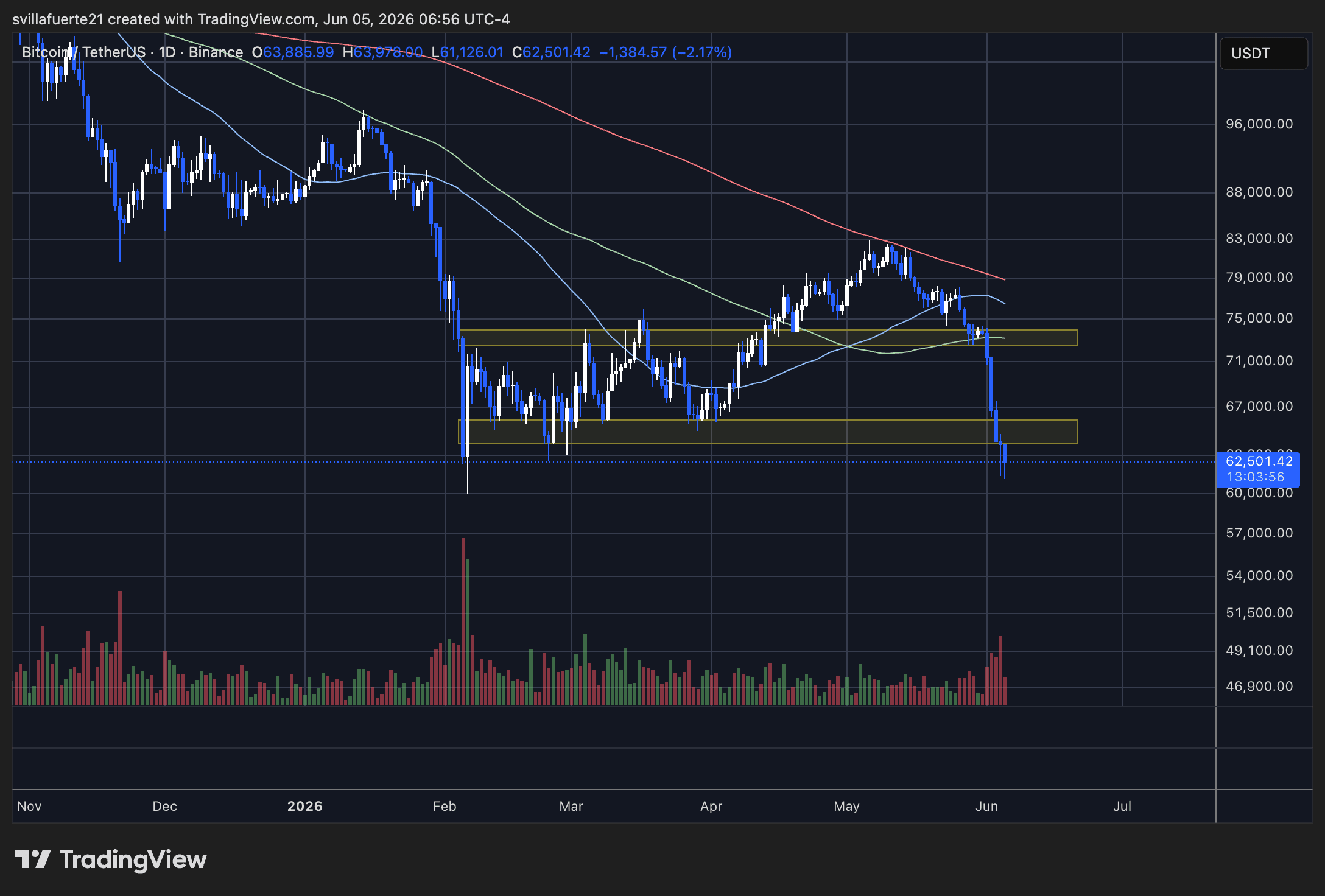
Technically, the structure has deteriorated significantly. Bitcoin has lost the $72,000-$74,000 support zone that previously acted as a major pivot throughout April and May. That area has now flipped into resistance and represents the first major obstacle should a relief rally emerge. More importantly, the breakdown occurred with expanding volume, suggesting the move is being driven by aggressive selling rather than a temporary liquidity vacuum.
The market is now testing the February bottom region near $61,000-$64,000. Unlike previous pullbacks, this support is being challenged after a sequence of lower highs and lower lows, confirming bearish market structure across the daily timeframe. BTC also remains below the 50-day, 100-day, and 200-day moving averages, reinforcing the dominance of sellers.
However, this area carries historical significance. The February capitulation ultimately marked the beginning of a multi-month recovery. If buyers defend the current zone, Bitcoin could attempt to build a base and stabilize. If support fails decisively, the next downside target becomes the psychological $60,000 level, followed by the high-$50,000 region.
Featured image from ChatGPT, chart from TradingView.com
read the full story
Bitcoin is struggling as the price tests $62,000 as support — a level that would represent a significant extension of the correction from the cycle highs and a test of the structural foundation that bulls have been pointing to throughout the decline. The weakness is real and the selling pressure is persistent — and XWIN Research Japan has published an analysis that cuts through the competing macro narratives to identify what the on-chain data suggests is the actual driver of the current correction.
The explanations circulating in the market range from geopolitical tensions to Federal Reserve policy to Strategy’s recent small Bitcoin sale. XWIN Research Japan’s CryptoQuant analysis suggests a simpler and more fundamental explanation: buyers disappeared.
The engine that powered Bitcoin’s 2024 to 2025 rally was not leverage, not retail momentum, and not speculative excess. It was consistent and sustained inflows into US spot Bitcoin ETFs — a structural demand source that absorbed supply methodically and provided the bid that supported progressively higher prices. In 2026, that engine reversed. ETF outflows increased while the Coinbase Premium remained negative for an extended period. Confirming that US institutional demand, the most durable and most significant category of buyer the market has ever seen, withdrew from active accumulation.
The Realized Cap data quantifies the consequence. Bitcoin’s Realized Cap declined from approximately $1.12 trillion to $1.08 trillion — a reduction that represents nearly $40 billion of capital leaving the network. When the metric that measures actual invested capital falls by that magnitude, the market is not experiencing a sentiment correction. It is experiencing a genuine demand withdrawal.
40 Billion Left the Network
The XWIN Research Japan analysis traces where the capital went after it left Bitcoin. US equities — particularly AI-related companies delivering strong earnings growth, executing aggressive share buyback programs, and driving the S&P 500 to record highs — presented a competing allocation that many institutions found more immediately compelling than Bitcoin in the current rate environment. Capital did not evaporate. It rotated into assets with visible profit growth and near-term catalysts that Bitcoin’s liquidity-dependent structure cannot currently match.
The futures market amplified the price decline without causing it. Open Interest dropped sharply, Funding Rates normalized, and more than $150 million in leveraged long positions were liquidated between June 3 and June 4. Those liquidations were a consequence of weakening demand rather than its origin — derivatives unwinding into a market already lacking the spot bid needed to absorb forced selling.
The comparison to 2022 is where the analysis provides its most important reassurance. Long-term holders remain largely intact. Exchange balances are still historically low. The current correction does not resemble the panic-driven supply excess that characterized the previous cycle’s collapse. The problem is not too much selling. It is too little buying.
The recovery conditions the report identifies are specific. ETF flows returning to positive territory, the Coinbase Premium recovering above zero, Realized Cap resuming growth, and capital concentration in AI stocks beginning to slow — these are the signals that would confirm demand is returning rather than rotating further away. June’s correction was demand-driven. The next major Bitcoin trend will be determined by the same force that caused it.
Bitcoin Clings To $62K As Breakdown Reaches Critical Support
Bitcoin remains under intense pressure after a violent selloff erased the entire April-May recovery and pushed price back into the same support zone that marked the February capitulation low. The daily chart shows BTC trading around $62,500 after briefly dipping near $61,000, placing the market directly inside the most important demand area of the year.
Technically, the structure has deteriorated significantly. Bitcoin has lost the $72,000-$74,000 support zone that previously acted as a major pivot throughout April and May. That area has now flipped into resistance and represents the first major obstacle should a relief rally emerge. More importantly, the breakdown occurred with expanding volume, suggesting the move is being driven by aggressive selling rather than a temporary liquidity vacuum.
The market is now testing the February bottom region near $61,000-$64,000. Unlike previous pullbacks, this support is being challenged after a sequence of lower highs and lower lows, confirming bearish market structure across the daily timeframe. BTC also remains below the 50-day, 100-day, and 200-day moving averages, reinforcing the dominance of sellers.
However, this area carries historical significance. The February capitulation ultimately marked the beginning of a multi-month recovery. If buyers defend the current zone, Bitcoin could attempt to build a base and stabilize. If support fails decisively, the next downside target becomes the psychological $60,000 level, followed by the high-$50,000 region.
Featured image from ChatGPT, chart from TradingView.com
read the full story
Should You Buy BTC Now? Analyst Reveals the Best Bitcoin Entry Levels After the Crash
The dips are made for buying, right? Or, maybe not yet.

Bitcoin Nearing a Bottom? Key Indicators Flash Mixed Signals After $59K Drop
Is bitcoin close to a bottom or is there more pain ahead for investors?
Brian Armstrong says Bitcoin drop hides crypto’s bigger story
Bitcoin has fallen nearly 25% over the past month, yet Coinbase CEO Brian Armstrong has argued that…

Bitcoin Plunges to $59,100 as 351,000 Traders Get Wiped Out in 24 Hours
Bitcoin hit a new 2026 low on Friday. The price slumped to $59,100 during the session, dragging the…

Bitcoin back above $61,000 after rout leads to $1.6 billion liquidations
Bitcoin fell as low as $59,227 overnight before recovering, steadying after Friday's strong jobs…

A little-known 1,250% rule could lock US banks out of Bitcoin
A group of Republican senators is warning US bank regulators that a little-known capital rule could…

Bitcoin Has 125 Days Until the Real Bottom, Charts Warn
Bitcoin sits 125 days from a cycle bottom three charts place in the $40,000s by Q4 2026, if history…

Hublot Big Bang Meca-10 P2P Review 2026: The 21-Piece Bitcoin Tribute Watch
Hublot Big Bang Meca-10 P2P ★★★★½ 4.6 / 5 Editorial review by The Currency Analytics The…

Bitcoin Loses $200 Billion but Its Biggest Believers Aren’t Selling
The market just shed $200 billion. And the loudest Bitcoin voices? Pretty much unbothered. Mati…
Hundreds of Millions in Bitcoin at Center of Violent Kidnapping Plot
A kidnapping and Lamborghini carjacking tied to a theft of hundreds of millions of dollars in…

Veteran Analyst Eyes $53,000 Bitcoin As Final Cycle Stage Begins
Veteran crypto analyst Bob Loukas says Bitcoin has entered the final stage of its current four-year…
Are professional investors dumping Bitcoin? Q1 data suggests…
Bitcoin's Q1 sell-off exposes a split between traders and long-term allocators.
Economist Robin Brooks Says Gold Is Behaving Like Bitcoin Now
Gold used to be the boring one. The asset you held when everything else was on fire. But Robin…

Robin Brooks: Neither Bitcoin Nor Gold Is Acting Like A True Safe Haven
TL;DR: Gold’s correlation with the S&P 500 index surged to over 0.50 in recent months.…

Bitcoin’s Market Structure Reflects The Influence Of Major Investors
Bitcoin’s market structure is increasingly reflecting the growing influence of major investors, as…
Where Is XRP Bounce Possible? Is Zcash (ZEC) Too Oversold? Bitcoin (BTC) Risks Slipping to $50,000: Crypto Market Review
The market is not ready to accept enough of support from bullish investors, despite the relatively…

Mapping the Bitcoin Rainbow Chart – Where will BTC’s market bottom occur?
Traders and investors must remember that the Rainbow Chart has its limitations.
Spot Bitcoin ETFs attract $3M as historic outflow streak comes to an end
U.S. spot Bitcoin ETFs have recorded $3.05 million in net inflows on Thursday, ending a record…