Bitcoin price fell below $60,000 this week and touched its lowest level since October 2024 as traders abandoned expectations for interest-rate cuts and began preparing for the Federal Reserve to raise borrowing costs later this year.
According to CryptoSlate's data, the largest digital asset dropped more than 4% in the last 24 hours to as low as $59,030 before recovering to roughly $61,650 as of press time. This move extended a decline that has erased more than 50% of its value since the record reached last October.
The distress in Bitcoin cascaded swiftly across the broader digital asset ecosystem. Ethereum, the second-largest cryptocurrency by market capitalization, dropped approximately 3% to trade near $1,650.
Alternative cryptocurrencies experienced similar depreciations. Major digital assets including Solana, BNB, Cardano, XRP, Dogecoin, and Hyperliquid all traded firmly in negative territory as the risk-off sentiment permeated every tier of the crypto market.
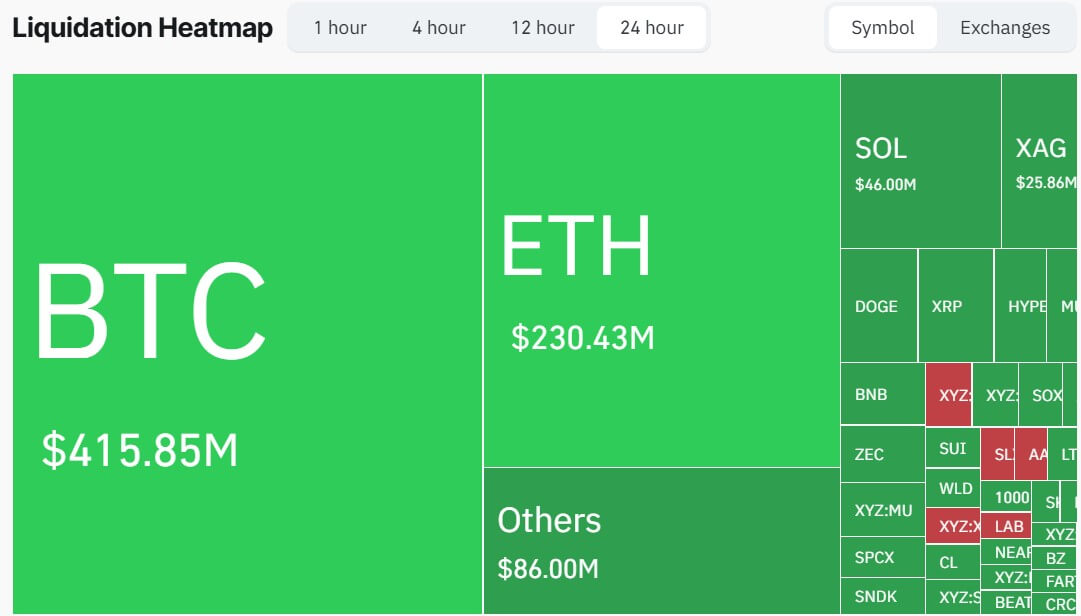
Market data tracker Coinglass reported that approximately $1 billion in derivative contracts were forcefully closed within a 24-hour window. The wipeout affected more than 176,000 individual market participants.
Crypto Market Liquidation in The Last 24 Hours (Source: CoinGlass)
The drawdown disproportionately impacted traders positioned for a rebound. Liquidations of long contracts, which are bets that prices would appreciate, accounted for about $781 million of the total, compared to $211 million in short liquidations.
This heavy imbalance reflects a market that was fundamentally mispositioned, with speculators caught leaning bullishly into a structural decline.
Bitcoin-specific contracts bore the brunt of the washout, suffering $417 million in forced closures. The single most severe liquidation materialized on the Binance exchange, involving a $12 million Bitcoin swap contract.
Meanwhile, ETH-linked derivatives traders absorbed roughly $230 million of the total liquidation wipeout.
Spot sellers and ETF redemptions drive the break
Trading data indicate that the decline began in the spot market, where investors buy and sell the underlying asset, rather than in futures markets.
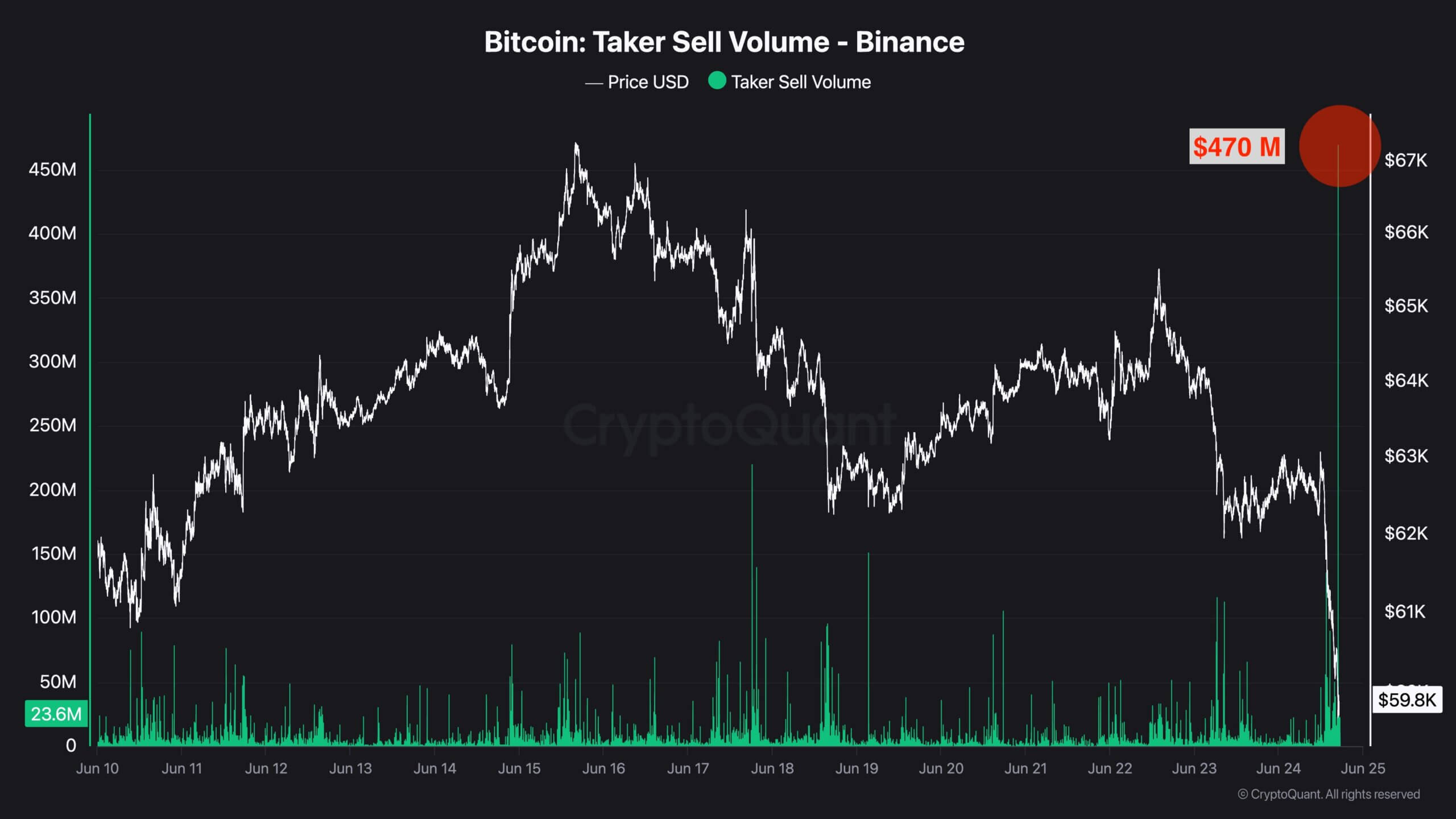
More than $470 million in Bitcoin sell orders were executed on Binance within one minute as the price crossed below $60,000, CryptoQuant data showed. Sell orders on the exchange exceeded $1.2 billion within the following hour.
The volume of orders clustered near $60,000 indicates that many investors had chosen the level as an exit point. Once those orders entered the market, available demand proved insufficient to absorb the supply without a steep drop in price.
Broader demand also remains weak. Glassnode said realized losses, withdrawals from spot Bitcoin exchange-traded funds, and increased demand for defensive options continued to weigh on sentiment.
Although some investors have bought at lower prices, the accumulation has not been strong enough to support a sustained recovery.
ETF redemptions have added to the pressure. The 13 US spot Bitcoin funds are approaching a seventh consecutive week of net outflows, with investors withdrawing more than $6 billion over the period, SoSoValue data showed.
Earlier in the year, market participants had aggressively priced in multiple interest rate cuts for 2026. Those forecasts have evaporated.
Instead, resilient inflation data and the economic fallout from the Iran conflict have prompted a stark repricing of Federal Reserve policy.
With the resumption of maritime shipping through the Strait of Hormuz alleviating some immediate geopolitical anxiety, the focus has shifted entirely to the strength of the US economy and the central bank's mandate to cool prices.
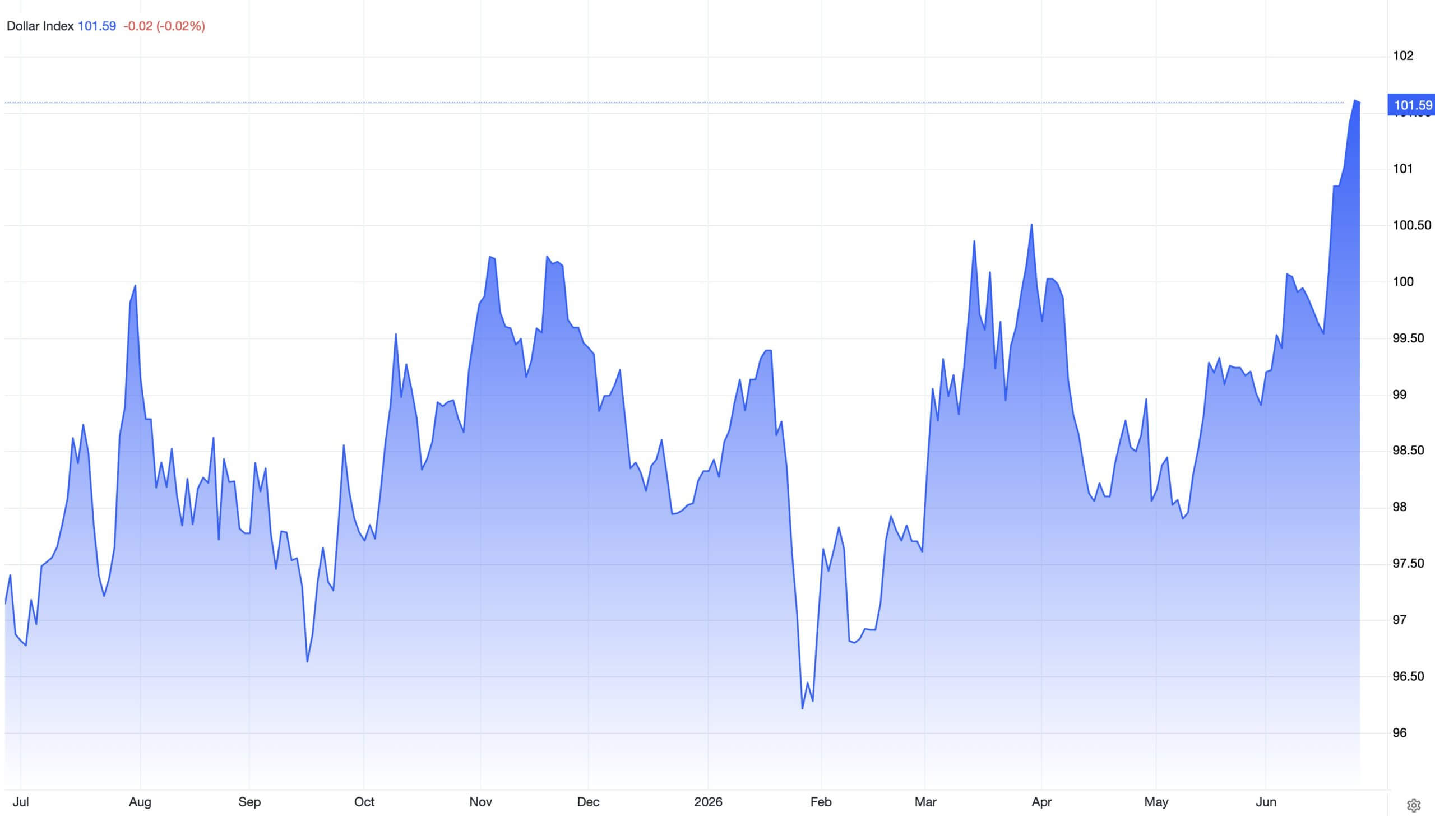
The US Dollar Index (DXY) has surged in response, breaking back above the 100 threshold and hitting a 13-month peak of 101.5. A stronger dollar historically applies inverse pressure to Bitcoin and other risk assets, as a higher-yielding fiat currency diminishes the appeal of non-yielding digital alternatives.
US Dollar Index
CryptoQuant analyst Axel Adler pointed out that the market is no longer hoping for a pivot. According to Adler, traders are pricing in a higher probability of a Federal Reserve interest rate hike by October, a scenario that would extend the restrictive liquidity backdrop if it materializes.
Historically, this would represent a hostile environment for highly speculative assets.
The bond market's reaction further validates this shift in expectations. With Treasury yields inching upward, the opportunity cost of holding non-yielding assets like Bitcoin has risen substantially. The tightening financial conditions strip away the excess liquidity that typically fuels speculative frenzies in the cryptocurrency sector.
For an asset class that thrives on abundant capital and zero-interest-rate environments, the prospect of a rate hike by the fourth quarter represents a formidable structural headwind.
Bitcoin is still waiting for market capitulation
Despite the steep drawdown and current market situation, some crypto analysts argue that the bottom may not yet be established.
James Lavish, co-managing partner at the Bitcoin Opportunity Fund, expressed reservations about the nature of the current selloff.
Lavish noted that genuine market bottoms are typically accompanied by massive volume spikes indicative of total panic and capitulation. The current price action, he suggested, resembles a buyer's strike rather than a final flush-out, pointing to persistent negative sentiment that could eventually force a deeper collapse.
Nevertheless, Lavish maintained that the long-term risk-to-reward ratio remains highly attractive at these depressed levels, provided the fundamental architecture of the Bitcoin network remains intact and central banks eventually return to currency debasement.
For now, however, digital asset investors face a grueling wait. As the Federal Reserve contemplates further tightening and institutional capital remains sidelined, Bitcoin's path back to its former highs looks increasingly arduous.