Bitcoin Crash To $30,000? China Mining Giant Says Strategy Can SurviveJiang Zhuoer, CEO of BTCTOP and one of China’s best-known Bitcoin mining figures, pushed back against fears that Strategy could become a major forced seller of BTC, arguing that the company’s balance-sheet risk remains manageable even under a severe Bitcoin drawdown.
In a post on X, Jiang said he does not believe MicroStrategy, now Strategy, will “substantially net sell BTC,” pointing to a group discussion he shared on the company’s liabilities, STRC interest payments, funding structure and market concerns. The comments come as investors debate whether Strategy’s Bitcoin-backed capital markets model could come under pressure if BTC weakens further or if demand for STRC remains fragile.
Bitcoin Panic Over Strategy Overblown?
At the center of Jiang’s argument is the distinction between selling some Bitcoin and becoming a net seller of Bitcoin. He argued that a limited sale of older, low-cost BTC could be used to demonstrate realized investment gains, support STRC-related payments and reassure traditional investors without changing the broader accumulation strategy.
“MicroStrategy will not significantly net-sell its coins,” the translated group discussion stated. “He already explained the reason for the last coin sale in an interview. He wanted to sell STRC.”
According to the discussion, Strategy’s logic rests on the assumption that Bitcoin’s long-term appreciation can support the cost of STRC funding. The message attributed the thesis to a calculation that BTC can compound at around 30% annually, while using roughly 10% to pay interest would still leave sufficient room for the strategy to work.
The concern, however, is not simply whether Strategy owns enough Bitcoin. It is whether the firm’s financing structure looks credible to traditional investors. The discussion framed the market’s core worry bluntly: if later STRC proceeds are used to pay earlier STRC interest, critics could view the model as resembling a Ponzi-like funding loop.
That is why, in Jiang’s view, selective Bitcoin sales may be necessary rather than alarming. Selling some of the earliest and cheapest BTC would allow Strategy to show accounting gains. Those gains could then be used to pay STRC interest, while newly raised STRC proceeds are deployed into additional Bitcoin purchases. If the new BTC purchases are several times larger than the old BTC sold, Jiang argued, Strategy remains a net buyer.
“So MicroStrategy has to sell some of the earliest and cheapest Bitcoin it bought,” the translated discussion said. “That way, accounting-wise, it can show investment gains. Then using the investment gains from selling Bitcoin to pay STRC interest becomes completely reasonable.”
Jiang also pushed back against fears that Strategy’s liabilities could spiral if STRC trades below par. He said the current debt-to-asset ratio is only about 5%, and characterized STRC’s discount as a short-term market sentiment issue rather than a sign of insolvency risk. In the worst case, he argued, several months of continued payments could restore confidence in the instrument.
The discussion used a real estate analogy to explain the point. If a borrower owns $10 billion of houses and has borrowed $500 million, lenders may still worry if the borrower insists the houses can never be sold. But if the borrower shows willingness to sell one house to cover interest, the risk profile changes.
“After all, I have 10 billion worth of houses, and I only borrowed 500 million,” the translated message said. “As long as I’m willing to sell houses, there absolutely won’t be a situation where I can’t repay 500 million. That is why MicroStrategy has to start selling coins: to borrow more money and buy more coins.”
Jiang’s argument also distinguishes STRC holders from Bitcoin holders. In his view, STRC buyers are not primarily betting on BTC upside; they care whether Strategy is willing and able to pay dividends. If the company shows that it can monetize BTC when needed, that may reduce the biggest concern among STRC investors.
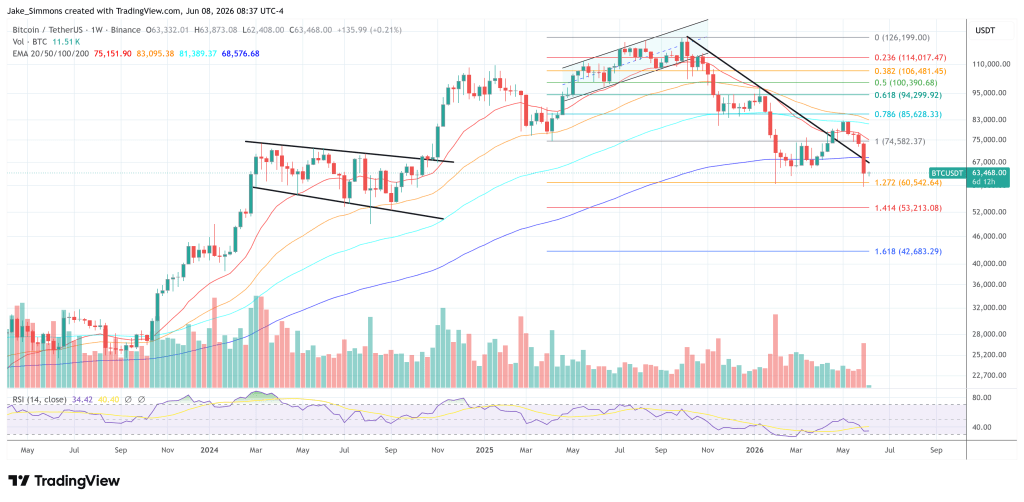
At press time, BTC traded at $63,468.
read the full story
Jiang Zhuoer, CEO of BTCTOP and one of China’s best-known Bitcoin mining figures, pushed back against fears that Strategy could become a major forced seller of BTC, arguing that the company’s balance-sheet risk remains manageable even under a severe Bitcoin drawdown.
In a post on X, Jiang said he does not believe MicroStrategy, now Strategy, will “substantially net sell BTC,” pointing to a group discussion he shared on the company’s liabilities, STRC interest payments, funding structure and market concerns. The comments come as investors debate whether Strategy’s Bitcoin-backed capital markets model could come under pressure if BTC weakens further or if demand for STRC remains fragile.
Bitcoin Panic Over Strategy Overblown?
At the center of Jiang’s argument is the distinction between selling some Bitcoin and becoming a net seller of Bitcoin. He argued that a limited sale of older, low-cost BTC could be used to demonstrate realized investment gains, support STRC-related payments and reassure traditional investors without changing the broader accumulation strategy.
“MicroStrategy will not significantly net-sell its coins,” the translated group discussion stated. “He already explained the reason for the last coin sale in an interview. He wanted to sell STRC.”
According to the discussion, Strategy’s logic rests on the assumption that Bitcoin’s long-term appreciation can support the cost of STRC funding. The message attributed the thesis to a calculation that BTC can compound at around 30% annually, while using roughly 10% to pay interest would still leave sufficient room for the strategy to work.
The concern, however, is not simply whether Strategy owns enough Bitcoin. It is whether the firm’s financing structure looks credible to traditional investors. The discussion framed the market’s core worry bluntly: if later STRC proceeds are used to pay earlier STRC interest, critics could view the model as resembling a Ponzi-like funding loop.
That is why, in Jiang’s view, selective Bitcoin sales may be necessary rather than alarming. Selling some of the earliest and cheapest BTC would allow Strategy to show accounting gains. Those gains could then be used to pay STRC interest, while newly raised STRC proceeds are deployed into additional Bitcoin purchases. If the new BTC purchases are several times larger than the old BTC sold, Jiang argued, Strategy remains a net buyer.
“So MicroStrategy has to sell some of the earliest and cheapest Bitcoin it bought,” the translated discussion said. “That way, accounting-wise, it can show investment gains. Then using the investment gains from selling Bitcoin to pay STRC interest becomes completely reasonable.”
Jiang also pushed back against fears that Strategy’s liabilities could spiral if STRC trades below par. He said the current debt-to-asset ratio is only about 5%, and characterized STRC’s discount as a short-term market sentiment issue rather than a sign of insolvency risk. In the worst case, he argued, several months of continued payments could restore confidence in the instrument.
The discussion used a real estate analogy to explain the point. If a borrower owns $10 billion of houses and has borrowed $500 million, lenders may still worry if the borrower insists the houses can never be sold. But if the borrower shows willingness to sell one house to cover interest, the risk profile changes.
“After all, I have 10 billion worth of houses, and I only borrowed 500 million,” the translated message said. “As long as I’m willing to sell houses, there absolutely won’t be a situation where I can’t repay 500 million. That is why MicroStrategy has to start selling coins: to borrow more money and buy more coins.”
Jiang’s argument also distinguishes STRC holders from Bitcoin holders. In his view, STRC buyers are not primarily betting on BTC upside; they care whether Strategy is willing and able to pay dividends. If the company shows that it can monetize BTC when needed, that may reduce the biggest concern among STRC investors.
At press time, BTC traded at $63,468.

Old Bitcoin Holders Are Selling Far Less Than in Previous Cycles, Says K33
TL;DR: Bitcoin rose 6% over the past week and K33 notes that 79% of the circulating supply is held…

Bitcoin in Danger: Here’s Why BTC May Dump in the Short Term
Will BTC plunge following the upcoming FOMC meeting?

Florida Man 'Bitcoin Rodney' Pleads Guilty Over $1.8 Billion HyperFund Crypto Fraud
A Miami-based man who went by the name “Bitcoin Rodney” pleaded guilty for his role in what…

Trace Finance raises $32M for cross-border stablecoin settlement expansion
The raise comes as stablecoin regulation advances globally and financial firms invest in…

Bitcoin price sets $64.5K week-to-date low as Strategy selling worries return
Bitcoin circled $65,000 after downside BTC price pressure into the FOMC meeting as analysis warned…
Strategy’s $10 billion STRC Bitcoin yield product sinks to yearly low as market demands higher payout
Strategy’s (formerly MicroStrategy) flagship dividend-paying preferred stock is trading at its…

A Second Nation Just Built a State Bitcoin Mining Pool — Oman’s Omanhash.om Redraws the Map
Oman has launched a mandatory national bitcoin mining pool, requiring every licensed cryptocurrency…

Bitcoin – BTC’s $68mln long bet has this ONE problem
A Bitcoin trader opened a 20x long position on 1036 BTC worth $68.1 million.

Mexican billionaire with 70% of his investment portfolio in bitcoin says it's better than real estate
Ricardo Salinas Pliego, whose net worth is estimated at roughly $5 billion, is a bitcoin maximalist…

Iran-US Nuclear Deal Puts Bitcoin and Oil Markets on a 60-Day Clock
Iran and the United States signed a memorandum of understanding, kicking off a 60-day negotiation…

Australians are Withdrawing Their Bitcoin Because of This Rule Change
Australia's crypto Travel Rule starts July 1, tightening transfer checks and pushing Bitcoin holders…

Bitcoin Price Analysis: BTC’s Recovery Hangs on One Critical Support Level
Bitcoin’s recovery has slowed after reaching a key resistance cluster, with the asset now…
CoinDesk 20 performance update: Bitcoin Cash (BCH) drops 3.1%, leading index lower
Cardano (ADA), down 2.8%, was also among the underperformers.
SpaceX's $2.6 trillion market cap nearly double that of bitcoin
Eight days after its IPO, SpaceX has surged past $2.5 trillion to become the world's sixth-largest…
Bitcoin's June downturn leaves $8.6 billion in options out of the money
Only 20% of June 26 options open interest is currently in the money, while bitcoin's 12% monthly…
Circle Launches cirBTC On Ethereum As New 1:1 Bitcoin-Backed DeFi Asset
Circle has launched cirBTC on Ethereum, entering the wrapped Bitcoin market with a 1:1 backed asset…
Strategy’s STRC Nears Record Low as Bitcoin Buying Draws Fire
Strategy STRC Near Record Low, Bitcoin Buys Unsustainable
The post appeared first on .

Oil finally loses its grip on Bitcoin – but now liquidity takes over the sell pressure
Brent below $80 removed one pressure point, but BTC still needs rates, ETF flows, and risk appetite…
Analyst Known for Nailing Bitcoin Cycles Says Key Indicator Signaling Low Is In for BTC, Sees Asset Repeating 2022 Pattern
A veteran trader who has a history of nailing Bitcoin’s cycles says a key indicator is signaling…

Wall Street is paying up for Bitcoin miners’ AI infrastructure before most of it is built
A megawatt leased to an AI tenant now commands a different price on Wall Street than a megawatt…