Bitcoin miner Bitdeer mined 921 BTC, but its smaller stash raises a bigger questionBitdeer's latest operating update has revealed a concrete insight into the recent Bitcoin miner-AI pivot: the company produced far more Bitcoin but ended the month with far fewer coins than it held a year earlier.
The company reported 921 BTC mined in May 2026, up 370% year over year, while BTC held at month-end stood at 171. In its May 2025 update, Bitdeer reported that it had mined 196 BTC and held 1,351 BTC.
That split sets up a sell-pressure question inside the miner-AI pivot. Bitdeer is asking investors to value a mining fleet, proprietary ASICs, power sites, AI cloud capacity, and future colocation revenue as a single business. The Bitcoin balance shows how much of that strategy still depends on converting mined coins into operating liquidity.
The answer is mixed. AI revenue may become a cash buffer that reduces the need to sell coins into weak mining economics. The May and first-quarter disclosures show a company producing more BTC while carrying a much smaller coin stack, alongside an AI infrastructure business that brings a different set of risks.
The BTC gap is the clearest signal
The May comparison is stark because the two numbers move in opposite directions. Production rose from 196 BTC to 921 BTC, while BTC held fell from 1,351 to 171.
[Caveat: Bitdeer's May 2026 figure includes BTC from self-mining and co-mining, while the May 2025 release labeled its mined BTC as self-mining only. Even with that distinction, the scale of the holdings gap is hard to miss.]
Metric
May 2025
May 2026
What changed
BTC mined
196
921
Output rose roughly 4.7 times year over year.
BTC held
1,351
171
The reported coin balance was about 87% lower.
Self-mining hashrate
13.6 EH/s
70.2 EH/s
Bitdeer scaled the mining base materially.
AI Cloud ARR
Not disclosed in the monthly table
About $69 million
AI cloud is now a central operating metric.
Tydal status
Infrastructure work underway
Advanced colocation negotiations
The site has become a core AI infrastructure test.
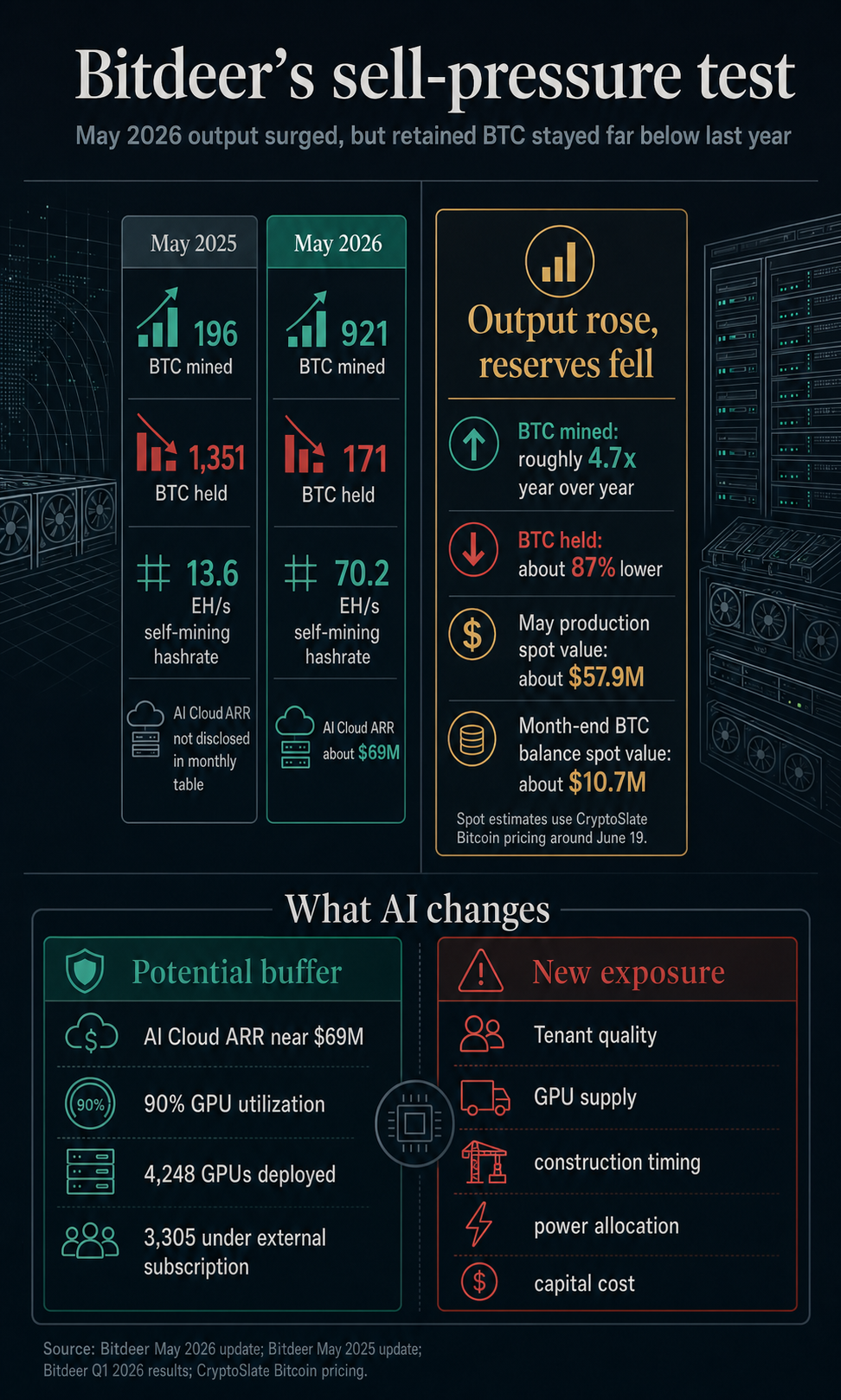
Using CryptoSlate Bitcoin pricing in the roughly $62,700 to $62,900 range on June 19, Bitdeer's May production was worth about $57.9 million, and its month-end BTC balance was worth about $10.7 million.
Those are rough spot estimates rather than company-reported dollar values, yet they show the order of magnitude. The month's production was large enough to matter, while the retained coin balance remained modest relative to the operating scale.
Monthly BTC held is a point-in-time balance, not a full flow-of-funds bridge. The figure alone cannot show how much of May's production was sold, pledged, retained, or otherwise used. It does show that higher production had yet to translate into a larger Bitcoin treasury.
For a Bitcoin miner moving into AI infrastructure, that difference changes the investment question: new revenue can either help the company hold more BTC or fund a more capital-intensive buildout.
The first-quarter numbers lend more weight to the May update. In its Q1 2026 results, Bitdeer reported mining 2,033 BTC, up from 350 BTC in Q1 2025. BTC held was 31 at quarter-end, down from 1,156 a year earlier. The company also disclosed $206.8 million of proceeds from the disposal of digital assets.
Bitdeer's mining revenue rose sharply as its fleet expanded, while the balance-sheet line moved like a company actively turning mined assets into capital for operations and growth.
The quarter also included $346.9 million of net cash used in operating activities, $93.7 million of capital expenditures for data center infrastructure, GPU procurement, tariffs, and mining rigs delivered to data centers, and a balance sheet with $1.9 billion in borrowing.
Bitdeer also reported $188.9 million in Q1 revenue, positive adjusted EBITDA of $14.4 million, and $297.7 million in cash, cash equivalents, and restricted cash.
It is running a large capital program that uses Bitcoin, debt, and infrastructure investment as interconnected parts of the same strategy.
AI revenue changes the cash question
Bitdeer's AI Cloud metrics are the strongest argument for an optimistic future. In May, the company said AI Cloud ARR held near $69 million at 90% GPU utilization, with 4,248 GPUs deployed and 3,305 GPUs under external subscription. It also launched two NVIDIA GB300 NVL72 clusters and added support for NVIDIA Nemotron 3 through its model studio.
The ARR figure had already moved sharply before May. Bitdeer's March update put AI Cloud ARR near $43 million. Its April update said ARR had climbed to about $69 million. May showed that level holding, which makes the update a test of durability rather than a fresh acceleration.
ARR is a run-rate metric. In Q1, Bitdeer recognized $3.7 million of AI Cloud revenue. The gap matters because ARR indicates potential future revenue visibility, while recognized revenue reflects revenue that has already flowed through the income statement. A $69 million annualized figure can strengthen the case for a less BTC-dependent business, but the cash benefits still have to show up against power bills, interest costs, capex, and mining volatility.
This is where Bitdeer's update hones a broader miner-AI debate. Recent CryptoSlate coverage showed that Wall Street has been paying higher valuations for Bitcoin miners with AI and HPC capacity before much of that capacity is delivered. Bitdeer's May release adds a company-level version of that question: what happens when the AI story is already large enough to report, while the Bitcoin balance still shows limited retention?
For Bitcoin miners, the best AI cloud and colocation options are straightforward. Contracted compute revenue can smooth cash generation, reduce dependence on selling mined BTC during weak periods, and make power assets valuable beyond hashprice.
The harder version is equally clear. Building AI infrastructure takes capital, customers, delivery discipline, and time. During that transition, the BTC treasury can remain a source of liquidity rather than a long-term reserve.
Tydal turns the pivot into execution risk
Tydal, Norway, is the clearest physical proof of Bitdeer's changing model. In March, Bitdeer said its Tydal Data Center subsidiary had engaged Data Center Installations AS to develop and convert the facility into an 180 MW AI data center, primarily for the colocation of NVIDIA Vera Rubin technology. The company said completion was anticipated as early as December 2026.
In May, Bitdeer said Tydal was in advanced negotiations with a potential colocation tenant and described the site as a visible proof point for converting owned power into long-duration contracted revenue.
That's the promise of the AI pivot in one sentence: power sites that once supported mining can become infrastructure for customers tied to contracted compute revenue rather than BTC-priced mining output.
Risk changes with the revenue model. Bitcoin mining exposes Bitdeer to hashprice, difficulty, fees, energy costs, machine efficiency, and the price of BTC. AI colocation introduces potential exposure to tenant quality, delivery milestones, GPU supply, construction timing, power allocation, contract terms, and capital costs. The risk may become more predictable, but it moves elsewhere.
Bitdeer's May update therefore reads less like a victory lap and more like a live operating test. Earlier CryptoSlate coverage of Bitdeer's February treasury drawdown showed why the question exists: a Bitcoin miner can keep producing Bitcoin while still using coins as liquidity to finance and grow.
For now, Bitdeer has scaled production, rebuilt some BTC holdings from the March low, held AI ARR near $69 million, and moved deeper into AI colocation. The missing link is a clearer bridge from AI run-rate to durable cash flow and from mined BTC to retained BTC.
If that bridge appears, Bitdeer's AI business could become a buffer against routine Bitcoin sales. If it fails to appear, the pivot may simply change the form of exposure: fewer coins on the balance sheet, more dependence on contracted compute, and a larger execution burden tied to power sites, customers, and capital markets.
That is the question Bitdeer's May update leaves open. The company mined 921 BTC, but the more important number may be 171: the amount of Bitcoin it still held at the end of the month.
The post appeared first on CryptoSlate.
read the full story
Bitdeer's latest operating update has revealed a concrete insight into the recent Bitcoin miner-AI pivot: the company produced far more Bitcoin but ended the month with far fewer coins than it held a year earlier.
The company reported 921 BTC mined in May 2026, up 370% year over year, while BTC held at month-end stood at 171. In its May 2025 update, Bitdeer reported that it had mined 196 BTC and held 1,351 BTC.
That split sets up a sell-pressure question inside the miner-AI pivot. Bitdeer is asking investors to value a mining fleet, proprietary ASICs, power sites, AI cloud capacity, and future colocation revenue as a single business. The Bitcoin balance shows how much of that strategy still depends on converting mined coins into operating liquidity.
The answer is mixed. AI revenue may become a cash buffer that reduces the need to sell coins into weak mining economics. The May and first-quarter disclosures show a company producing more BTC while carrying a much smaller coin stack, alongside an AI infrastructure business that brings a different set of risks.
The BTC gap is the clearest signal
The May comparison is stark because the two numbers move in opposite directions. Production rose from 196 BTC to 921 BTC, while BTC held fell from 1,351 to 171.
[Caveat: Bitdeer's May 2026 figure includes BTC from self-mining and co-mining, while the May 2025 release labeled its mined BTC as self-mining only. Even with that distinction, the scale of the holdings gap is hard to miss.]
| Metric | May 2025 | May 2026 | What changed |
|---|---|---|---|
| BTC mined | 196 | 921 | Output rose roughly 4.7 times year over year. |
| BTC held | 1,351 | 171 | The reported coin balance was about 87% lower. |
| Self-mining hashrate | 13.6 EH/s | 70.2 EH/s | Bitdeer scaled the mining base materially. |
| AI Cloud ARR | Not disclosed in the monthly table | About $69 million | AI cloud is now a central operating metric. |
| Tydal status | Infrastructure work underway | Advanced colocation negotiations | The site has become a core AI infrastructure test. |
Using CryptoSlate Bitcoin pricing in the roughly $62,700 to $62,900 range on June 19, Bitdeer's May production was worth about $57.9 million, and its month-end BTC balance was worth about $10.7 million.
Those are rough spot estimates rather than company-reported dollar values, yet they show the order of magnitude. The month's production was large enough to matter, while the retained coin balance remained modest relative to the operating scale.
Monthly BTC held is a point-in-time balance, not a full flow-of-funds bridge. The figure alone cannot show how much of May's production was sold, pledged, retained, or otherwise used. It does show that higher production had yet to translate into a larger Bitcoin treasury.
For a Bitcoin miner moving into AI infrastructure, that difference changes the investment question: new revenue can either help the company hold more BTC or fund a more capital-intensive buildout.
The first-quarter numbers lend more weight to the May update. In its Q1 2026 results, Bitdeer reported mining 2,033 BTC, up from 350 BTC in Q1 2025. BTC held was 31 at quarter-end, down from 1,156 a year earlier. The company also disclosed $206.8 million of proceeds from the disposal of digital assets.

Bitdeer's mining revenue rose sharply as its fleet expanded, while the balance-sheet line moved like a company actively turning mined assets into capital for operations and growth.
The quarter also included $346.9 million of net cash used in operating activities, $93.7 million of capital expenditures for data center infrastructure, GPU procurement, tariffs, and mining rigs delivered to data centers, and a balance sheet with $1.9 billion in borrowing.
Bitdeer also reported $188.9 million in Q1 revenue, positive adjusted EBITDA of $14.4 million, and $297.7 million in cash, cash equivalents, and restricted cash.
It is running a large capital program that uses Bitcoin, debt, and infrastructure investment as interconnected parts of the same strategy.
AI revenue changes the cash question
Bitdeer's AI Cloud metrics are the strongest argument for an optimistic future. In May, the company said AI Cloud ARR held near $69 million at 90% GPU utilization, with 4,248 GPUs deployed and 3,305 GPUs under external subscription. It also launched two NVIDIA GB300 NVL72 clusters and added support for NVIDIA Nemotron 3 through its model studio.
The ARR figure had already moved sharply before May. Bitdeer's March update put AI Cloud ARR near $43 million. Its April update said ARR had climbed to about $69 million. May showed that level holding, which makes the update a test of durability rather than a fresh acceleration.
ARR is a run-rate metric. In Q1, Bitdeer recognized $3.7 million of AI Cloud revenue. The gap matters because ARR indicates potential future revenue visibility, while recognized revenue reflects revenue that has already flowed through the income statement. A $69 million annualized figure can strengthen the case for a less BTC-dependent business, but the cash benefits still have to show up against power bills, interest costs, capex, and mining volatility.
This is where Bitdeer's update hones a broader miner-AI debate. Recent CryptoSlate coverage showed that Wall Street has been paying higher valuations for Bitcoin miners with AI and HPC capacity before much of that capacity is delivered. Bitdeer's May release adds a company-level version of that question: what happens when the AI story is already large enough to report, while the Bitcoin balance still shows limited retention?

For Bitcoin miners, the best AI cloud and colocation options are straightforward. Contracted compute revenue can smooth cash generation, reduce dependence on selling mined BTC during weak periods, and make power assets valuable beyond hashprice.
The harder version is equally clear. Building AI infrastructure takes capital, customers, delivery discipline, and time. During that transition, the BTC treasury can remain a source of liquidity rather than a long-term reserve.
Tydal turns the pivot into execution risk
Tydal, Norway, is the clearest physical proof of Bitdeer's changing model. In March, Bitdeer said its Tydal Data Center subsidiary had engaged Data Center Installations AS to develop and convert the facility into an 180 MW AI data center, primarily for the colocation of NVIDIA Vera Rubin technology. The company said completion was anticipated as early as December 2026.
In May, Bitdeer said Tydal was in advanced negotiations with a potential colocation tenant and described the site as a visible proof point for converting owned power into long-duration contracted revenue.
That's the promise of the AI pivot in one sentence: power sites that once supported mining can become infrastructure for customers tied to contracted compute revenue rather than BTC-priced mining output.

Risk changes with the revenue model. Bitcoin mining exposes Bitdeer to hashprice, difficulty, fees, energy costs, machine efficiency, and the price of BTC. AI colocation introduces potential exposure to tenant quality, delivery milestones, GPU supply, construction timing, power allocation, contract terms, and capital costs. The risk may become more predictable, but it moves elsewhere.
Bitdeer's May update therefore reads less like a victory lap and more like a live operating test. Earlier CryptoSlate coverage of Bitdeer's February treasury drawdown showed why the question exists: a Bitcoin miner can keep producing Bitcoin while still using coins as liquidity to finance and grow.
For now, Bitdeer has scaled production, rebuilt some BTC holdings from the March low, held AI ARR near $69 million, and moved deeper into AI colocation. The missing link is a clearer bridge from AI run-rate to durable cash flow and from mined BTC to retained BTC.
If that bridge appears, Bitdeer's AI business could become a buffer against routine Bitcoin sales. If it fails to appear, the pivot may simply change the form of exposure: fewer coins on the balance sheet, more dependence on contracted compute, and a larger execution burden tied to power sites, customers, and capital markets.
That is the question Bitdeer's May update leaves open. The company mined 921 BTC, but the more important number may be 171: the amount of Bitcoin it still held at the end of the month.
The post appeared first on CryptoSlate.
read the full story
Bitcoin Options Traders Load up on $120K Strike Through December 2026
Bitcoin traded at $64,159 at 6:45 p.m. Eastern time on Saturday, and the derivatives market around…

Bitcoin Faces Key $64,100 Resistance As Analyst Watches Fib Reaction Zone
An X analyst says Bitcoin is approaching local H4 resistance near $64,100, a level tied to a 1:1…


Kiyosaki Waits for Bitcoin and Ethereum Reversal Before Buying Again
Robert Kiyosaki isn’t buying yet. The “Rich Dad, Poor Dad” author says he’ll…

Bitcoin rotations into altcoins collapses: Have altseasons 'disappeared'?
BTC's crypto market dominance is holding above a key support, signaling Bitcoin may keep absorbing…

Bitcoin Cost-Of-Production Signal Raises Miner Stress Question As BTC Holds Support
An X post claimed Bitcoin is again trading below average cost of production, while TradingView…
Main Street msUSD Stablecoin Loses Dollar Peg and Crashes 90%
msUSD lost its dollar peg after Accountable ended its Main Street verification deal, erasing most of…

Attorney Ian Cohen Takes On $238 Billion Fight Over Satoshi’s Untouched Bitcoin Wallets
Attorney Ian R. Cohen has filed a court rebuttal challenging a lawsuit that wants to seize roughly…
STRC Preferred Stock Craters as Bond Buyback Drains Cash During Bitcoin Slump
STRC is in trouble. The company’s preferred stock has taken a serious hit, caught between a…
13 Billion Dollars in Bitcoin Options Expire This Month, Bears Hold the Edge
Bitcoin is under real pressure right now. A $13 billion options expiry is hitting the market this…
As Top Analysts Turn Bearish on Bitcoin, Cryptoquant’s CEO Stands Almost Alone
Cryptoquant CEO Ki Young Ju says the consensus among top bitcoin analysts has flipped bearish,…
CZ Floats Freezing Satoshi’s Bitcoin Over Quantum Risk
CZ floated freezing Satoshi's Bitcoin after a quantum fork but says it would be a community call,…
Bitcoin Network Activity Is Rising as BTC Falls Nearly 50% Below Peak Price: CryptoQuant
Activity on the Bitcoin network is surging, CryptoQuant said, but it's not correlating with price…

Why a resilient jobs market keeps turning into a Bitcoin sell signal
Good news for the American worker came at the worst possible moment for Bitcoin. Initial jobless…
Why Isn’t Robert Kiyosaki Buying the Dip in BTC, ETH, Gold, and Silver?
The popular investor and author believes the environment is more important.

Cryptoquant: BTC-to-Altcoin Rotation Has Collapsed and the Alt-Season Era May Be Over
Cryptoquant CEO Ki Young Ju says the bitcoin-to- altcoin rotation that once powered every alt season…
Bitcoin shrugged off Japan’s rate hike – The bigger liquidity test came from Washington
The Bank of Japan raised its benchmark interest rate to 1% on June 16, the highest level the country…
Michael Saylor Touts $48 Billion Bitcoin Turnaround, But Can MicroStrategy’s STRC Survive 2026?
Saylor says Strategy reserves top debt by $48 billion, but STRC trades below par as traders debate…
Bitcoin Traders Split As BTC Holds $60K–$63.7K Support While Bulls Eye $67K
TradingView analysts are split on Bitcoin after multiple June 20 charts framed BTC between recovery…
200 BTC Moves From Named Wallet as Two Lawyers Clash Over $293B ‘Noah Doe’ Bitcoin Case
A New York Supreme Court dispute involving 39,069 bitcoin wallet addresses took another turn this…