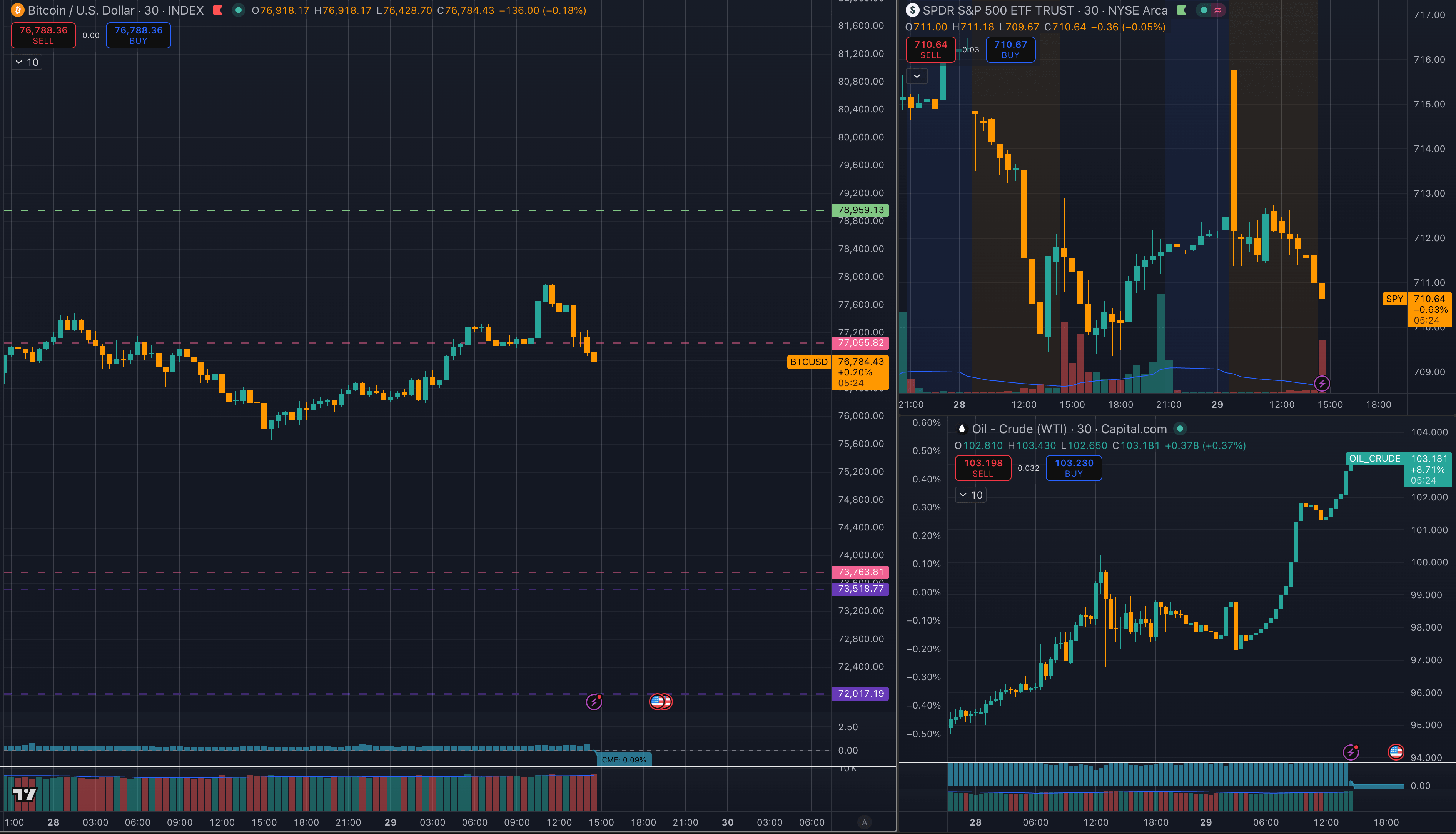
Bitcoin surges alongside oil as BTC price finally decouples from the war narrative… until US markets openedBitcoin is trading near $76,600 after reversing from an earlier intraday push toward $78,000, while crude oil trades near $103 and the S&P 500 fell as the US stock market opened.
Before the US cash session, Bitcoin rose even as crude oil kept climbing, suggesting crypto-specific positioning was strong enough to resist the oil-inflation trade for part of the day.
After the open, the picture turned back toward equities. The chart below shows Bitcoin rolling over as the S&P 500 moved lower, while crude oil remained elevated.
That leaves two signals in tension: Bitcoin can trade independently of stocks while cash equities are closed, but US equity risk appetite can still pull it back once the main session begins.
Broader market data shows roughly $2.6 trillion in crypto market cap, about $122 billion in 24-hour volume, and Bitcoin dominance near 60%.
CryptoSlate's Bitcoin market page showed Bitcoin in the upper-$77,000s earlier today up about 1.6% over 24 hours, with market cap around $1.56 trillion. The latest chart shows why that intraday strength fell off: the US open turned the move from a simple oil-shock divergence into an equity follow-through test.
The open made equities the trigger
The first phase of the session weakened the simple April template that higher oil automatically means lower Bitcoin. Crude oil climbed through the $100 area, yet Bitcoin still moved toward $78,000 before US cash equities opened.
The second phase restored the equity branch of the trade. Once the S&P 500 fell at the open, Bitcoin slipped back toward the mid-$76,000s even as crude oil pushed higher.
Bitcoin showed it can resist the oil shock for part of a session. The same session also showed that the equity open can pull the asset back into the broader risk trade.
This is also consistent with prior CryptoSlate coverage. On Apr. 23, Bitcoin's drop below $78,000 looked more like an equity and risk-appetite impulse than a direct oil move, because crude was comparatively flat while the S&P 500 softened.
Today's chart adds a sharper version of that setup. Oil is rising, Bitcoin initially resisted the pressure, and the S&P 500 open then became the event that pulled Bitcoin lower.
Oil still controls the outer boundary
The oil channel has already been built into Bitcoin's April setup. On Apr. 24, Bitcoin held near $78,000 as oil climbed past $100, turning the asset into a test of whether scarce-asset demand could survive a stronger dollar, higher real-yield pressure, and weaker liquidity conditions.
A separate analysis of the global oil shock and the Fed said fuel, freight, and input costs can move from commodity screens into realized inflation.
That channel can keep setting rates and liquidity conditions even when Bitcoin finds a short-term bid.
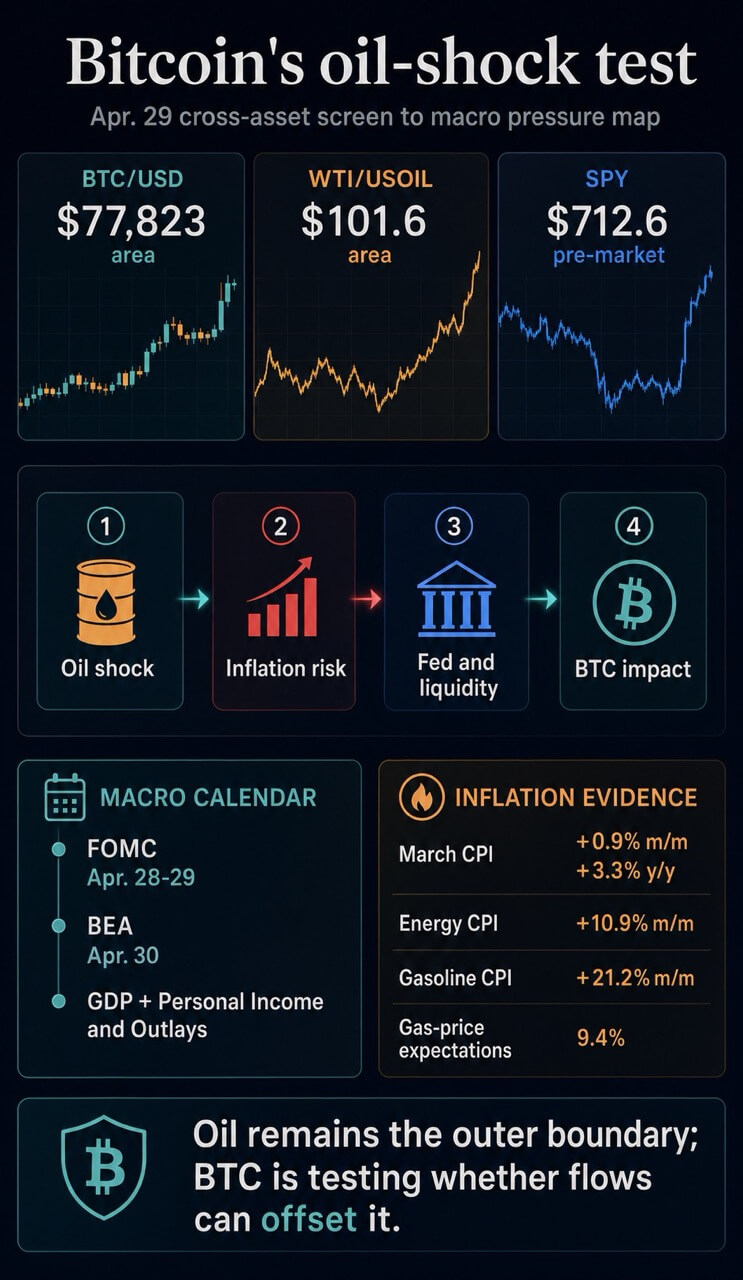
The official inflation data keeps that risk concrete. The Bureau of Labor Statistics said March CPI rose 0.9% from February and 3.3% from a year earlier.
Energy rose 10.9% on the month, led by a 21.2% jump in gasoline. The New York Fed's March survey then showed year-ahead gas-price expectations at 9.4%, the highest reading since March 2022.
Energy-market structure adds another caveat. The Energy Information Administration described a wider Brent-WTI spread and disrupted navigation through the Strait of Hormuz as part of the global crude-market backdrop. Crude stress can move from commodity pricing into inflation expectations, which keeps the Fed channel open.
The calendar concentrates that pressure. The Federal Reserve calendar places the Apr. 28-29 FOMC meeting directly over this cross-asset move.
The BEA schedule lists Q1 GDP and March Personal Income and Outlays for Apr. 30. That same late-April window had already been framed as a volatility cluster around options, oil, and the Fed.
The next policy and data prints can still decide whether the oil move becomes a persistent financial-conditions problem.
Flows are the offset, equities are the confirmation
The counterweight is demand. CoinShares' latest weekly report showed digital asset investment products taking in $1.2 billion, the fourth positive week in a row.
Bitcoin accounted for $933 million of that total. CoinShares also said the Apr. 28-29 FOMC decision was likely adding caution at the margin.
On Apr. 28, fund flows and spot demand were strong enough to rebuild the bid, but the Fed still had the next hard test.
That helps explain the pre-open resilience. Bitcoin can rise even while crude oil stays elevated when fund demand, positioning, or crypto-specific liquidity is strong enough for a session. The post-open reversal shows why that alone is incomplete.
CME's E-mini S&P 500 futures remain a strong follow-up check for whether the equity branch supports or undermines the next Bitcoin move.
Signal
What supports Bitcoin
What pressures Bitcoin
Crude and inflation
Scarce-asset demand can return during policy stress.
Higher fuel costs can lift inflation expectations, keep the Fed cautious, and tighten liquidity.
Flows and positioning
CoinShares reported $933 million of Bitcoin product inflows in the latest week.
Flow strength still faces the FOMC and bond-market test.
Equities
S&P 500 and futures follow-through would support a risk-appetite interpretation.
A weaker equity open can pull Bitcoin back into the risk-asset trade.
The Apr. 22 setup gave this move a useful threshold. It said Bitcoin holding flat or firming around $78,000 while oil stayed high would weaken the war-era template that higher oil automatically means lower Bitcoin.
So far today, Bitcoin met that test before the US equity open and then lost momentum once the S&P 500 turned lower.
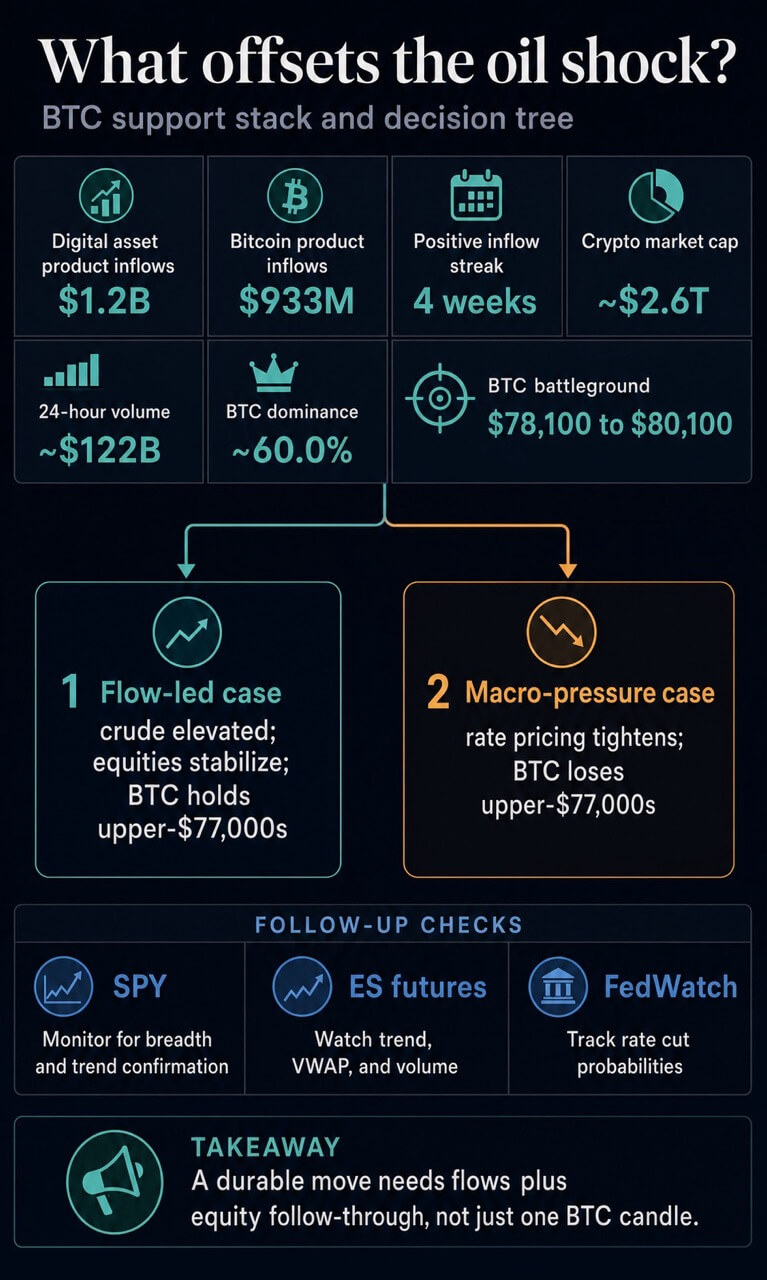
A later Apr. 28 bond-market analysis placed the Bitcoin battleground around the $78,100 to $80,100 area.
Below that zone, sellers can argue that the rally is another failed attempt into resistance. Above it, flows have a better chance of turning the recent rebound into a durable demand signal.
CME FedWatch remains the live market-implied check on how rate expectations are moving through that test.
Two scenarios follow from the updated chart. In the flow-led case, crude oil stays elevated but does not accelerate, the S&P 500 stabilizes, and Bitcoin reclaims the upper-$77,000s before testing the $78,100 to $80,100 band.
In the macro-pressure case, crude keeps inflation expectations warm, Fed pricing moves against risk assets, the S&P 500 weakens, and Bitcoin remains below the upper-$77,000s. That would restore the familiar April sequence: oil pressure first, equity stress second, Bitcoin liquidity last.
Bitcoin ignored crude oil long enough to prove the oil shock is not the only intraday force. Once the US market opened, equities became the trigger that pulled Bitcoin back. The regime test now depends on whether flows can rebuild the bid while crude oil and the Fed keep pressure on risk assets.
The post appeared first on CryptoSlate.
read the full storyMore from CryptoSlate
Bitcoin is trading near $76,600 after reversing from an earlier intraday push toward $78,000, while crude oil trades near $103 and the S&P 500 fell as the US stock market opened.
Before the US cash session, Bitcoin rose even as crude oil kept climbing, suggesting crypto-specific positioning was strong enough to resist the oil-inflation trade for part of the day.
After the open, the picture turned back toward equities. The chart below shows Bitcoin rolling over as the S&P 500 moved lower, while crude oil remained elevated.
That leaves two signals in tension: Bitcoin can trade independently of stocks while cash equities are closed, but US equity risk appetite can still pull it back once the main session begins.
Broader market data shows roughly $2.6 trillion in crypto market cap, about $122 billion in 24-hour volume, and Bitcoin dominance near 60%.
CryptoSlate's Bitcoin market page showed Bitcoin in the upper-$77,000s earlier today up about 1.6% over 24 hours, with market cap around $1.56 trillion. The latest chart shows why that intraday strength fell off: the US open turned the move from a simple oil-shock divergence into an equity follow-through test.
The open made equities the trigger
The first phase of the session weakened the simple April template that higher oil automatically means lower Bitcoin. Crude oil climbed through the $100 area, yet Bitcoin still moved toward $78,000 before US cash equities opened.
The second phase restored the equity branch of the trade. Once the S&P 500 fell at the open, Bitcoin slipped back toward the mid-$76,000s even as crude oil pushed higher.
Bitcoin showed it can resist the oil shock for part of a session. The same session also showed that the equity open can pull the asset back into the broader risk trade.
This is also consistent with prior CryptoSlate coverage. On Apr. 23, Bitcoin's drop below $78,000 looked more like an equity and risk-appetite impulse than a direct oil move, because crude was comparatively flat while the S&P 500 softened.

Today's chart adds a sharper version of that setup. Oil is rising, Bitcoin initially resisted the pressure, and the S&P 500 open then became the event that pulled Bitcoin lower.
Oil still controls the outer boundary
The oil channel has already been built into Bitcoin's April setup. On Apr. 24, Bitcoin held near $78,000 as oil climbed past $100, turning the asset into a test of whether scarce-asset demand could survive a stronger dollar, higher real-yield pressure, and weaker liquidity conditions.

A separate analysis of the global oil shock and the Fed said fuel, freight, and input costs can move from commodity screens into realized inflation.
That channel can keep setting rates and liquidity conditions even when Bitcoin finds a short-term bid.
The official inflation data keeps that risk concrete. The Bureau of Labor Statistics said March CPI rose 0.9% from February and 3.3% from a year earlier.
Energy rose 10.9% on the month, led by a 21.2% jump in gasoline. The New York Fed's March survey then showed year-ahead gas-price expectations at 9.4%, the highest reading since March 2022.
Energy-market structure adds another caveat. The Energy Information Administration described a wider Brent-WTI spread and disrupted navigation through the Strait of Hormuz as part of the global crude-market backdrop. Crude stress can move from commodity pricing into inflation expectations, which keeps the Fed channel open.
The calendar concentrates that pressure. The Federal Reserve calendar places the Apr. 28-29 FOMC meeting directly over this cross-asset move.
The BEA schedule lists Q1 GDP and March Personal Income and Outlays for Apr. 30. That same late-April window had already been framed as a volatility cluster around options, oil, and the Fed.
The next policy and data prints can still decide whether the oil move becomes a persistent financial-conditions problem.
Flows are the offset, equities are the confirmation
The counterweight is demand. CoinShares' latest weekly report showed digital asset investment products taking in $1.2 billion, the fourth positive week in a row.
Bitcoin accounted for $933 million of that total. CoinShares also said the Apr. 28-29 FOMC decision was likely adding caution at the margin.
On Apr. 28, fund flows and spot demand were strong enough to rebuild the bid, but the Fed still had the next hard test.

That helps explain the pre-open resilience. Bitcoin can rise even while crude oil stays elevated when fund demand, positioning, or crypto-specific liquidity is strong enough for a session. The post-open reversal shows why that alone is incomplete.
CME's E-mini S&P 500 futures remain a strong follow-up check for whether the equity branch supports or undermines the next Bitcoin move.
| Signal | What supports Bitcoin | What pressures Bitcoin |
|---|---|---|
| Crude and inflation | Scarce-asset demand can return during policy stress. | Higher fuel costs can lift inflation expectations, keep the Fed cautious, and tighten liquidity. |
| Flows and positioning | CoinShares reported $933 million of Bitcoin product inflows in the latest week. | Flow strength still faces the FOMC and bond-market test. |
| Equities | S&P 500 and futures follow-through would support a risk-appetite interpretation. | A weaker equity open can pull Bitcoin back into the risk-asset trade. |
The Apr. 22 setup gave this move a useful threshold. It said Bitcoin holding flat or firming around $78,000 while oil stayed high would weaken the war-era template that higher oil automatically means lower Bitcoin.
So far today, Bitcoin met that test before the US equity open and then lost momentum once the S&P 500 turned lower.
A later Apr. 28 bond-market analysis placed the Bitcoin battleground around the $78,100 to $80,100 area.
Below that zone, sellers can argue that the rally is another failed attempt into resistance. Above it, flows have a better chance of turning the recent rebound into a durable demand signal.
CME FedWatch remains the live market-implied check on how rate expectations are moving through that test.
Two scenarios follow from the updated chart. In the flow-led case, crude oil stays elevated but does not accelerate, the S&P 500 stabilizes, and Bitcoin reclaims the upper-$77,000s before testing the $78,100 to $80,100 band.
In the macro-pressure case, crude keeps inflation expectations warm, Fed pricing moves against risk assets, the S&P 500 weakens, and Bitcoin remains below the upper-$77,000s. That would restore the familiar April sequence: oil pressure first, equity stress second, Bitcoin liquidity last.
Bitcoin ignored crude oil long enough to prove the oil shock is not the only intraday force. Once the US market opened, equities became the trigger that pulled Bitcoin back. The regime test now depends on whether flows can rebuild the bid while crude oil and the Fed keep pressure on risk assets.
The post appeared first on CryptoSlate.
read the full story| More from CryptoSlate |
|---|

Bitcoin Sees Declining Short-Term Activity Amid Gradual Upside Momentum
Bitcoin may have pulled back briefly after days of upward action, but its price is still holding…

Big Tech AI Capex Tops $650 Billion as Q1 Earnings Beats Pressure Bitcoin Risk Trade
Big Tech Q1 earnings beat estimates, but Meta's $145B capex hike and AI spending fears weighed on…

Bitcoin recovery stalls after Fed holds interest rates, citing ‘uncertainty’ in Middle East
Bitcoin dropped under $75,000 after FOMC minutes showed the US Federal Reserve holding interest…

Meta's Former Blockchain Lead Makes Stunning $1 Million Bitcoin (BTC) Price Prediction
Lightspark CEO and co-founder David Marcus is standing by an ultra-bullish, seven-figure price…

Meta Launches USDC Stablecoin Creator Payouts on Solana and Polygon via Stripe
Facebook and Instagram parent company Meta is now offering stablecoin payouts to content creators in…

A Stealth Force In Derivatives—Why Bitcoin Can’t Punch Past $80,000 Yet
Bitcoin (BTC) failed again to push back above the $80,000 level this week, a price point that has…

Be SCARED If You Don't Own Bitcoin | Michael Saylor's $10M ENDGAME is Here
A billionaire just issued a global warning and it is not subtle. Tim Draper and Michael Saylor lay…

150K Bitcoin inflows build pressure – Why BTC price could consolidate
Bitcoin’s rally meets resistance as profit-taking rises and activity cools, keeping momentum…

Eric Trump says bitcoin in its 'greatest period ever' as Wall Street falls in line
Speaking at Bitcoin Las Vegas 2026, the American Bitcoin co-founder declared the last six months a…

Price predictions 4/29: BTC, ETH, XRP, BNB, SOL, DOGE, HYPE, ADA, BCH, XMR
Bitcoin’s sell-off accelerated leading into this week’s FOMC, but charts highlight some…
Analyst Reveals Bitcoin Big Picture, Predicts 50% Crash By EOY
Bitcoin’s price structure is starting to look less like a clean recovery to $80,000 and more like…
Eric Trump, John Koudounis Call Bitcoin a Global Reserve Asset, Float $1M Price Target
American Bitcoin Co-Founder and Calamos CEO John Koudounis told attendees at Bitcoin 2026 in Las…

Bitcoin Dips Under $76K as Fed Holds Rates in Rare 8-4 Split
ETH is down 7% on the week as the Fed signals the bar for rate cuts has risen, and ETF outflows top…

Meta Launches Stablecoin Payouts In Colombia And The Philippines
The social media giant has rolled out USDC payments via Stripe on Solana and Polygon.
Tech giant Meta starts paying some creators in stablecoin with Stripe's support
The tech giant is first offering the feature to select creators in Colombia and the Philippines.
Bitcoin Swings $2,800 as Traders Dump at $77,882 Peak, Pushing Price Toward $75,100
On April 29, bitcoin experienced significant price swings, peaking at $77,882 before retreating to…

Bitcoin-Backed Loans Are Unlocking Homeownership for an Entire New Generation
At the Bitcoin 2026 Conference, executives from SALT Lending and Peoples Reserve argued that…
Bitcoin falls as traders cut risk ahead of FOMC: Will TradFi, spot ETF volumes bolster $70K support?
Bitcoin price volatility tends to spike before and after the FOMC, a pattern that is playing out…
Steak ‘n Shake Says Bitcoin Payments Cut Processing Costs by 50%, Save $6 Million Annually
Steak ‘n Shake exec Michael Boes told Bitcoin 2026 attendees that Bitcoin has become central to…
Visa Scales Stablecoin Rails to Nine Networks as Partners Cite Real-World Demand
Visa announced April 29 that its global stablecoin settlement pilot has reached a $7 billion…