Bitcoin To $125,000: Arthur Hayes Says The Setup Is Turning BullishArthur Hayes says Bitcoin’s macro setup is turning bullish again, arguing that wartime spending, US fiscal deficits and bank-led credit creation could outweigh fears of a smaller Federal Reserve balance sheet. Speaking at the Bitcoin 2026 conference in Las Vegas, the BitMEX co-founder said Bitcoin is increasingly trading as a response to “wartime inflation,” not just the artificial intelligence cycle.
Hayes framed the recent shift around a simple premise: governments are openly preparing to spend more on defense, and that spending ultimately has to be financed. In his view, that puts Bitcoin back in familiar territory as a liquidity-sensitive asset with a hard-money narrative.
“Since the war has started, Bitcoin has outperformed,” Hayes said. “It outperformed NASDAQ and outperformed the SaaS stocks. And basically, I think that Bitcoin is now focusing on wartime inflation.”
The core of Hayes’ argument was not that the Fed will suddenly return to explicit quantitative easing. Instead, he focused on what he described as a likely balance-sheet reshuffling between the Fed and the commercial banking system, one that could allow officials to claim the Fed is shrinking while leaving the broader dollar liquidity picture largely intact.
Bitcoin Vs. The Hawkish Fed Narrative
Hayes addressed market concerns around Kevin Warsh, whom he said investors have viewed as a potentially hawkish Fed chair because of his criticism of the central bank’s large balance sheet. Hayes said those fears miss the practical constraints facing monetary officials when the US government is still issuing massive amounts of debt.
“If the market believes that there’s going to be less dollar liquidity floating around the system because of what Warsh will do with the Fed, then they’ll be bearish on Bitcoin and other risk assets,” Hayes said. “This is what we’ve seen in the media talking about sort of this hawkish Fed that’s going to come into place after May when Warsh takes over. Now, I don’t believe that’s the case.”
According to Hayes, Warsh would be constrained by the Treasury’s need to keep the bond market functioning. He argued that the Fed cannot pursue balance-sheet reduction in a vacuum when the US government must continue funding large deficits.
“At the end of the day, when you’ve issued $38 trillion of debt and you need to fund the government, the Federal Reserve will do what it’s asked to do, which is make sure the market is orderly so that people can buy this debt,” Hayes said.
The Bank Balance Sheet Trade
Hayes’ central mechanism is a swap: commercial banks reduce their holdings of Fed reserves and replace them with Treasuries and repos. In that scenario, the Fed’s balance sheet can become smaller on paper, while the banking system absorbs more government debt.
“The point of all this is that the net effect on dollar liquidity is neutral,” Hayes said. “There’s nothing being sold, there’s nothing being bought. It’s just a swap. It’s purely regulatory fiction in terms of who is allowed to hold what.”
That distinction matters for Bitcoin because Hayes says investors should care less about the stated size of the Fed’s balance sheet and more about whether the overall system is creating or destroying dollar liquidity. If debt simply migrates from the Fed to regulated bank balance sheets, the impact may be far less restrictive than markets fear.
Hayes linked that transition to US banking deregulation and specifically cited changes to the Enhanced Supplementary Leverage Ratio, which he said went live on April 1. In his telling, the rule change allows large banks such as JPMorgan and Citibank to absorb more Treasuries and repos, while smaller banks can expand construction and industrial lending.
He also cited an S&P Global estimate that the ESLR balance-sheet reduction could generate $1.3 trillion of new loans.
Wartime Spending Becomes The Demand Engine
Hayes argued that the demand side of the lending cycle is already visible. Defense spending, critical resource production and AI infrastructure are all becoming national-security priorities, he said, creating borrowers with government-backed demand and therefore more attractive credit profiles for banks.
“Why will banks have demand for loans? One of the criticisms about this analysis from some of my other macro-fans is that they claim the banking system is not creating enough loans or there’s not enough demand,” Hayes said. “Well, we have a great source of demand that is the US Department of War.”
He said banks would lend to defense suppliers, resource miners and hyperscalers as AI capital expenditure becomes part of the national-security framework. Hayes described bank lending as especially important because, in his view, it carries a higher multiplier than central bank lending, estimating that around $4 trillion in credit could ultimately be created.
That is the basis for his renewed bullishness. Hayes said his liquidity chart bottomed in November of last year, roughly around the same time as Bitcoin, and argued that after a period of war-driven uncertainty, the market may now be ready to move higher.
“I think we’ve had a bit of a chop. We’ve had a bit of a war. Now it’s time to break out,” Hayes said. “And that’s why I believe Bitcoin is going higher. I think my end of year choice target is like $125,000, whatever, it doesn’t fucking matter, I’m wrong anyways.”
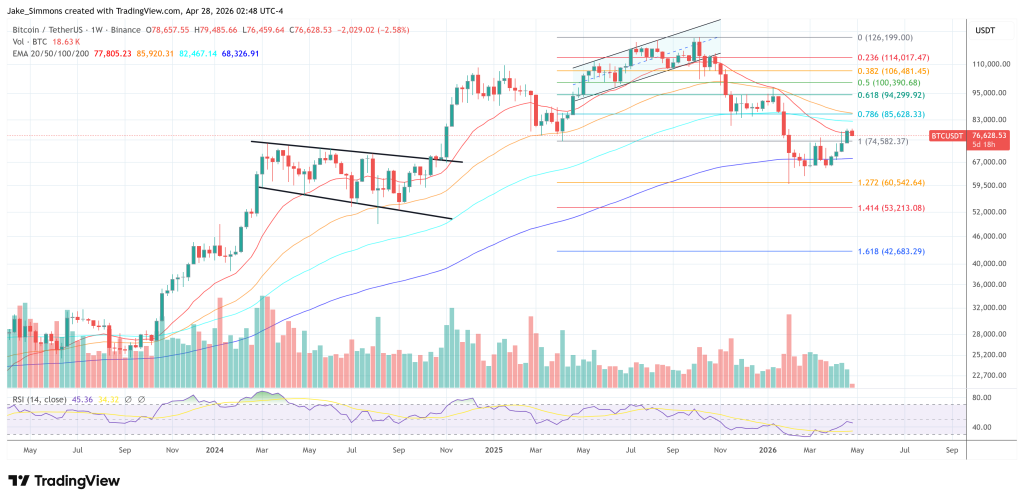
At press time, Bitcoin traded at $76,628.
read the full story
Arthur Hayes says Bitcoin’s macro setup is turning bullish again, arguing that wartime spending, US fiscal deficits and bank-led credit creation could outweigh fears of a smaller Federal Reserve balance sheet. Speaking at the Bitcoin 2026 conference in Las Vegas, the BitMEX co-founder said Bitcoin is increasingly trading as a response to “wartime inflation,” not just the artificial intelligence cycle.
Hayes framed the recent shift around a simple premise: governments are openly preparing to spend more on defense, and that spending ultimately has to be financed. In his view, that puts Bitcoin back in familiar territory as a liquidity-sensitive asset with a hard-money narrative.
“Since the war has started, Bitcoin has outperformed,” Hayes said. “It outperformed NASDAQ and outperformed the SaaS stocks. And basically, I think that Bitcoin is now focusing on wartime inflation.”
The core of Hayes’ argument was not that the Fed will suddenly return to explicit quantitative easing. Instead, he focused on what he described as a likely balance-sheet reshuffling between the Fed and the commercial banking system, one that could allow officials to claim the Fed is shrinking while leaving the broader dollar liquidity picture largely intact.
Bitcoin Vs. The Hawkish Fed Narrative
Hayes addressed market concerns around Kevin Warsh, whom he said investors have viewed as a potentially hawkish Fed chair because of his criticism of the central bank’s large balance sheet. Hayes said those fears miss the practical constraints facing monetary officials when the US government is still issuing massive amounts of debt.
“If the market believes that there’s going to be less dollar liquidity floating around the system because of what Warsh will do with the Fed, then they’ll be bearish on Bitcoin and other risk assets,” Hayes said. “This is what we’ve seen in the media talking about sort of this hawkish Fed that’s going to come into place after May when Warsh takes over. Now, I don’t believe that’s the case.”
According to Hayes, Warsh would be constrained by the Treasury’s need to keep the bond market functioning. He argued that the Fed cannot pursue balance-sheet reduction in a vacuum when the US government must continue funding large deficits.
“At the end of the day, when you’ve issued $38 trillion of debt and you need to fund the government, the Federal Reserve will do what it’s asked to do, which is make sure the market is orderly so that people can buy this debt,” Hayes said.
The Bank Balance Sheet Trade
Hayes’ central mechanism is a swap: commercial banks reduce their holdings of Fed reserves and replace them with Treasuries and repos. In that scenario, the Fed’s balance sheet can become smaller on paper, while the banking system absorbs more government debt.
“The point of all this is that the net effect on dollar liquidity is neutral,” Hayes said. “There’s nothing being sold, there’s nothing being bought. It’s just a swap. It’s purely regulatory fiction in terms of who is allowed to hold what.”
That distinction matters for Bitcoin because Hayes says investors should care less about the stated size of the Fed’s balance sheet and more about whether the overall system is creating or destroying dollar liquidity. If debt simply migrates from the Fed to regulated bank balance sheets, the impact may be far less restrictive than markets fear.
Hayes linked that transition to US banking deregulation and specifically cited changes to the Enhanced Supplementary Leverage Ratio, which he said went live on April 1. In his telling, the rule change allows large banks such as JPMorgan and Citibank to absorb more Treasuries and repos, while smaller banks can expand construction and industrial lending.
He also cited an S&P Global estimate that the ESLR balance-sheet reduction could generate $1.3 trillion of new loans.
Wartime Spending Becomes The Demand Engine
Hayes argued that the demand side of the lending cycle is already visible. Defense spending, critical resource production and AI infrastructure are all becoming national-security priorities, he said, creating borrowers with government-backed demand and therefore more attractive credit profiles for banks.
“Why will banks have demand for loans? One of the criticisms about this analysis from some of my other macro-fans is that they claim the banking system is not creating enough loans or there’s not enough demand,” Hayes said. “Well, we have a great source of demand that is the US Department of War.”
He said banks would lend to defense suppliers, resource miners and hyperscalers as AI capital expenditure becomes part of the national-security framework. Hayes described bank lending as especially important because, in his view, it carries a higher multiplier than central bank lending, estimating that around $4 trillion in credit could ultimately be created.
That is the basis for his renewed bullishness. Hayes said his liquidity chart bottomed in November of last year, roughly around the same time as Bitcoin, and argued that after a period of war-driven uncertainty, the market may now be ready to move higher.
“I think we’ve had a bit of a chop. We’ve had a bit of a war. Now it’s time to break out,” Hayes said. “And that’s why I believe Bitcoin is going higher. I think my end of year choice target is like $125,000, whatever, it doesn’t fucking matter, I’m wrong anyways.”
At press time, Bitcoin traded at $76,628.

Japan Bitbank Launches Crypto-Linked Card That Settles Bills in Bitcoin
Bitbank Launches Crypto Card That Settles Bills in Bitcoin
The post appeared first on .

Trump Claims Iran Is Collapsing and Wants to Reopen the Strait: Bitcoin on Edge
Is this another psychological game or is Iran indeed admitting its dire situation?

New wallet offers way to tackle Bitcoin’s quantum risk without a fork
The Postquant Labs project uses Arch Network to deliver post-quantum signature protection without a…

White House Crypto Adviser Hints at ‘Breakthrough’ Bitcoin Reserve Move
A "big announcement" on the U.S. Bitcoin strategic reserve could drop soon, but Treasury and a…

Bitcoin demand hits 2025 highs – So why hasn’t BTC price recovered?
Abundant Bitcoin capital highlights weak conviction despite strong market liquidity.

Here’s Why The Bitcoin And Ethereum Prices Have Been Rising And Falling Sharply
Bitcoin and Ethereum have spent the past few weeks moving like assets caught between two powerful…
Trump’s Bitcoin Reserve Could Be Near As White House Signals Major Update
A bill to lock in the US Strategic Bitcoin Reserve is being renamed the American Reserves…
Stablecoin transfer volume drops 19% even as supply keeps rising: RWA.xyz
Stablecoin transfer volume fell more than 19% in 30 days even as supply, holders and active…

Bitcoin's Next Move Hinges on $82K CME Gap as Earnings, FOMC Loom
Big Tech earnings and the FOMC are challenging investor risk appetite, with $82K as a make-or-break…

Cathie Wood’s Bitcoin bull thesis concedes stablecoins won the real-world payment fight
Cathie Wood built ARK Invest's Bitcoin case on the idea that Bitcoin would become a global monetary…

Bitcoin (BTC) Flashes a Rare Buy Signal: How High Can the Price Go?
BTC may explode by over 200% if history repeats itself.
$1.71 Trillion T. Rowe Price Advances With New Crypto ETF for XRP and SHIB; $96,600 Bitcoin Is Valid Outlook: Bollinger Bands; Dogecoin Ends $0 ETF Streak as DOGE Price Targets $0.1 - Morning Crypto Report
T. Rowe Price readies TKNZ ETF with XRP and SHIB, while Bitcoin targets $96,600 via Bollinger Bands,…

Bitcoin Stalls at $79.5K Before Sliding Three Grand in a Sharp Pullback
TL;DR Bitcoin rallied to $79,500 on Monday but was rejected again, sliding first toward $77,500 and…

Bitcoin Reclaims Critical Trend Line After 6 Months
Bitcoin (BTC) closed above the 21-week exponential moving average for the first time in roughly six…

Bitcoin Falls as Bank of Japan’s 6-3 Hawkish Hold Revives Carry Trade Fears
Bitcoin slipped near $76,400 after the BOJ's 6-3 hawkish hold revived June rate hike bets and yen…
NOWPayments Boosts USDT Processing Speed 5x on BSC and Ethereum to Improve Stablecoin Settlement Efficiency
Amsterdam, Netherlands, 28th April 2026, Chainwire
Colombia Bitcoin: Largest Pension Fund Adds BTC Exposure
Colombia's Largest Pension Fund Adds Bitcoin to Portfolio
The post appeared first on .

Bitcoin Enters Pensions: Millions Of Colombian Workers To Get Access
Young workers between 18 and 45 are the target audience for a new Bitcoin investment product quietly…