Bitcoin’s biggest ETF is becoming the sell wall bulls have to breakBlackRock's iShares Bitcoin Trust has become the test Bitcoin bulls did not want. The ETF that helped turn regulated access into a simple institutional-demand story is now the main place where price-sensitive holders are showing up.
Farside Investors' Bitcoin ETF flow data shows that US spot Bitcoin ETFs lost roughly $1.79 billion over the June 22-26 trading week. IBIT accounted for about $1.30 billion of that total, or nearly 73% of the weekly exit.
The latest daily line sharpened the signal: Farside's June 26 table showed a $444.5 million net outflow from the ETF complex, with the full negative print coming from IBIT.
That concentration changes the recovery test. Bitcoin can still treat the ETF complex as a demand channel, but the largest spot Bitcoin ETF must now also be treated as a redemption channel.
If the same wrapper that validated Bitcoin for brokerage-account buyers becomes the main exit lane, spot buyers outside the ETF complex have to absorb the exposure when ETF holders cut risk.
IBIT carried the ETF exit
The Farside data turns the week into a market-structure signal because the pressure was concentrated in the market's most visible Bitcoin ETF.
Flow measure
June 22-26, 2026
Total US spot Bitcoin ETF net flow
-$1.7873 billion
IBIT net flow
-$1.3035 billion
IBIT share of weekly outflow
About 72.9%
June 26 total ETF net flow
-$444.5 million
June 26 IBIT net flow
-$444.5 million
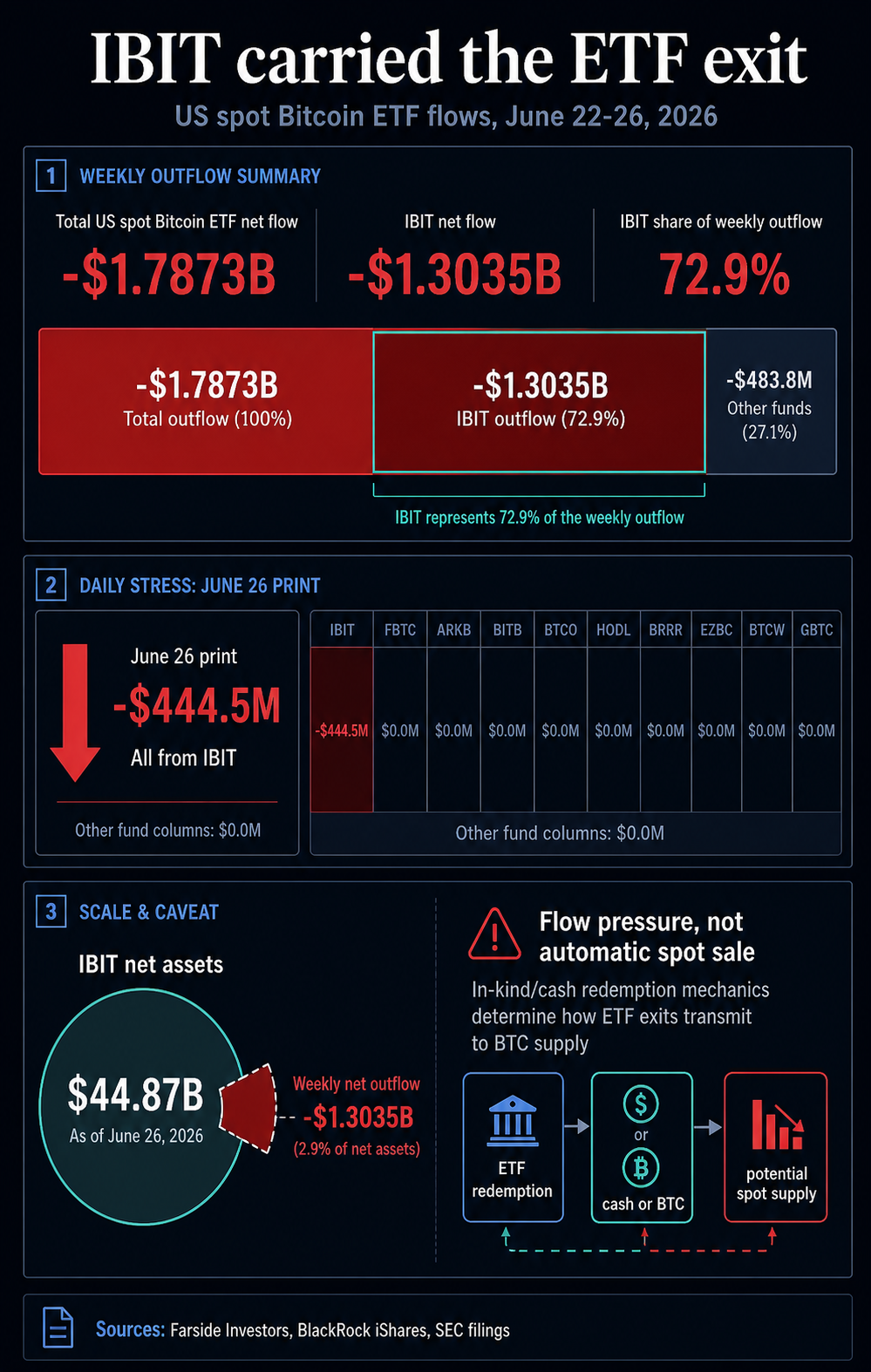
IBIT is more than another ticker in the ETF complex. It is one of Bitcoin's clearest regulated access points through existing brokerage accounts, and its scale gives its flows more market weight than redemptions from smaller funds.
When that product accounts for most of a weekly exit, the signal is no longer simply cooling across the ETF market. It is a stress test for the strongest access rail Bitcoin gained from the spot ETF launch.
The flow also landed while Bitcoin was already under pressure. CryptoSlate market data showed BTC trading around $60,000 on June 28 with negative seven-day and 30-day performance.
Recent CryptoSlate coverage had already tracked the broader ETF capitulation backdrop and Bitcoin's struggle around the high-$50,000 to low-$60,000 zone. The added pressure now is that IBIT itself becomes the marginal flow to watch.
The early spot ETF story was straightforward: regulated access widened the buyer base, ETF demand reduced available supply, and Bitcoin gained a more familiar ownership rail for institutions and brokerage-account investors.
The latest data keeps that history intact while showing the same access point can work in reverse once ETF holders decide they want out.
IBIT's size is the reason the outflow week matters, and it also keeps the move in perspective. BlackRock's official iShares product page listed IBIT with $44.87 billion in net assets as of June 26, alongside a benchmark level near $59,813.
A $1.30 billion weekly outflow is large enough to dominate the ETF complex, while still representing a small fraction of the fund's asset base. IBIT remains a major regulated Bitcoin wrapper. The market issue is what that scale does at the margin.
When IBIT takes in money, its size reinforces the institutional-demand narrative. When it loses money, its scale makes the outflow harder for the rest of the market to ignore.
A smaller fund can bleed without changing the whole ETF conversation. IBIT cannot. Its redemptions suggest ETF ownership may be becoming more price-sensitive near Bitcoin's support zone.
That distinction is central around $60,000. A constructive interpretation is that the largest redemptions have already passed through the system, outflows will slow next, and a reclaim of the $59,000-$62,000 area looks like absorption.
The cautious interpretation is that the next bounce has to survive fresh ETF selling pressure rather than merely recover from a liquidation flush.
That is the sell-wall version of the IBIT story. It does not require BlackRock to be bearish on Bitcoin or IBIT holders to exit all at once. It is a market-structure claim: the largest access product can become the first place where price-sensitive ownership appears.
ETF mechanics keep the claim precise
ETF flow data is a pressure signal rather than a direct on-chain sale log.
In July 2025, the SEC permitted in-kind creations and redemptions for crypto ETPs. IBIT filings also show that redemption mechanics can involve cash proceeds from selling Bitcoin or Bitcoin itself, depending on the path used.
An ETF outflow should therefore be treated as a transmission risk rather than as automatic evidence that every redeemed dollar was immediately sold into the spot market.
The risk is still real. A large, liquid ETF can turn investor de-risking into a recurring source of pressure on Bitcoin supply or supply expectations, especially if redemptions are cash-settled or if redeemed Bitcoin is sold afterward.
The market does not need perfect mechanical certainty for the signal to matter. If IBIT keeps printing large negative days, buyers have to ask who is absorbing the exposure as they leave the ETF wrapper.
If Bitcoin is unable to reclaim the $60,000 area while that happens, the old institutional-demand story weakens. If flows stabilize quickly, the same data may look like a reset after a crowded trade cleared.
The real test is whether ETF ownership has matured into a two-way source of price pressure. Spot ETFs gave investors an easier path to ownership. Easier ownership also means easier exit.
IBIT's latest outflow week puts that tradeoff in front of Bitcoin at a fragile point on the chart.
If IBIT outflows slow and Bitcoin holds the high-$50,000s before reclaiming the $59,000-$62,000 band, the week can be treated as a possible capitulation or flow reset.
In that version, ETF holders who wanted out exited, the market absorbed the transmission risk, and the largest regulated product remains a net positive for Bitcoin over longer horizons.
If IBIT continues to dominate redemptions while Bitcoin fails to rebuild above $60,000, the interpretation changes. The ETF complex would define the next recovery test by requiring non-ETF spot buyers to defend the market without help from the wrapper that once supplied the easiest bullish story.
The latest IBIT-led exit leaves Bitcoin with a live test rather than a settled verdict. One week of flow data cannot establish investor motives, and redemption mechanics prevent a simple dollar-for-dollar spot-selling claim.
But the data does show that the market's most visible Bitcoin ETF can become the dominant source of outflow pressure at exactly the moment Bitcoin needs demand outside the ETF complex.
For Bitcoin, that makes the next few trading sessions unusually consequential. A slowing IBIT bleed would turn the week into evidence of exhaustion. Another round of large redemptions would make the sell-wall framing harder to dismiss.
The post appeared first on CryptoSlate.
read the full story
BlackRock's iShares Bitcoin Trust has become the test Bitcoin bulls did not want. The ETF that helped turn regulated access into a simple institutional-demand story is now the main place where price-sensitive holders are showing up.
Farside Investors' Bitcoin ETF flow data shows that US spot Bitcoin ETFs lost roughly $1.79 billion over the June 22-26 trading week. IBIT accounted for about $1.30 billion of that total, or nearly 73% of the weekly exit.
The latest daily line sharpened the signal: Farside's June 26 table showed a $444.5 million net outflow from the ETF complex, with the full negative print coming from IBIT.
That concentration changes the recovery test. Bitcoin can still treat the ETF complex as a demand channel, but the largest spot Bitcoin ETF must now also be treated as a redemption channel.
If the same wrapper that validated Bitcoin for brokerage-account buyers becomes the main exit lane, spot buyers outside the ETF complex have to absorb the exposure when ETF holders cut risk.
IBIT carried the ETF exit
The Farside data turns the week into a market-structure signal because the pressure was concentrated in the market's most visible Bitcoin ETF.
| Flow measure | June 22-26, 2026 |
|---|---|
| Total US spot Bitcoin ETF net flow | -$1.7873 billion |
| IBIT net flow | -$1.3035 billion |
| IBIT share of weekly outflow | About 72.9% |
| June 26 total ETF net flow | -$444.5 million |
| June 26 IBIT net flow | -$444.5 million |
IBIT is more than another ticker in the ETF complex. It is one of Bitcoin's clearest regulated access points through existing brokerage accounts, and its scale gives its flows more market weight than redemptions from smaller funds.
When that product accounts for most of a weekly exit, the signal is no longer simply cooling across the ETF market. It is a stress test for the strongest access rail Bitcoin gained from the spot ETF launch.

The flow also landed while Bitcoin was already under pressure. CryptoSlate market data showed BTC trading around $60,000 on June 28 with negative seven-day and 30-day performance.
Recent CryptoSlate coverage had already tracked the broader ETF capitulation backdrop and Bitcoin's struggle around the high-$50,000 to low-$60,000 zone. The added pressure now is that IBIT itself becomes the marginal flow to watch.

The early spot ETF story was straightforward: regulated access widened the buyer base, ETF demand reduced available supply, and Bitcoin gained a more familiar ownership rail for institutions and brokerage-account investors.
The latest data keeps that history intact while showing the same access point can work in reverse once ETF holders decide they want out.
IBIT's size is the reason the outflow week matters, and it also keeps the move in perspective. BlackRock's official iShares product page listed IBIT with $44.87 billion in net assets as of June 26, alongside a benchmark level near $59,813.
A $1.30 billion weekly outflow is large enough to dominate the ETF complex, while still representing a small fraction of the fund's asset base. IBIT remains a major regulated Bitcoin wrapper. The market issue is what that scale does at the margin.
When IBIT takes in money, its size reinforces the institutional-demand narrative. When it loses money, its scale makes the outflow harder for the rest of the market to ignore.

A smaller fund can bleed without changing the whole ETF conversation. IBIT cannot. Its redemptions suggest ETF ownership may be becoming more price-sensitive near Bitcoin's support zone.
That distinction is central around $60,000. A constructive interpretation is that the largest redemptions have already passed through the system, outflows will slow next, and a reclaim of the $59,000-$62,000 area looks like absorption.
The cautious interpretation is that the next bounce has to survive fresh ETF selling pressure rather than merely recover from a liquidation flush.
That is the sell-wall version of the IBIT story. It does not require BlackRock to be bearish on Bitcoin or IBIT holders to exit all at once. It is a market-structure claim: the largest access product can become the first place where price-sensitive ownership appears.
ETF mechanics keep the claim precise
ETF flow data is a pressure signal rather than a direct on-chain sale log.
In July 2025, the SEC permitted in-kind creations and redemptions for crypto ETPs. IBIT filings also show that redemption mechanics can involve cash proceeds from selling Bitcoin or Bitcoin itself, depending on the path used.
An ETF outflow should therefore be treated as a transmission risk rather than as automatic evidence that every redeemed dollar was immediately sold into the spot market.
The risk is still real. A large, liquid ETF can turn investor de-risking into a recurring source of pressure on Bitcoin supply or supply expectations, especially if redemptions are cash-settled or if redeemed Bitcoin is sold afterward.
The market does not need perfect mechanical certainty for the signal to matter. If IBIT keeps printing large negative days, buyers have to ask who is absorbing the exposure as they leave the ETF wrapper.
If Bitcoin is unable to reclaim the $60,000 area while that happens, the old institutional-demand story weakens. If flows stabilize quickly, the same data may look like a reset after a crowded trade cleared.
The real test is whether ETF ownership has matured into a two-way source of price pressure. Spot ETFs gave investors an easier path to ownership. Easier ownership also means easier exit.
IBIT's latest outflow week puts that tradeoff in front of Bitcoin at a fragile point on the chart.
If IBIT outflows slow and Bitcoin holds the high-$50,000s before reclaiming the $59,000-$62,000 band, the week can be treated as a possible capitulation or flow reset.
In that version, ETF holders who wanted out exited, the market absorbed the transmission risk, and the largest regulated product remains a net positive for Bitcoin over longer horizons.
If IBIT continues to dominate redemptions while Bitcoin fails to rebuild above $60,000, the interpretation changes. The ETF complex would define the next recovery test by requiring non-ETF spot buyers to defend the market without help from the wrapper that once supplied the easiest bullish story.
The latest IBIT-led exit leaves Bitcoin with a live test rather than a settled verdict. One week of flow data cannot establish investor motives, and redemption mechanics prevent a simple dollar-for-dollar spot-selling claim.
But the data does show that the market's most visible Bitcoin ETF can become the dominant source of outflow pressure at exactly the moment Bitcoin needs demand outside the ETF complex.
For Bitcoin, that makes the next few trading sessions unusually consequential. A slowing IBIT bleed would turn the week into evidence of exhaustion. Another round of large redemptions would make the sell-wall framing harder to dismiss.
The post appeared first on CryptoSlate.
read the full story
Why a collapse in $1 trillion AI spending boom could hit Bitcoin traders first
Over the past year, the artificial intelligence trade has become one of the main pillars supporting…
Circle’s USDC Becomes First Stablecoin Supported by BNY Mellon for Institutional Clients
America's oldest bank will allow institutional clients to store, mint, redeem, and transfer USDC.


Strategy Authorizes up to $1.25B of Bitcoin Sales as Saylor Formalizes Capital Pivot
The largest corporate Bitcoin holder will lift its STRC preferred dividend to 12% and can now sell…

The 52% Coincidence: Bitcoin and Silver Are Bleeding in Near-Perfect Sync
Bitcoin and silver both trade about 52% below record highs, with matching chart structures and…

Bitcoin Price Analysis: Is $54K Inevitable for BTC if $60K Support Is Decisively Lost?
After yielding to heavy selling pressure and losing several key support levels over the past few…
Tom Lee's BitMine Adds $43 Million in Ethereum as Strategy Halts Bitcoin Buys
BitMine Immersion Technologies continued adding to its Ethereum stockpile, even as its Bitcoin…

Bitcoin and Silver Both Sit 52% Below Peak With $39,000 Drop Risk Looming
Bitcoin and silver are falling in lockstep. Both assets are trading roughly 52% below their…

Bitcoin treasury investors are turning on companies diluting them to keep buying
On June 22, Strategy sold $335.5 million of its own common stock, set aside roughly $300 million of…
Bitcoin Holds Below $60K With Markets Bracing for a Pivotal Week
TL;DR: Bitcoin trades at $59,800, down more than 50% from its all-time high set in October. The…

Wall Street's BNY expands stablecoin services for institutions, starting with Circle's USDC
The world's largest custody bank is adding USDC custody and minting services as stablecoins move…

Death Spiral? Schiff Says Falling BTC Will Force Strategy to Sell More
Financial commentator and long-time crypto skeptic Peter Schiff has sounded the alarm on Strategy's…

Strategy opens door to selling billions of bitcoin under new capital plan. Here's what it means
The company can now sell bitcoin to fund the USD reserve, support preferred dividends, and finance…
Bitcoin Nears $60,000 as Traders Hold Their Breath
Bitcoin is priced at $59,800 this Monday, marking a 0.6% increase over 24 hours. It’s not…
From Bitcoin critics to blockchain believers: The 5 biggest crypto backflips
If you can't beat 'em, join 'em. Here are five crypto skeptics who have reluctantly embraced the…

XRP Records 115% ETF Shift Ahead of Historically Positive Q3; 2024 Shiba Inu (SHIB) Billionaire Appears On-Chain; Saylor Legalizes Bitcoin Sales With 12% Dividend Boost - Morning Crypto Report
XRP ETF inflows surge 115% ahead of historically strongest quarter, a dormant SHIB whale moves $2.7M…
Strategy unveils capital framework to preserve Bitcoin exposure, pay dividends
Michael Saylor’s Strategy unveiled a capital framework allowing Bitcoin sales to fund dividends, a…
Breez launches Bitcoin-to-stablecoin payments across more than 30 blockchains
The new SDK feature lets developers route payments from Bitcoin balances to recipients in USDC and…