Bitwise Research Shows How Much Loss Your Bitcoin Incurs Depending On How Long You HoldBitwise Research has shed light on how holding durations can impact the ROI and outcomes of Bitcoin (BTC) investments, revealing a major distinction between short-term risk and long-term performance. The data shows that while short holding periods carry significant chances of loss, extended investment timeframes dramatically reduce downside risks. The findings are drawing significant attention in the crypto community as investors reassess their strategy in the ongoing bear market.
Why Holding Bitcoin For Long Carries Less Risk
New research compiled by Bitwise and shared by crypto analyst Bitcoin Archive indicates that the probability of incurring losses on Bitcoin declines as the holding period increases, based on historical performance spanning more than a decade. The chart, sourced from Glassnode, shows that short-term exposure to BTC carries the highest level of uncertainty and the greatest likelihood of loss.
The numbers on the chart highlight just how unstable the Bitcoin price can be in the near term. If someone buys and sells within a day, their chances of losing money increase substantially. Even holding for a month does not improve things much, suggesting that short term price movements are largely unpredictable and driven by noise, speculation, and rapid sentiment shifts.
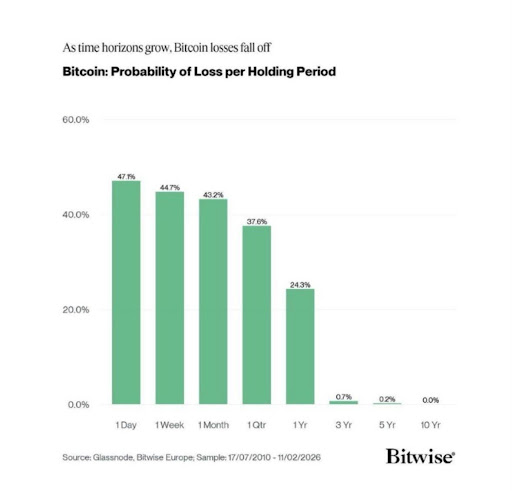
Looking at the chart’s numbers, a one-day holding period has a 47.1% chance of loss, while a one-week period shows a similar risk of 44.7%. Even at monthly intervals, the probability of loss stays elevated, reflecting the risks faced by active traders. Bitwise shows that holding BTC for just one month results in a marginal decline to 43.2%, underscoring the strong volatility across shorter timeframes.
However, as the holding period increases, the risk begins to decline noticeably. By the time an investor holds Bitcoin for several months or up to a year, the probability of loss drops, but remains significant. The chart shows that at the quarterly level, the probability of loss decreases to 37.6%. For over a year, the likelihood of loss drops further to 24.3%, highlighting a clear contrast when holding for just a day.
Bitcoin Loss Probability During Multi-Year Holds
Most success stories and outsized returns in the crypto market typically come from whales or investors who have held BTC for 5 to more than 10 years. The profit margins of these investors are significantly larger than those of short-term traders who move in and out of positions based on market conditions and short-term hype.
Bitwise research data confirms this trend, showing that meaningful reductions in loss probability only appear over multi-year holding periods. Investors who hold BTC for over three years see their probability of loss fall sharply to 0.7%, while holding for beyond five years reduces it further to 0.2%. Across the ten-year range covered by the data, there were no recorded instances of investors selling at a loss, indicating that all observed holding periods of that length resulted in gains.
The findings suggest that while Bitcoin remains highly unpredictable in the short term, its long-term performance has consistently and historically favored patient investors.

read the full story
Bitwise Research has shed light on how holding durations can impact the ROI and outcomes of Bitcoin (BTC) investments, revealing a major distinction between short-term risk and long-term performance. The data shows that while short holding periods carry significant chances of loss, extended investment timeframes dramatically reduce downside risks. The findings are drawing significant attention in the crypto community as investors reassess their strategy in the ongoing bear market.
Why Holding Bitcoin For Long Carries Less Risk
New research compiled by Bitwise and shared by crypto analyst Bitcoin Archive indicates that the probability of incurring losses on Bitcoin declines as the holding period increases, based on historical performance spanning more than a decade. The chart, sourced from Glassnode, shows that short-term exposure to BTC carries the highest level of uncertainty and the greatest likelihood of loss.
The numbers on the chart highlight just how unstable the Bitcoin price can be in the near term. If someone buys and sells within a day, their chances of losing money increase substantially. Even holding for a month does not improve things much, suggesting that short term price movements are largely unpredictable and driven by noise, speculation, and rapid sentiment shifts.
Looking at the chart’s numbers, a one-day holding period has a 47.1% chance of loss, while a one-week period shows a similar risk of 44.7%. Even at monthly intervals, the probability of loss stays elevated, reflecting the risks faced by active traders. Bitwise shows that holding BTC for just one month results in a marginal decline to 43.2%, underscoring the strong volatility across shorter timeframes.
However, as the holding period increases, the risk begins to decline noticeably. By the time an investor holds Bitcoin for several months or up to a year, the probability of loss drops, but remains significant. The chart shows that at the quarterly level, the probability of loss decreases to 37.6%. For over a year, the likelihood of loss drops further to 24.3%, highlighting a clear contrast when holding for just a day.
Bitcoin Loss Probability During Multi-Year Holds
Most success stories and outsized returns in the crypto market typically come from whales or investors who have held BTC for 5 to more than 10 years. The profit margins of these investors are significantly larger than those of short-term traders who move in and out of positions based on market conditions and short-term hype.
Bitwise research data confirms this trend, showing that meaningful reductions in loss probability only appear over multi-year holding periods. Investors who hold BTC for over three years see their probability of loss fall sharply to 0.7%, while holding for beyond five years reduces it further to 0.2%. Across the ten-year range covered by the data, there were no recorded instances of investors selling at a loss, indicating that all observed holding periods of that length resulted in gains.
The findings suggest that while Bitcoin remains highly unpredictable in the short term, its long-term performance has consistently and historically favored patient investors.

Bitcoin’s $3.8 billion recovery in 2026 hits crossroads with the path to $150,000 still open
Several recovery engines are running in parallel as Bitcoin trades near $78,000, roughly 38% below…

Analyst Says Everyone Misunderstood The M2-Bitcoin Relationship, Here’s What Happens
The relationship between Bitcoin and the M2 Global Money supply chart has been a long one in the…

Fold brings Bitcoin to employee paychecks with enterprise bonus platform launch
Fold Holdings has rolled out a Bitcoin-based bonus program for employees, expanding its push to…

Bitcoin faces quantum computers: The real issue isn’t technical
Bitcoin can block quantum computers. Probably. But first, the network must agree on how to do it.…

Bitcoin-holder Metaplanet raises $50 million to buy more BTC
Metaplanet has issued 8 billion yen, or about $50 million, in zero-interest bonds to fund additional…

BTC Crowd Flips From Extreme Pessimism to Ultra FOMO as Price Nears $80K
According to analysts, a sustained break above $80,000 for BTC would be more convincing if it…

Nearly $10 Billion April Options Expiry Puts Bitcoin and Ethereum Direction in Focus
Over $9.8 billion in Bitcoin and Ethereum options expired April 24 as both assets traded well above…

Bitcoin’s rally stalls as market stops paying premium for long exposure – Details
Rapid deterioration on the 7DMA basis highlighted that the market was unwilling to pay a premium to…

Major Bitcoin Miner Keeps Cashing Out Bitcoin (BTC)
Riot Platforms, one of the industry's largest publicly traded Bitcoin miners, is showing no signs of…

Bitcoin ETFs Pull $2.4 Billion as Investors Pile Back Into Crypto Funds
Spot Bitcoin ETFs just grabbed $2.4 billion in less than two weeks. That’s a pretty wild…
Verifiable Bitcoin Accounts for Institutional Bitcoin. Your Custody, Your Terms.
New York, United States of America, 23rd April 2026, Chainwire
Crypto Analyst Michaël van de Poppe Says Bitcoin Is Headed Higher – Here Are His Targets
Crypto analyst Michaël van de Poppe says Bitcoin is clearly bullish. In a series of posts on X, van…

Morgan Stanley is positioning itself as the reserve manager for the stablecoin industry
The Wall Street giant has announced a fund build specifically for stablecoin issuers. Here is what…
Morgan Stanley launches stablecoin offering through money market fund
Stablecoin issuers must invest a minimum of $10 million into Morgan Stanley’s money market fund,…

Bitcoin ETFs just pulled $2 billion in 8 days while short-term holders quietly started selling
Spot bitcoin ETFs logged their first 8-day inflow streak since October, but on-chain profit-taking…
Bitcoin Whales Accumulate 69% More BTC as ARK Warns the Bottom Isn’t In
ARK Invest’s latest Bitcoin Quarterly argues the market has not yet reached a bottom, even as…
Bitcoin Enters Disbelief Phase As Traders Keep Shorting The Rally
Bitcoin’s advance over the past four weeks is colliding with a derivatives market that still looks…
Spot Bitcoin ETFs Log $2.4B in Less Than Two Weeks
Spot Bitcoin Exchange Traded Funds (ETFs) have officially flipped into positive net flows for the…
Bitcoin rally is stalling as Japanese inflation adds to Iran war–driven market jitters
Crypto markets weaken amid rising Japan inflation, Iran war oil disruptions, and expectations of a…
Pay with Peso, Crypto, or both: Coins.ph pioneers Stablecoin payment utility in the Philippines with first-of-its-kind QRPh integration
MANILA, Philippines — Coins.ph, the Philippines’ leading crypto-native digital wallet and a…
