Bitwise Research Shows How Much Loss Your Bitcoin Incurs Depending On How Long You HoldBitwise Research has shed light on how holding durations can impact the ROI and outcomes of Bitcoin (BTC) investments, revealing a major distinction between short-term risk and long-term performance. The data shows that while short holding periods carry significant chances of loss, extended investment timeframes dramatically reduce downside risks. The findings are drawing significant attention in the crypto community as investors reassess their strategy in the ongoing bear market.
Why Holding Bitcoin For Long Carries Less Risk
New research compiled by Bitwise and shared by crypto analyst Bitcoin Archive indicates that the probability of incurring losses on Bitcoin declines as the holding period increases, based on historical performance spanning more than a decade. The chart, sourced from Glassnode, shows that short-term exposure to BTC carries the highest level of uncertainty and the greatest likelihood of loss.
The numbers on the chart highlight just how unstable the Bitcoin price can be in the near term. If someone buys and sells within a day, their chances of losing money increase substantially. Even holding for a month does not improve things much, suggesting that short term price movements are largely unpredictable and driven by noise, speculation, and rapid sentiment shifts.
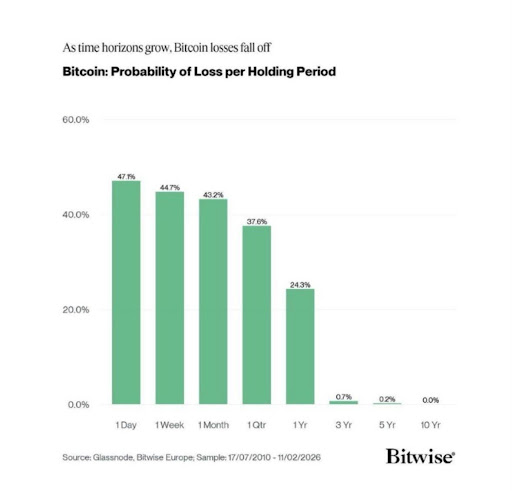
Looking at the chart’s numbers, a one-day holding period has a 47.1% chance of loss, while a one-week period shows a similar risk of 44.7%. Even at monthly intervals, the probability of loss stays elevated, reflecting the risks faced by active traders. Bitwise shows that holding BTC for just one month results in a marginal decline to 43.2%, underscoring the strong volatility across shorter timeframes.
However, as the holding period increases, the risk begins to decline noticeably. By the time an investor holds Bitcoin for several months or up to a year, the probability of loss drops, but remains significant. The chart shows that at the quarterly level, the probability of loss decreases to 37.6%. For over a year, the likelihood of loss drops further to 24.3%, highlighting a clear contrast when holding for just a day.
Bitcoin Loss Probability During Multi-Year Holds
Most success stories and outsized returns in the crypto market typically come from whales or investors who have held BTC for 5 to more than 10 years. The profit margins of these investors are significantly larger than those of short-term traders who move in and out of positions based on market conditions and short-term hype.
Bitwise research data confirms this trend, showing that meaningful reductions in loss probability only appear over multi-year holding periods. Investors who hold BTC for over three years see their probability of loss fall sharply to 0.7%, while holding for beyond five years reduces it further to 0.2%. Across the ten-year range covered by the data, there were no recorded instances of investors selling at a loss, indicating that all observed holding periods of that length resulted in gains.
The findings suggest that while Bitcoin remains highly unpredictable in the short term, its long-term performance has consistently and historically favored patient investors.

read the full story
Bitwise Research has shed light on how holding durations can impact the ROI and outcomes of Bitcoin (BTC) investments, revealing a major distinction between short-term risk and long-term performance. The data shows that while short holding periods carry significant chances of loss, extended investment timeframes dramatically reduce downside risks. The findings are drawing significant attention in the crypto community as investors reassess their strategy in the ongoing bear market.
Why Holding Bitcoin For Long Carries Less Risk
New research compiled by Bitwise and shared by crypto analyst Bitcoin Archive indicates that the probability of incurring losses on Bitcoin declines as the holding period increases, based on historical performance spanning more than a decade. The chart, sourced from Glassnode, shows that short-term exposure to BTC carries the highest level of uncertainty and the greatest likelihood of loss.
The numbers on the chart highlight just how unstable the Bitcoin price can be in the near term. If someone buys and sells within a day, their chances of losing money increase substantially. Even holding for a month does not improve things much, suggesting that short term price movements are largely unpredictable and driven by noise, speculation, and rapid sentiment shifts.
Looking at the chart’s numbers, a one-day holding period has a 47.1% chance of loss, while a one-week period shows a similar risk of 44.7%. Even at monthly intervals, the probability of loss stays elevated, reflecting the risks faced by active traders. Bitwise shows that holding BTC for just one month results in a marginal decline to 43.2%, underscoring the strong volatility across shorter timeframes.
However, as the holding period increases, the risk begins to decline noticeably. By the time an investor holds Bitcoin for several months or up to a year, the probability of loss drops, but remains significant. The chart shows that at the quarterly level, the probability of loss decreases to 37.6%. For over a year, the likelihood of loss drops further to 24.3%, highlighting a clear contrast when holding for just a day.
Bitcoin Loss Probability During Multi-Year Holds
Most success stories and outsized returns in the crypto market typically come from whales or investors who have held BTC for 5 to more than 10 years. The profit margins of these investors are significantly larger than those of short-term traders who move in and out of positions based on market conditions and short-term hype.
Bitwise research data confirms this trend, showing that meaningful reductions in loss probability only appear over multi-year holding periods. Investors who hold BTC for over three years see their probability of loss fall sharply to 0.7%, while holding for beyond five years reduces it further to 0.2%. Across the ten-year range covered by the data, there were no recorded instances of investors selling at a loss, indicating that all observed holding periods of that length resulted in gains.
The findings suggest that while Bitcoin remains highly unpredictable in the short term, its long-term performance has consistently and historically favored patient investors.

US Bitcoin ETFs are on their longest inflow streak this year as funds hit near 7% of BTC supply
Demand for US-listed spot Bitcoin ETFs has rebounded into its longest positive stretch of 2026,…

Central Bank of Brazil: Stablecoins Dominate Over $6.9 Billion Crypto Purchases Registered in Q1
According to data released by the Central Bank of Brazil, stablecoin purchases comprised $6.8…


Bitcoin price prediction – Here’s what’s limiting BTC’s breakout potential on the charts
Should you be betting on a decisive long-term trend shift?

Bitcoin nears $80K resistance – But a supply shock has started forming
With Bitcoin near production cost and supply shrinking, markets may shift from hype to fundamentals.
Bitcoin Price Reacts After Trump Evacuated Following White House Gunshots
Binance's CZ also weighed in on the matter, saying it was "sickening" to see another attempt on…

Shark Tank Kevin O’Leary Now Says Forget Alts, Hold Bitcoin, Ethereum
“Shark Tank” judge and business magnate Kevin O'Leary says he only recommends owning Bitcoin and…
Bitcoiners cast doubt on the US military's understanding of the network
Bitcoin advocate Matthew Kratter said US Navy Admiral Samuel Paparo's Senate testimony on Tuesday…

Olenox Announces Merge With CS Digital to Develop Low Cost, Off-Grid Bitcoin Mining Opportunities
The two companies would agree to merge, with CS Digital receiving $55 million in an all-share…
Tether Conducts Biggest USDT Freeze Ever, Grayscale Makes Case for Bitcoin Bottom, And More – Week In Review
Europe’s MiCA rules helped euro stablecoins surge even as broader crypto adoption cooled, while a…
Bitcoin Price Wave Down To $40,000 Shows When The Bottom Will Begin
According to a crypto analyst, the Bitcoin price remains firmly in a bear trend and could be…
Ripple Says Multi-Asset Stablecoin Rails Are Becoming Critical for Global Payments
Stablecoin payments are moving rapidly into multi-asset infrastructure as volumes climb across…
Bitcoin Setup Suggests Liquidity Hunt Before Next Directional Move
Bitcoin is currently showing a structure that often precedes sharp volatility, with liquidity…
Why Bitcoin Trades Like Risk Asset Despite Safe Haven Properties, Willy Woo Explains
Bitcoin’s safe-haven properties remain under market pressure as Willy Woo says major capital pools…
Morgan Stanley Adds Stablecoin Fund After Bitcoin ETF Launch
Morgan Stanley Investment Management launched a stablecoin reserve fund to meet rising institutional…
Michael Saylor Says Bitcoin's Bear Market Is OVER — They Can't Stop It!
Michael Saylor is buying at a pace that could trigger a historic Bitcoin supply shock. At the same…

Historical Data Shows Bitcoin Price Has Never Breached This Level – Will It Start Now?
Bitcoin’s price action has been climbing steadily off its February low around $61,300, but…

Why Bitcoin Still Acts Like A Risk Asset Despite Safe-Haven Claims
Bitcoin was built with many of the qualities typically associated with a safe-haven asset: it is…
Metaplanet Raises $50M via Zero-Interest Bonds to Expand its 40,177 BTC Treasury
Tokyo-listed Metaplanet Inc. issued its 20th series of zero-interest bonds on April 24, 2026,…
The Domain Satoshi May Have Dropped: E-cash.org Predates Bitcoin.org by 29 days
A domain registered on July 20, 2008 — e-cash.org — is drawing renewed attention from Bitcoin…