Bitwise Research Shows How Much Loss Your Bitcoin Incurs Depending On How Long You HoldBitwise Research has shed light on how holding durations can impact the ROI and outcomes of Bitcoin (BTC) investments, revealing a major distinction between short-term risk and long-term performance. The data shows that while short holding periods carry significant chances of loss, extended investment timeframes dramatically reduce downside risks. The findings are drawing significant attention in the crypto community as investors reassess their strategy in the ongoing bear market.
Why Holding Bitcoin For Long Carries Less Risk
New research compiled by Bitwise and shared by crypto analyst Bitcoin Archive indicates that the probability of incurring losses on Bitcoin declines as the holding period increases, based on historical performance spanning more than a decade. The chart, sourced from Glassnode, shows that short-term exposure to BTC carries the highest level of uncertainty and the greatest likelihood of loss.
The numbers on the chart highlight just how unstable the Bitcoin price can be in the near term. If someone buys and sells within a day, their chances of losing money increase substantially. Even holding for a month does not improve things much, suggesting that short term price movements are largely unpredictable and driven by noise, speculation, and rapid sentiment shifts.
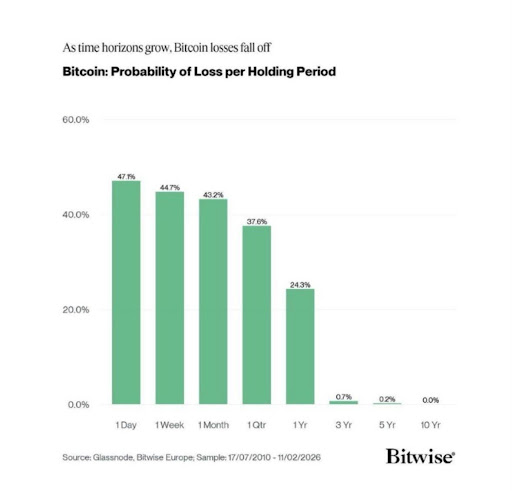
Looking at the chart’s numbers, a one-day holding period has a 47.1% chance of loss, while a one-week period shows a similar risk of 44.7%. Even at monthly intervals, the probability of loss stays elevated, reflecting the risks faced by active traders. Bitwise shows that holding BTC for just one month results in a marginal decline to 43.2%, underscoring the strong volatility across shorter timeframes.
However, as the holding period increases, the risk begins to decline noticeably. By the time an investor holds Bitcoin for several months or up to a year, the probability of loss drops, but remains significant. The chart shows that at the quarterly level, the probability of loss decreases to 37.6%. For over a year, the likelihood of loss drops further to 24.3%, highlighting a clear contrast when holding for just a day.
Bitcoin Loss Probability During Multi-Year Holds
Most success stories and outsized returns in the crypto market typically come from whales or investors who have held BTC for 5 to more than 10 years. The profit margins of these investors are significantly larger than those of short-term traders who move in and out of positions based on market conditions and short-term hype.
Bitwise research data confirms this trend, showing that meaningful reductions in loss probability only appear over multi-year holding periods. Investors who hold BTC for over three years see their probability of loss fall sharply to 0.7%, while holding for beyond five years reduces it further to 0.2%. Across the ten-year range covered by the data, there were no recorded instances of investors selling at a loss, indicating that all observed holding periods of that length resulted in gains.
The findings suggest that while Bitcoin remains highly unpredictable in the short term, its long-term performance has consistently and historically favored patient investors.

read the full story
Bitwise Research has shed light on how holding durations can impact the ROI and outcomes of Bitcoin (BTC) investments, revealing a major distinction between short-term risk and long-term performance. The data shows that while short holding periods carry significant chances of loss, extended investment timeframes dramatically reduce downside risks. The findings are drawing significant attention in the crypto community as investors reassess their strategy in the ongoing bear market.
Why Holding Bitcoin For Long Carries Less Risk
New research compiled by Bitwise and shared by crypto analyst Bitcoin Archive indicates that the probability of incurring losses on Bitcoin declines as the holding period increases, based on historical performance spanning more than a decade. The chart, sourced from Glassnode, shows that short-term exposure to BTC carries the highest level of uncertainty and the greatest likelihood of loss.
The numbers on the chart highlight just how unstable the Bitcoin price can be in the near term. If someone buys and sells within a day, their chances of losing money increase substantially. Even holding for a month does not improve things much, suggesting that short term price movements are largely unpredictable and driven by noise, speculation, and rapid sentiment shifts.
Looking at the chart’s numbers, a one-day holding period has a 47.1% chance of loss, while a one-week period shows a similar risk of 44.7%. Even at monthly intervals, the probability of loss stays elevated, reflecting the risks faced by active traders. Bitwise shows that holding BTC for just one month results in a marginal decline to 43.2%, underscoring the strong volatility across shorter timeframes.
However, as the holding period increases, the risk begins to decline noticeably. By the time an investor holds Bitcoin for several months or up to a year, the probability of loss drops, but remains significant. The chart shows that at the quarterly level, the probability of loss decreases to 37.6%. For over a year, the likelihood of loss drops further to 24.3%, highlighting a clear contrast when holding for just a day.
Bitcoin Loss Probability During Multi-Year Holds
Most success stories and outsized returns in the crypto market typically come from whales or investors who have held BTC for 5 to more than 10 years. The profit margins of these investors are significantly larger than those of short-term traders who move in and out of positions based on market conditions and short-term hype.
Bitwise research data confirms this trend, showing that meaningful reductions in loss probability only appear over multi-year holding periods. Investors who hold BTC for over three years see their probability of loss fall sharply to 0.7%, while holding for beyond five years reduces it further to 0.2%. Across the ten-year range covered by the data, there were no recorded instances of investors selling at a loss, indicating that all observed holding periods of that length resulted in gains.
The findings suggest that while Bitcoin remains highly unpredictable in the short term, its long-term performance has consistently and historically favored patient investors.

Bitcoin Derivatives Buying Pressure Continues To Rise — Is $80K Inevitable?
The price of Bitcoin has been enjoying significant bullish momentum over the past few weeks, with…

US Banks Have Only 4 Days Left to Shape GENIUS Act Stablecoin Rules at OCC
The OCC closes its GENIUS Act stablecoin comment window May 1, ending 18 months of regulatory…

Understanding Bitcoin’s April rally and the market imbalance at the heart of it
Bitcoin’s rally revealed a split market across the board.

ETH Builds Wall Street Base While BTC Captures Bulk of ETF Money
Bitcoin’s pulling in the big dollars. Institutional money keeps flooding into Bitcoin ETFs,…

Bitcoin leads ETF flows, but Ethereum builds institutional base for Q2 showdown
Is Ethereum quietly entering its Wall Street phase despite Bitcoin's capital lead?
The Most Eventful Week of 2026? How Bitcoin Will React to These Key Events
Here are the most important economic events that will take place in the next week, include a few…

Bitcoin Leverage Builds as Price Stalls Below $80,000
Bitcoin (BTC) traders are stacking the long side of futures by more than three to one, according to…
Paul Sztorc Plans eCash Fork to Redistribute Satoshi’s BTC to New Investors
Paul Sztorc just dropped a bomb. The drivechain developer behind BIP-300 wants to hard fork Bitcoin…
Bitcoin’s price to $80K – Here’s why that will happen sooner, rather than later!
It's an interesting time for Bitcoin traders everywhere right now.
Michael Saylor teases Bitcoin buy, but bulls may get less
Michael Saylor hinted at another Strategy Bitcoin buy, but slower MSTR funding suggests the next BTC…

Miners Beat Bitcoin by 70% in 2026 as Terawulf Locks $12.8B in AI Contracts
The bitcoin mining and digital infrastructure sector has had a split personality through the first…

Hong Kong targets 10,000 BTC in purchases for Asia’s first regulated Bitcoin capital pool
A Hong Kong-listed company wants to attract more than 10,000 BTC into a regulated asset management…

'Beat Goes On': Michael Saylor Hints at Buying More Bitcoin, but Don't Expect Billions This Time
Michael Saylor's upcoming BTC buy announcement may upset bulls as the MSTR funding engine stalls…

Bitcoin whales build long positions as funding stays deeply negative
Long bias from the largest perpetual traders on Hyperliquid has built steadily through February,…

Freezing 5.6 million dormant bitcoin could trigger ‘worst’ single-day repricing
Maximalists warn freezing 5.6M BTC risks instant sell-offs, while others say quantum threats leave…
Five Big Tech Earnings Could Decide Bitcoin’s Next Move This Week
Five of the largest US technology companies report quarterly results this week, and the outcomes…
The Beat Goes On: Saylor’s New Bitcoin Chart Sharpens Accumulation Watch After Major BTC Buy
Strategy’s bitcoin positioning drew renewed attention as Michael Saylor revived his orange-dot…
Satoshi's Final Bitcoin Advice Turns 15 Years; Attack on Litecoin: Was It an Inside Job? Top Devs Weigh In; Dogecoin Targets $0.1 Resistance with 30% Upside Expected - Morning Crypto Report
Satoshi's final advice turns 15 as BTC hits $78,000; Was the Litecoin hack an inside job? Plus,…
Analyst Who Called Bitcoin’s Top Correctly Now Predicting The Bottom
Bitcoin has spent April staging a recovery from its March lows, briefly climbing back above $79,000.…
Bitcoin’s Next Move: New ATH or Dump to $55K? Analysts Clash but Bulls Dominate
The $55,000 bottom has appeared in a few analysts' recent analysis on BTC's future price moves.