China issues $44B cash injection giving Bitcoin bulls a new signal as fear grips marketChina's central bank gave Bitcoin traders a new liquidity gauge on June 29 by opening an overnight reverse repo channel worth 300 billion yuan, or roughly $44.1 billion.
The signal lands as BTC tries to steady itself near $60,000. One operation shows the tool is live; repeated use would tell traders whether the PBOC is building a recurring liquidity valve that can change the risk-asset backdrop.
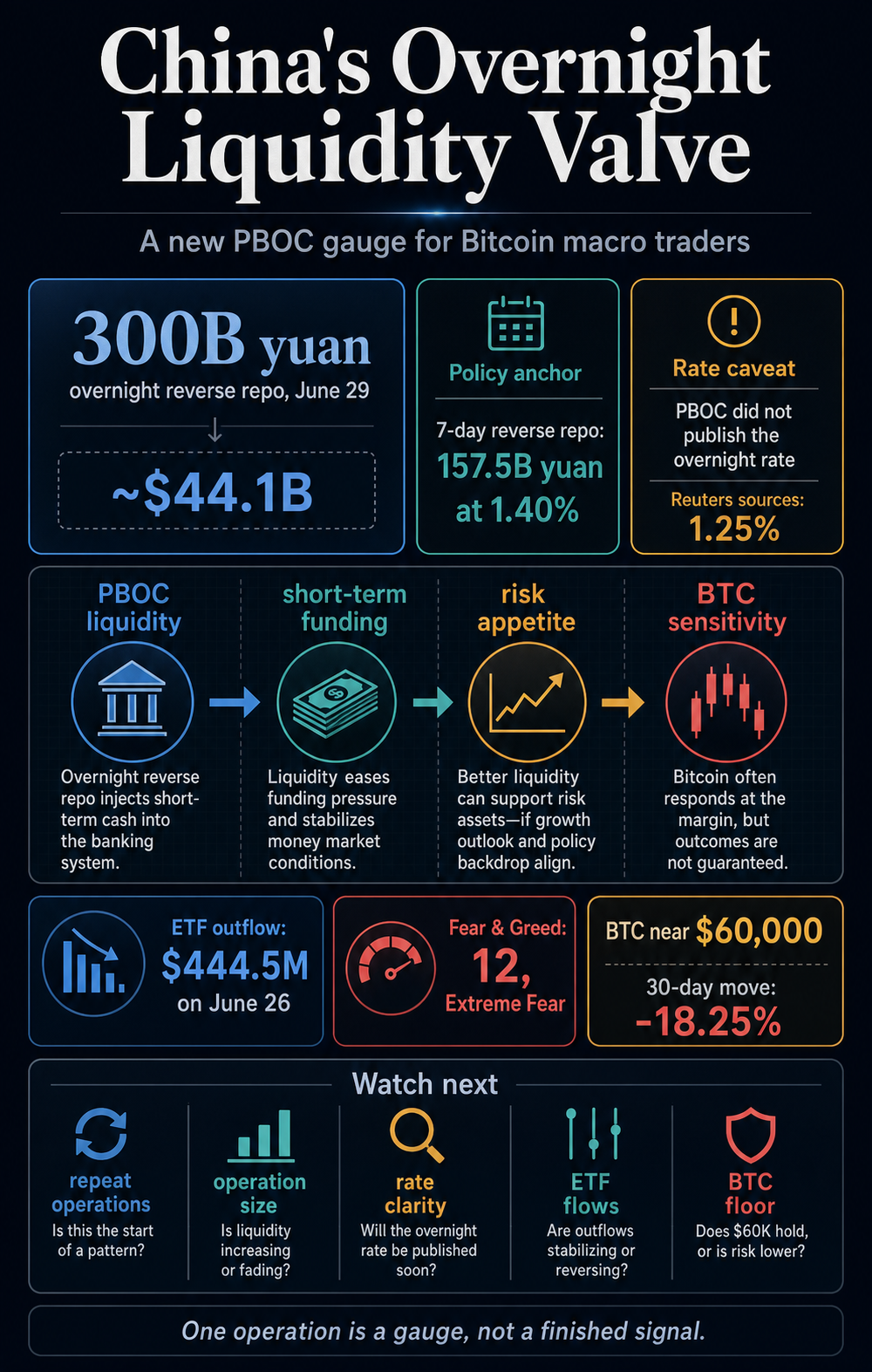
The People's Bank of China said it conducted 300 billion yuan of overnight reverse repos on June 29, alongside 157.5 billion yuan of seven-day reverse repos at a 1.40% rate. At the current conversion, the overnight operation was worth roughly $44.1 billion.
That is relevant for Bitcoin because the operation turns a policy framework change into a daily money-market gauge. If the PBOC continues to use overnight reverse repos, traders get a more immediate view of how aggressively China is smoothing short-term funding stress.
If the operation proves to be a one-off month-end adjustment, the market will have less reason to treat it as a durable tailwind.
China's new overnight tool is useful for macro traders, while a single liquidity operation has not flipped Bitcoin's risk backdrop. BTC was trading at $60,042 on CryptoSlate on June 29 after falling 18.25% over 30 days, while ETF demand and sentiment remained weak enough to keep traders defensive.
The new valve in China's money markets
The PBOC pre-announced that it would add overnight reverse repo operations on June 29 and June 30 to better meet short-term liquidity needs in the banking system, using fixed-rate, quantity-bidding operations.
The macro value reflects the PBOC's use of a daily liquidity valve and the injection size. In central-bank terms, an overnight operation can add cash quickly, show where funding pressure is building, and reveal how much liquidity the central bank is willing to supply at the front end of the money market.
The PBOC's official June 29 notice confirmed the amounts but did not disclose an overnight rate. Reuters-syndicated coverage reported that sources put the inaugural overnight reverse repo rate at 1.25%. Business Times coverage noted that analysts viewed the withholding of the official rate as a way to avoid diluting the seven-day reverse repo's role as the main policy signal.
That fits the broader framework described by PBOC Governor Pan Gongsheng. In remarks carried by the Bank for International Settlements, Pan described the seven-day reverse repo rate as the key policy rate, with an interest-rate corridor around it and overnight repo or reverse repo operations added when needed.
For traders, the variables are now concrete: whether China adds liquidity, how often it repeats the operation, at what size, and whether market funding conditions respond.
PBOC variable
What changed
Why BTC traders may follow it
Caveat
Overnight reverse repo size
300 billion yuan on June 29
Shows the scale of immediate cash added to short-term funding markets
One operation does not prove a lasting easing cycle
Operation frequency
June 29 and June 30 were pre-announced dates
Repeated use would make the tool a cleaner daily liquidity gauge
Month-end funding needs may explain part of the move
Rate signal
PBOC did not publish the overnight rate; Reuters sources reported 1.25%
The rate could show how the new tool sits against the seven-day policy rate
Without official disclosure, traders rely on inference and source reporting
Seven-day reverse repo
157.5 billion yuan at 1.40%
Remains the main policy-rate anchor for China's money market
The overnight tool should be read alongside the policy-rate framework
Why Bitcoin traders care now
Bitcoin has a long history of reacting to global liquidity conditions, but the connection is rarely mechanical. Liquidity can help risk assets when it eases funding stress, improves leverage conditions, or shifts investor appetite back toward higher-beta trades.
It can also fail to move BTC if local credit demand is weak, the dollar tightens, ETF flows continue to bleed, or traders decide the move is too small to change positioning.
That is why the China gauge belongs beside other market inputs rather than above them. The first operation gives traders a concrete number.
The next few operations will show whether the PBOC is merely smoothing short-term funding or building a repeatable liquidity valve around the front end of the curve.
Bitcoin's own setup makes that distinction more important. CryptoSlate's market page showed BTC dominance at 58.1% on June 29, while the Bitcoin page showed a steep 30-day decline and price clustered near the psychological $60,000 level.
A market in that condition is more sensitive to marginal liquidity because traders are already debating whether selling pressure has been exhausted or is still feeding on weak demand.
ETF flows add to that fragility while staying secondary to the China-liquidity question. Farside Investors showed a $444.5 million net outflow from US spot Bitcoin ETFs on June 26.
Alternative.me's Crypto Fear and Greed Index showed a live reading of 12, or Extreme Fear, when captured on June 29. CryptoSlate's crypto sentiment analysis sits at a slightly negative 38/100.
Those numbers explain why traders are looking for a macro offset. They leave open whether China can supply it.
The practical question is whether PBOC's new overnight activity appears alongside improving ETF flows, calmer sentiment, or a firmer Bitcoin floor.
A durable signal would require repetition. A single 300-billion-yuan operation signals to traders that the tool is live. Repeated injections near that scale, or larger operations during periods of funding stress, would make it harder to dismiss as a calendar-driven liquidity adjustment.
If the PBOC continues to withhold the official overnight rate, markets will infer the level from Reuters-source reporting, money-market pricing, and the relationship with the seven-day reverse repo.
If the rate becomes clearer, traders can judge whether the overnight valve is simply operational plumbing or a more active effort to guide short-term funding costs.
Transmission remains the hard filter. China can add liquidity without Bitcoin immediately rallying if the cash stays inside domestic funding markets or if broader risk appetite remains poor.
The operation is better understood as a liquidity gauge than a direct Bitcoin catalyst. China's new overnight tool may affect BTC if repeated use coincides with easing funding stress and a recovery in risk demand.
CryptoSlate's recent coverage adds context. Prior analysis has separately connected PBOC liquidity, debt-versus-liquidity gaps, ETF pressure, and Bitcoin's sensitivity to macro conditions.
China's central bank has now given traders a shorter-duration gauge to compare with Bitcoin's price action.
The risk for Bitcoin bulls is mistaking a new gauge for a finished signal. The PBOC's June 29 operation creates a new reference point for global liquidity.
It leaves ETF outflows, weak sentiment, and Bitcoin's sharp 30-day drop still in the foreground.
The market now has a clearer sequence to follow. Future PBOC overnight reverse repos will show whether the operation extends beyond June 30.
Operation sizes near or above 300 billion yuan would carry more weight than a quick retreat. A clearer overnight rate relative to the seven-day policy rate would help traders separate routine plumbing from stronger funding support.
If those pieces begin moving together, China's overnight reverse repo could become a useful macro tell for Bitcoin traders. If they diverge, the first operation will look less like a bullish catalyst and more like another reminder that liquidity affects BTC only when it actually reaches risk appetite.
The post appeared first on CryptoSlate.
read the full story
China's central bank gave Bitcoin traders a new liquidity gauge on June 29 by opening an overnight reverse repo channel worth 300 billion yuan, or roughly $44.1 billion.
The signal lands as BTC tries to steady itself near $60,000. One operation shows the tool is live; repeated use would tell traders whether the PBOC is building a recurring liquidity valve that can change the risk-asset backdrop.
The People's Bank of China said it conducted 300 billion yuan of overnight reverse repos on June 29, alongside 157.5 billion yuan of seven-day reverse repos at a 1.40% rate. At the current conversion, the overnight operation was worth roughly $44.1 billion.
That is relevant for Bitcoin because the operation turns a policy framework change into a daily money-market gauge. If the PBOC continues to use overnight reverse repos, traders get a more immediate view of how aggressively China is smoothing short-term funding stress.
If the operation proves to be a one-off month-end adjustment, the market will have less reason to treat it as a durable tailwind.
China's new overnight tool is useful for macro traders, while a single liquidity operation has not flipped Bitcoin's risk backdrop. BTC was trading at $60,042 on CryptoSlate on June 29 after falling 18.25% over 30 days, while ETF demand and sentiment remained weak enough to keep traders defensive.
The new valve in China's money markets
The PBOC pre-announced that it would add overnight reverse repo operations on June 29 and June 30 to better meet short-term liquidity needs in the banking system, using fixed-rate, quantity-bidding operations.
The macro value reflects the PBOC's use of a daily liquidity valve and the injection size. In central-bank terms, an overnight operation can add cash quickly, show where funding pressure is building, and reveal how much liquidity the central bank is willing to supply at the front end of the money market.
The PBOC's official June 29 notice confirmed the amounts but did not disclose an overnight rate. Reuters-syndicated coverage reported that sources put the inaugural overnight reverse repo rate at 1.25%. Business Times coverage noted that analysts viewed the withholding of the official rate as a way to avoid diluting the seven-day reverse repo's role as the main policy signal.
That fits the broader framework described by PBOC Governor Pan Gongsheng. In remarks carried by the Bank for International Settlements, Pan described the seven-day reverse repo rate as the key policy rate, with an interest-rate corridor around it and overnight repo or reverse repo operations added when needed.
For traders, the variables are now concrete: whether China adds liquidity, how often it repeats the operation, at what size, and whether market funding conditions respond.
| PBOC variable | What changed | Why BTC traders may follow it | Caveat |
|---|---|---|---|
| Overnight reverse repo size | 300 billion yuan on June 29 | Shows the scale of immediate cash added to short-term funding markets | One operation does not prove a lasting easing cycle |
| Operation frequency | June 29 and June 30 were pre-announced dates | Repeated use would make the tool a cleaner daily liquidity gauge | Month-end funding needs may explain part of the move |
| Rate signal | PBOC did not publish the overnight rate; Reuters sources reported 1.25% | The rate could show how the new tool sits against the seven-day policy rate | Without official disclosure, traders rely on inference and source reporting |
| Seven-day reverse repo | 157.5 billion yuan at 1.40% | Remains the main policy-rate anchor for China's money market | The overnight tool should be read alongside the policy-rate framework |
Why Bitcoin traders care now
Bitcoin has a long history of reacting to global liquidity conditions, but the connection is rarely mechanical. Liquidity can help risk assets when it eases funding stress, improves leverage conditions, or shifts investor appetite back toward higher-beta trades.
It can also fail to move BTC if local credit demand is weak, the dollar tightens, ETF flows continue to bleed, or traders decide the move is too small to change positioning.
That is why the China gauge belongs beside other market inputs rather than above them. The first operation gives traders a concrete number.

The next few operations will show whether the PBOC is merely smoothing short-term funding or building a repeatable liquidity valve around the front end of the curve.
Bitcoin's own setup makes that distinction more important. CryptoSlate's market page showed BTC dominance at 58.1% on June 29, while the Bitcoin page showed a steep 30-day decline and price clustered near the psychological $60,000 level.

A market in that condition is more sensitive to marginal liquidity because traders are already debating whether selling pressure has been exhausted or is still feeding on weak demand.
ETF flows add to that fragility while staying secondary to the China-liquidity question. Farside Investors showed a $444.5 million net outflow from US spot Bitcoin ETFs on June 26.
Alternative.me's Crypto Fear and Greed Index showed a live reading of 12, or Extreme Fear, when captured on June 29. CryptoSlate's crypto sentiment analysis sits at a slightly negative 38/100.
Those numbers explain why traders are looking for a macro offset. They leave open whether China can supply it.
The practical question is whether PBOC's new overnight activity appears alongside improving ETF flows, calmer sentiment, or a firmer Bitcoin floor.
A durable signal would require repetition. A single 300-billion-yuan operation signals to traders that the tool is live. Repeated injections near that scale, or larger operations during periods of funding stress, would make it harder to dismiss as a calendar-driven liquidity adjustment.
If the PBOC continues to withhold the official overnight rate, markets will infer the level from Reuters-source reporting, money-market pricing, and the relationship with the seven-day reverse repo.
If the rate becomes clearer, traders can judge whether the overnight valve is simply operational plumbing or a more active effort to guide short-term funding costs.
Transmission remains the hard filter. China can add liquidity without Bitcoin immediately rallying if the cash stays inside domestic funding markets or if broader risk appetite remains poor.
The operation is better understood as a liquidity gauge than a direct Bitcoin catalyst. China's new overnight tool may affect BTC if repeated use coincides with easing funding stress and a recovery in risk demand.
CryptoSlate's recent coverage adds context. Prior analysis has separately connected PBOC liquidity, debt-versus-liquidity gaps, ETF pressure, and Bitcoin's sensitivity to macro conditions.
China's central bank has now given traders a shorter-duration gauge to compare with Bitcoin's price action.
The risk for Bitcoin bulls is mistaking a new gauge for a finished signal. The PBOC's June 29 operation creates a new reference point for global liquidity.
It leaves ETF outflows, weak sentiment, and Bitcoin's sharp 30-day drop still in the foreground.
The market now has a clearer sequence to follow. Future PBOC overnight reverse repos will show whether the operation extends beyond June 30.
Operation sizes near or above 300 billion yuan would carry more weight than a quick retreat. A clearer overnight rate relative to the seven-day policy rate would help traders separate routine plumbing from stronger funding support.
If those pieces begin moving together, China's overnight reverse repo could become a useful macro tell for Bitcoin traders. If they diverge, the first operation will look less like a bullish catalyst and more like another reminder that liquidity affects BTC only when it actually reaches risk appetite.
The post appeared first on CryptoSlate.
read the full story
Why a collapse in $1 trillion AI spending boom could hit Bitcoin traders first
Over the past year, the artificial intelligence trade has become one of the main pillars supporting…
Circle’s USDC Becomes First Stablecoin Supported by BNY Mellon for Institutional Clients
America's oldest bank will allow institutional clients to store, mint, redeem, and transfer USDC.


Strategy Authorizes up to $1.25B of Bitcoin Sales as Saylor Formalizes Capital Pivot
The largest corporate Bitcoin holder will lift its STRC preferred dividend to 12% and can now sell…

Tom Lee's BitMine Adds $43 Million in Ethereum as Strategy Halts Bitcoin Buys
BitMine Immersion Technologies continued adding to its Ethereum stockpile, even as its Bitcoin…

The 52% Coincidence: Bitcoin and Silver Are Bleeding in Near-Perfect Sync
Bitcoin and silver both trade about 52% below record highs, with matching chart structures and…

Bitcoin Price Analysis: Is $54K Inevitable for BTC if $60K Support Is Decisively Lost?
After yielding to heavy selling pressure and losing several key support levels over the past few…
Bitcoin and Silver Both Sit 52% Below Peak With $39,000 Drop Risk Looming
Bitcoin and silver are falling in lockstep. Both assets are trading roughly 52% below their…

Wall Street's BNY expands stablecoin services for institutions, starting with Circle's USDC
The world's largest custody bank is adding USDC custody and minting services as stablecoins move…

Bitcoin treasury investors are turning on companies diluting them to keep buying
On June 22, Strategy sold $335.5 million of its own common stock, set aside roughly $300 million of…
Bitcoin Holds Below $60K With Markets Bracing for a Pivotal Week
TL;DR: Bitcoin trades at $59,800, down more than 50% from its all-time high set in October. The…

Death Spiral? Schiff Says Falling BTC Will Force Strategy to Sell More
Financial commentator and long-time crypto skeptic Peter Schiff has sounded the alarm on Strategy's…

Strategy opens door to selling billions of bitcoin under new capital plan. Here's what it means
The company can now sell bitcoin to fund the USD reserve, support preferred dividends, and finance…
Bitcoin Nears $60,000 as Traders Hold Their Breath
Bitcoin is priced at $59,800 this Monday, marking a 0.6% increase over 24 hours. It’s not…
From Bitcoin critics to blockchain believers: The 5 biggest crypto backflips
If you can't beat 'em, join 'em. Here are five crypto skeptics who have reluctantly embraced the…

XRP Records 115% ETF Shift Ahead of Historically Positive Q3; 2024 Shiba Inu (SHIB) Billionaire Appears On-Chain; Saylor Legalizes Bitcoin Sales With 12% Dividend Boost - Morning Crypto Report
XRP ETF inflows surge 115% ahead of historically strongest quarter, a dormant SHIB whale moves $2.7M…
Strategy unveils capital framework to preserve Bitcoin exposure, pay dividends
Michael Saylor’s Strategy unveiled a capital framework allowing Bitcoin sales to fund dividends, a…
Breez launches Bitcoin-to-stablecoin payments across more than 30 blockchains
The new SDK feature lets developers route payments from Bitcoin balances to recipients in USDC and…
Strategy Could Sell Up to $1.25B of Bitcoin Under 'Digital Credit Capital Framework'
The Bitcoin treasury firm has approved a framework for "active capital management," its Chair…