Morgan Stanley launched its spot Bitcoin ETF on Apr. 8 on NYSE Arca, calling MSBT the first cryptocurrency ETP from a US bank-affiliated asset manager and pricing its sponsor fee at 0.14%, the lowest Bitcoin ETP sponsor fee.
By Apr. 16, Farside Investors' data showed cumulative net inflows of $116 million across seven trading sessions.
Against Morgan Stanley Investment Management's $1.9 trillion in assets under management as of Dec. 31, 2025, that figure represents roughly 0.006% of the platform. At the 0.14% fee rate, it would generate only about $162,400 in annual gross revenue if assets were held at that level.
What makes the MSBT launch harder to ignore is the competitive arithmetic.
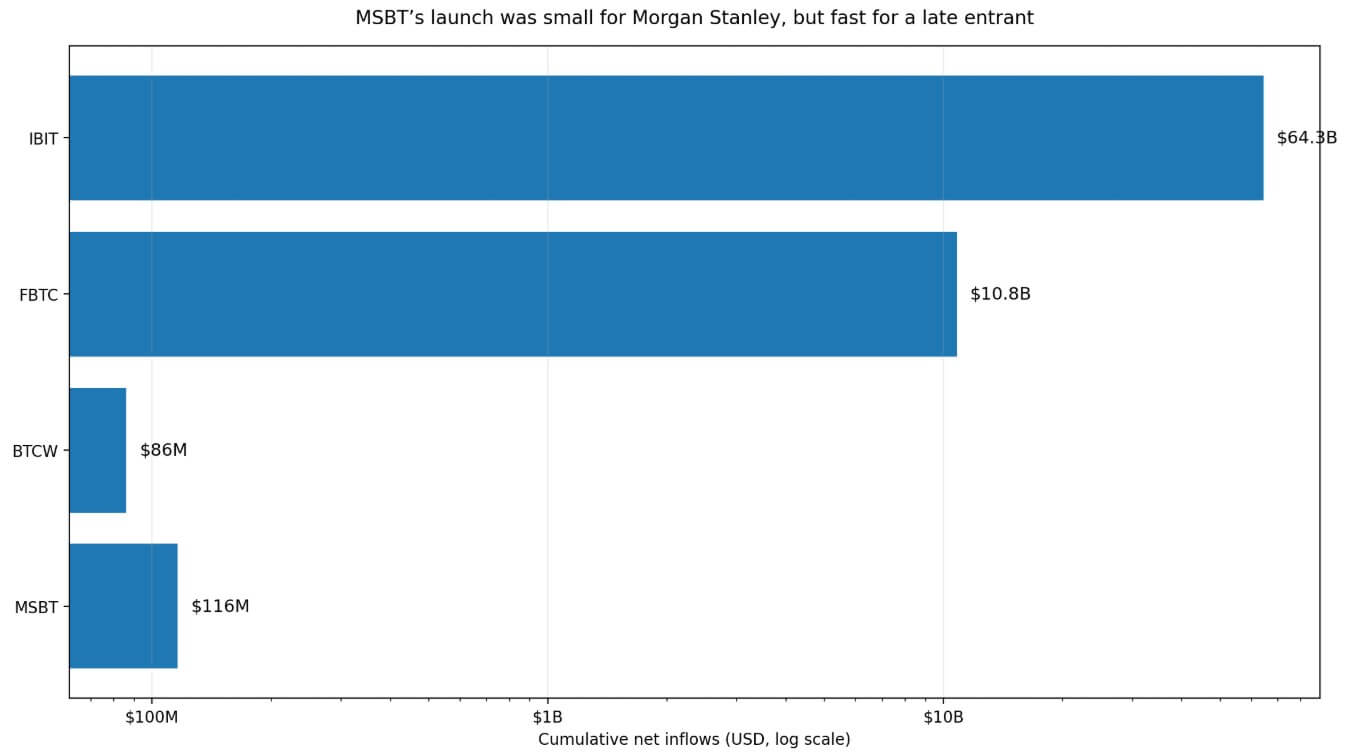
For a late entrant launching into a choppy Bitcoin market, clearing an existing competitor's total in less than two weeks establishes that brand, price, and distribution can still generate demand in a field already dominated by BlackRock's IBIT at $64.3 billion and Fidelity's FBTC at $10.8 billion.
A logarithmic bar chart shows MSBT's $116 million in cumulative net inflows surpassing BTCW's $86 million, while trailing FBTC at $10.8 billion and IBIT at $64.3 billion.
Morgan Stanley has converted “crypto access” into “crypto manufacturing.”
The filing was the first such move by a major US bank, and Morningstar's Bryan Armor told Reuters that a bank's entry into the crypto ETF market adds legitimacy and that others could follow.
Goldman Sachs filed for its first Bitcoin ETF product on Apr. 14, six days after MSBT launched. The timing reinforces the sense that the reputational barrier to bank-branded Bitcoin products is contracting fast.
Morgan Stanley's own launch statement frames MSBT as part of a firmwide digital asset push spanning custody, trading, and product development. The fund is both a product decision and a positioning decision.
The 0.14% fee sets a price anchor that tells the market Morgan Stanley intends to compete on cost and trust, and reveals how it expects the category to evolve.
The battlefield is wide
Bank of America announced that advisers across its Private Bank, Merrill, and Merrill Edge platforms will be able to recommend crypto allocations starting Jan. 5, with no asset threshold.
Charles Schwab said on Apr. 16 that it would begin a phased rollout of direct spot Bitcoin and Ethereum trading for retail clients in the coming weeks. Together, those moves show that the fight for Bitcoin's next wave of capital runs through advice, brokerage access, and custody-integrated client experience.
Firm
Move
Date
What it controls
Why it matters
Morgan Stanley
Launched MSBT
Apr. 8
ETF wrapper
Proves a bank-branded product can gather assets
Goldman Sachs
Filed for first Bitcoin ETF product
Apr. 14
ETF pipeline
Signals peer response / shrinking stigma
Bank of America
Advisers can recommend crypto allocations
Jan. 5
Advice / distribution
Opens crypto to mainstream wealth channels
Charles Schwab
Rolling out direct BTC and ETH trading
Apr. 16
Trading interface
Captures client flow without needing its own ETF
MSBT demonstrates that a bank can wrap Bitcoin in a familiar product and attract money, while Bank of America and Schwab demonstrate that a bank can also capture the same client relationship simply by controlling the recommendation or the trading interface.
Firms that do neither now face a specific competitive pressure, as rivals are accumulating either the wrapper or the client touchpoint, and in some cases both.
Citi expects US ETF assets to more than double from roughly $10.4 trillion to $25 trillion by 2030, with active ETFs gaining share. Bitcoin products are competing inside an ETF industry already organized around fee compression, distribution control, and model-portfolio inclusion.
Late entrants in that environment tend to win through price and platform relationships, which is exactly the bet Morgan Stanley's 0.14% fee implies.
The permission signal becomes a wave
If MSBT's opening pace held, Farside arithmetic would place it near $498 million after 30 trading sessions and over $1 billion after 63 trading sessions.
The straight-line projection extrapolates the current pace into a scenario, and the direction it points toward carries real strategic weight.
Goldman's filing could convert into a launched product by late June, while other firms watching two major banks move within days of each other face a weaker internal case for inaction.
The Morningstar framing that bank entry adds legitimacy, and others could follow, acquiring more force each time a new institution moves.
For Bitcoin, that path produces an outcome measured in more bank-branded wrappers, meaning more conventional allocation pathways via adviser model portfolios, standard brokerage workflows, and custody-integrated access for clients who have never opened a crypto exchange account.
That makes demand stickier, slower-moving, and less dependent on retail sentiment cycles.
Citi's 12-month base target of $112,000 and bull case of $165,000 represent the outer range of what broader institutional normalization could support if the current sequence of launches and distribution expansions continues to build.
Fed Governor Christopher Waller said a swift resolution to the Middle East conflict could keep hopes of a rate cut alive later in the year. Goldman Sachs, Morgan Stanley, and Bank of America all expect two cuts starting in September.
Easier financial conditions would support risk assets across the board, and Bitcoin would draw an additional tailwind from any meaningful shift in the rate path.
A crowded category
The less constructive reading of the same data holds that MSBT's early inflows confirm viability for a bank-branded launch while leaving the category leaders' distribution moat intact.
IBIT's $64.3 billion and FBTC's $10.8 billion represent advantages in scale, liquidity, and adviser familiarity that took years and a favorable regulatory moment to accumulate.
If flows flatten after the launch window, a pattern common across new ETF entrants, rivals may conclude that the distribution moat around IBIT and FBTC is wider than Morgan Stanley's launch suggested.
Scenario
MSBT flow path
What it says about Wall Street
What it means for Bitcoin
Launch pace holds
~$498M after 30 sessions; >$1B after 63
Bank-branded Bitcoin wrappers are commercially viable
More normalized institutional access
Flows slow but stay healthy
~$250M–$500M
Viable niche product, but not a category disruptor
Positive for access, limited direct price impact
Flows fade sharply
Below ~$250M
Distribution moat of IBIT/FBTC remains dominant
Symbolic validation, but narrow support
In that scenario, the industry response shifts from “launch our own ETF” toward “expand access through advice and direct trading,” which Bank of America and Schwab are already doing.
For Bitcoin, that outcome delivers symbolic validation. Glassnode's Accumulation Trend Score sits at 0, its language around the recovery has been cautious, and Bitcoin stays roughly 40% below its all-time high of $126,223.
In that environment, a market held together by selective flows and a narrow coalition of buyers stays vulnerable to macro reversals and sentiment shifts.
Citi's recessionary downside case of $58,000 represents the bearish 12-month outer envelope if tighter financial conditions persist and the institutional bid loses depth.
MSBT's weekly inflows staying above $50 million or compressing toward single-digit figures as the launch premium fades, Goldman's filing converting into an actual listed product, other firms responding through manufacturing or through advice and brokerage access instead, and deeper fee competition, will clarify which path is forming.
A second or third bank entrant undercutting 0.14% would point out that the category has entered a distribution war, which tends to expand access while compressing margins for all participants.
A major bank has now established, with a live product and a real asset base, that bank-branded Bitcoin exposure is commercially viable. Goldman filed days later.
Every firm watching that sequence is now calculating that the cost of moving looks lower than it did a month ago.