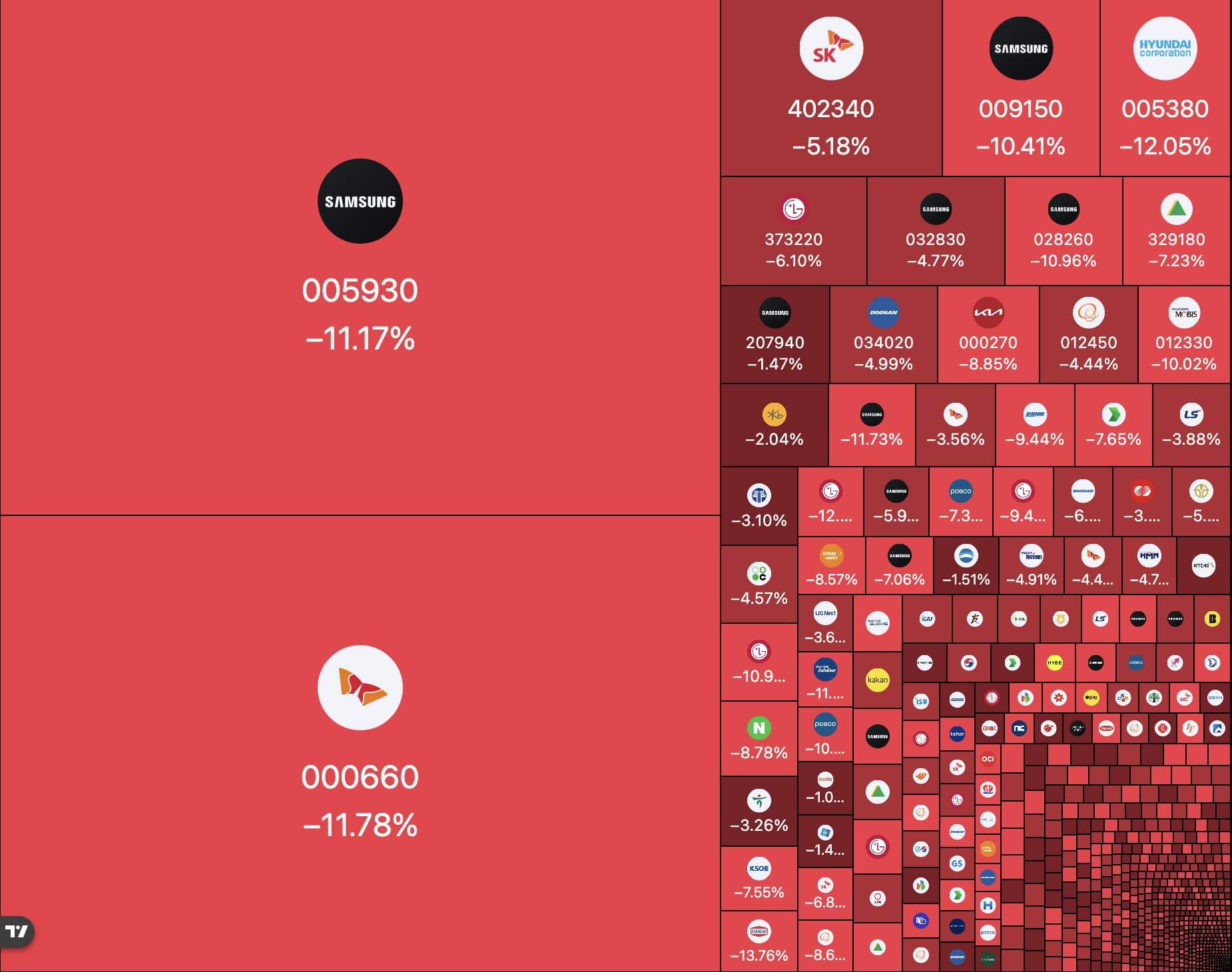
South Korea’s benchmark KOSPI stock index plunged nearly 10% today, triggering a market-wide trading halt one day after the country’s top financial regulator acknowledged that authorities had rushed the approval of leveraged funds tied to its two largest chipmakers.
According to reports, the KOSPI closed down 9.99% at 8,203.84, its steepest decline since March 4. Samsung Electronics and SK Hynix lost more than 12% each as overseas investors retreated from the semiconductor shares that had driven South Korea to the top of global equity-market rankings.
South Korea KOSPI Crash
Bitcoin fell alongside the retreat in risk assets, dropping as much as $1,500 within several hours and slipping below $63,000.
The cryptocurrency traded near $62,300 after touching an intraday low of around $62,000, according to CryptoSlate data.
Chip Concentration Turns a Retreat Into a Rout
The South Korean selloff followed weakness in US technology shares and growing expectations that interest rates could remain elevated. Selling spread across Asia, pushing the MSCI Asia-Pacific index down about 2.9% and Japan’s Nikkei 225 roughly 3% lower.
South Korea suffered the largest decline because of the KOSPI’s dependence on Samsung and SK Hynix.
Together, the two companies account for more than half of the index’s market value, leaving the benchmark closely tied to investor expectations for artificial intelligence servers and high-bandwidth memory chips.
That concentration had produced substantial gains before Tuesday. The KOSPI reached a record above 9,100 points on Monday and, even after the selloff, remained up almost 95% for the year.
The same structure worked in reverse when foreign investors began reducing their exposure. Declines in the two chipmakers pulled down the broader index and triggered an automatic 20-minute suspension of trading.
South Korean investors have also accumulated record amounts of debt to participate in the rally. Borrowed retail investment reached about 60 trillion won, or $39 billion, by the end of May, increasing the risk that falling prices would produce margin calls and forced sales.
South Korean regulator reverses course on leveraged ETFs
The market break followed an unusual admission from Financial Supervisory Service Governor Lee Chan-jin.
On June 22, Lee reportedly said that the regulator had acted too quickly when it permitted leveraged exchange-traded funds tracking Samsung and SK Hynix. The products, introduced in late May, seek to deliver multiples of each stock’s daily performance and can therefore produce larger losses when the underlying shares decline.
Authorities had viewed the funds as one way to draw South Korean retail investors away from US markets and back toward domestic stocks, potentially reducing pressure on the won.
Lee acknowledged that the products had done little to stabilize the currency and said he regretted not blocking their introduction.
Sixteen leveraged funds tied to Samsung and SK Hynix launched with about $3 billion in combined assets. Their holdings subsequently increased to more than $9 billion, with retail investors accounting for roughly 92% of ownership.
That growth raised concerns about the funds’ rebalancing requirements. Leveraged ETFs must buy or sell securities and derivatives as prices move to maintain their targeted daily exposure.
Those transactions can reinforce the direction of a market move, particularly when the products track companies that already dominate an index.
Goldman Sachs estimated before the launch that a 5% swing in Korean stocks could generate approximately $4.7 billion of dealer rebalancing flows, equivalent to about one-eighth of normal daily share turnover.
The Financial Supervisory Service is now considering stabilization measures, though Lee did not specify whether they could include leverage limits, tighter eligibility requirements, or restrictions on new products.
Bitcoin’s decline triggers wider unwind in leveraged trades
Bitcoin’s fall below $63,000 accelerated as traders reduced exposure to risk assets and leveraged crypto positions began to unravel.
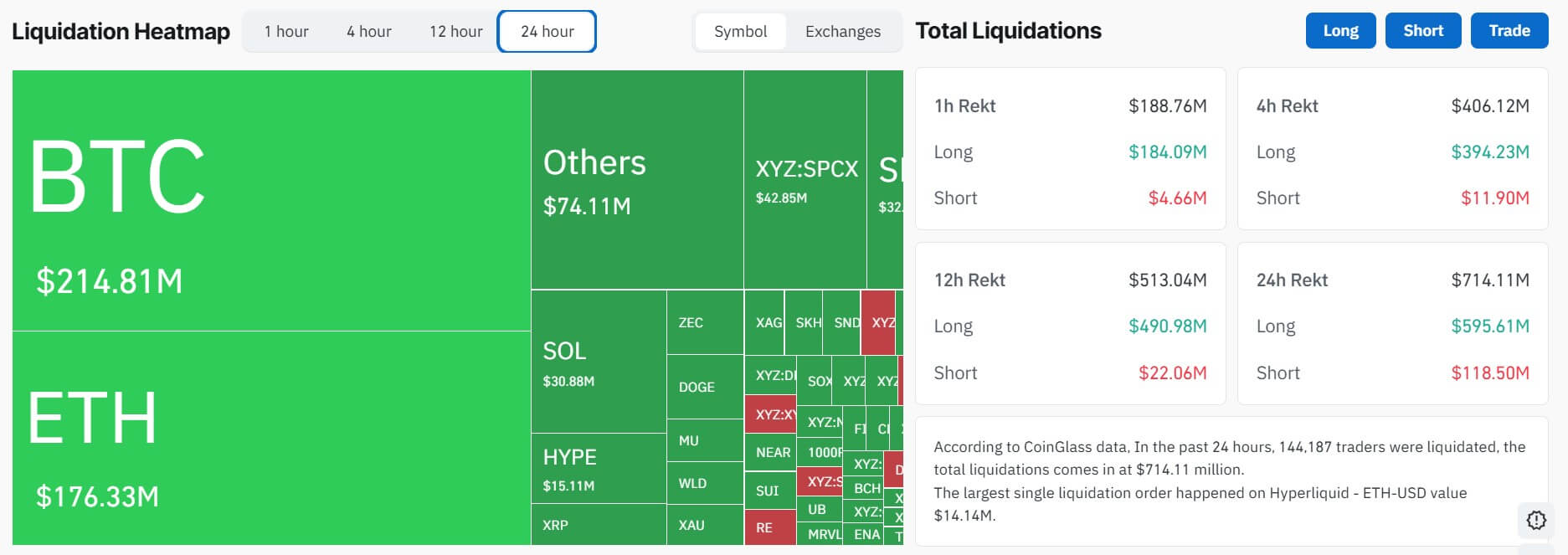
CoinGlass data showed that exchanges liquidated around $190 million in crypto positions within the past 1 hour. Long traders accounted for about $184 million of the total, reflecting how heavily the market had been positioned for prices to rise.
Liquidations climbed to approximately $714 million over 24 hours. Bitcoin traders suffered about $215 million in forced closures, while ETH positions accounted for roughly $177 million.
Crypto Market Liquidation (Source: CoinGlass)
The selloff intensified after Bitcoin fell through price levels at which some leveraged positions no longer had sufficient collateral. Exchanges automatically closed those trades, generating additional sell orders and adding momentum to the decline.
The timing does not mean the KOSPI rout directly caused Bitcoin’s fall. Rather, both markets were caught in a broader retreat from technology shares and other risk-sensitive assets as investors assessed the prospect of tighter financial conditions.
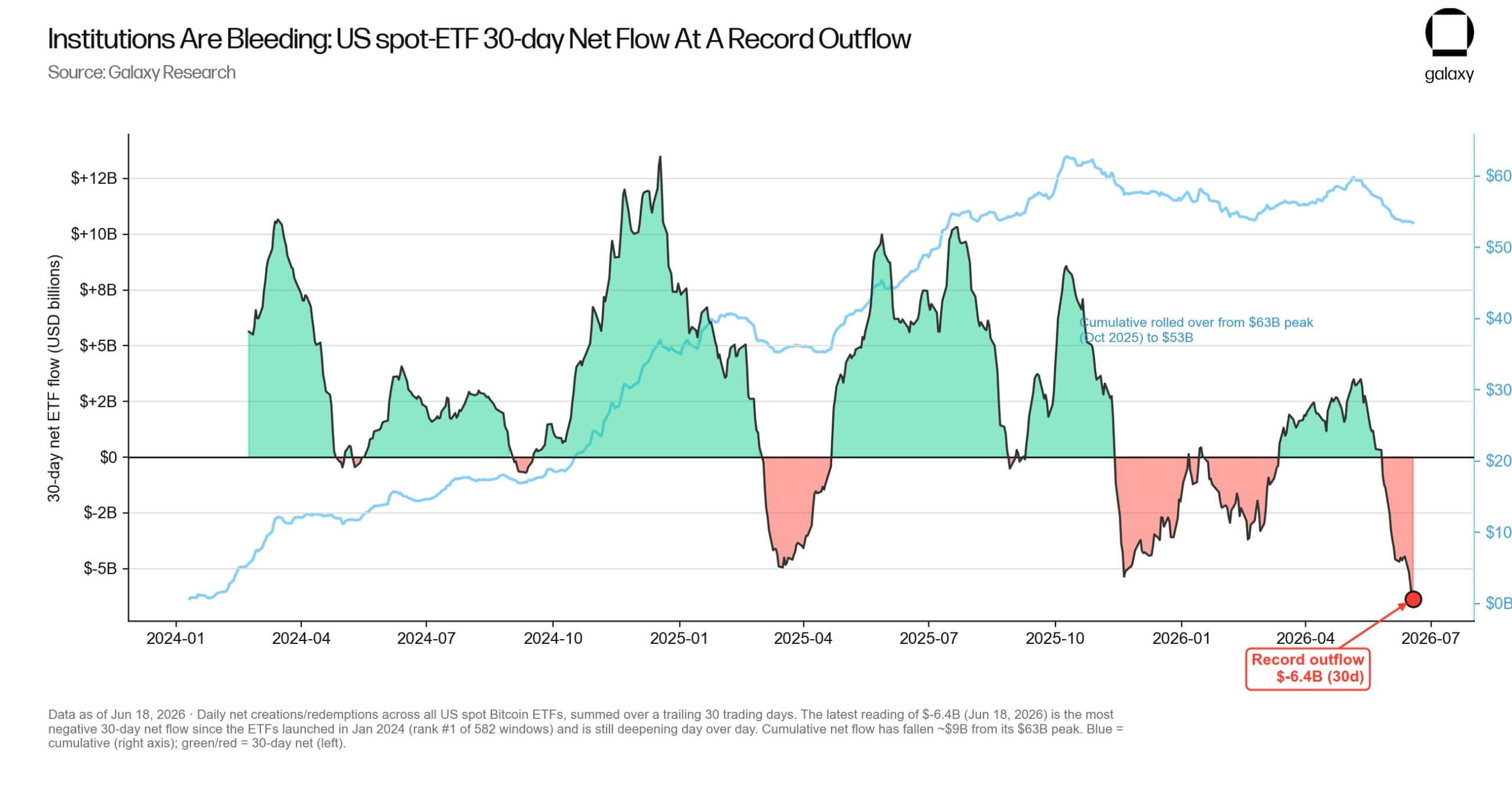
Meanwhile, Bitcoin had also entered the session with weaker institutional demand. US-listed spot Bitcoin ETFs recorded a rolling 30-day net outflow of about $6.35 billion, the largest for any comparable period since the funds began trading.
Bitcoin ETFs Outflow (Source: Galaxy Research)
Those withdrawals have removed an important source of buying support, leaving the market more vulnerable to sudden changes in sentiment.
So, this price decline showed how a wider risk-off move can become more severe in crypto when leverage forces traders out of their positions.