Strategy Authorizes $1.25Bn BTC Sale in New Monetization PlanIn Bitcoin news today, Strategy (MSTR), Michael Saylor’s corporate Bitcoin treasury firm, disclosed in a June 29 SEC filing that it may sell up to $1.25Bn worth of Bitcoin, the most explicit signal yet that the company’s long-held accumulation model is giving way to active balance-sheet management.
This disclosure dropped as Bitcoin continues to struggle to reclaim $60,000, currently trading for $59,150, down -1% in the past 24 hours and nearly -6% on the week.
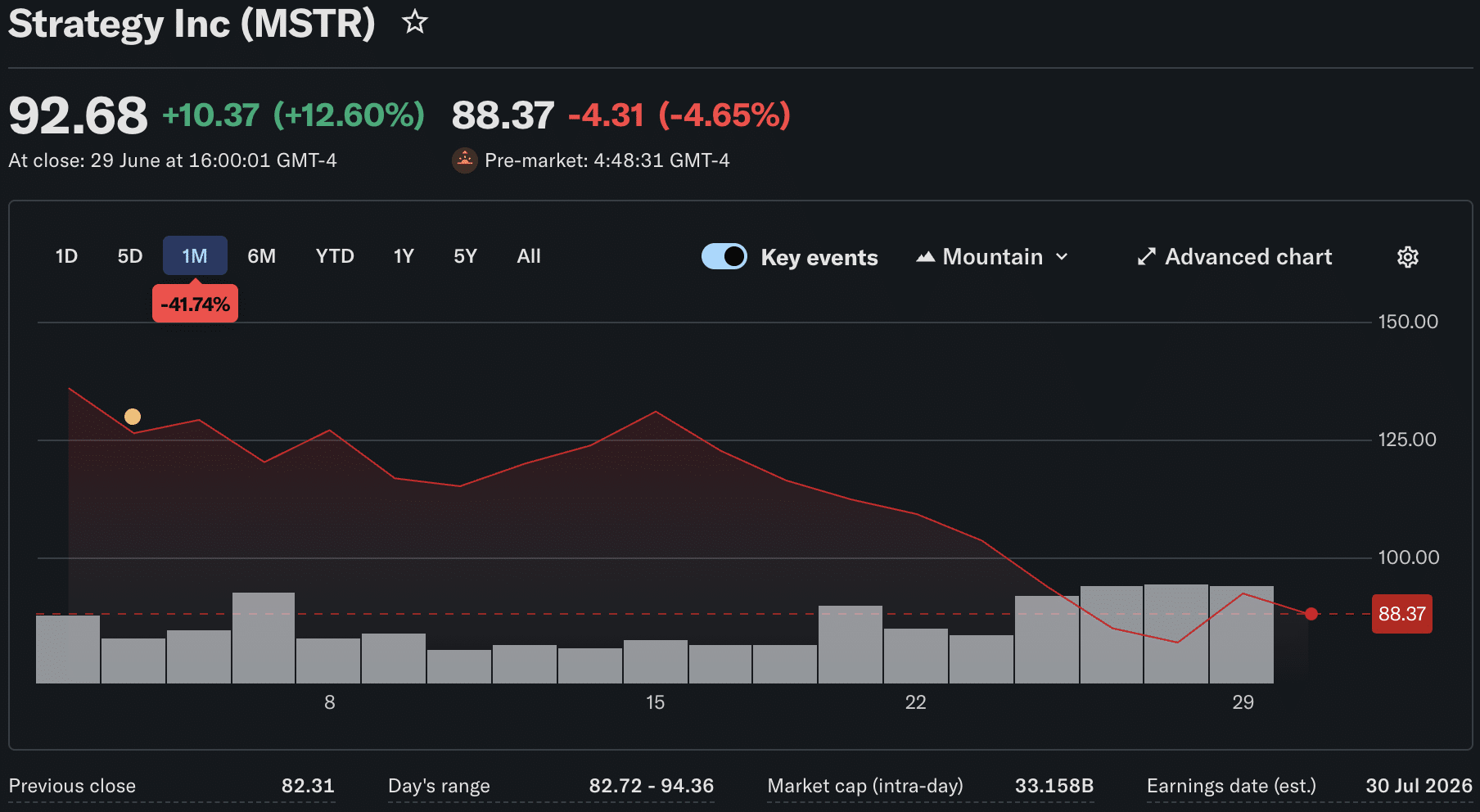
MSTR is trading at $92.68 today, down -41% over the past month, while STRC is at $83.67, up +12% on the day but still down -15.4% since the beginning of June.
Bitcoin News: What Strategy’s Bitcoin Monetization Program Actually Does
Strategy framed the potential sale under a newly announced Bitcoin Monetization Program, with sales to be executed “from time to time” depending on market conditions, capital needs, and other strategic considerations, according to the filing.
The proceeds would flow into the company’s cash reserve, currently sitting at approximately $2.55Bn, and cover preferred stock dividends, interest payments, and other corporate obligations.
The company’s annual preferred dividend and interest burden runs at roughly $1.76Bn, according to research context from the filing period. Combined, the $2.55Bn cash reserve and the $1.25Bn Bitcoin sale authorization provide approximately 25.9 months of coverage against those obligations.
The board has set a minimum coverage floor of 12 months; dropping below that threshold requires explicit board approval before any drawdown from reserves. Alongside the Bitcoin sale disclosure, Strategy authorized two separate $1Bn share repurchase programs.
This includes one for its Class A common stock and one for its Digital Credit Securities, which is the company’s umbrella term for its various series of preferred stock.
DISCOVER: Best Meme Coin ICOs to Invest in 2026
The mNAV Problem: Why the Flywheel Has Stalled
The more structurally significant data point in this story is the collapse of Strategy’s mNAV, a valuation metric that compares the company’s enterprise value to the total market value of its Bitcoin holdings. On June 27, Strategy’s mNAV fell below 1.0 for the first time in a meaningful stretch, according to data cited across multiple market trackers.
When mNAV sits above 1, Strategy can issue new shares at a premium to net Bitcoin value, use the proceeds to buy more Bitcoin, and effectively manufacture Bitcoin-per-share accretion, a self-reinforcing mechanism Saylor built the entire capital strategy around.
Below 1, that flywheel reverses: new equity dilutes rather than accrues, debt markets become more expensive to access, and direct Bitcoin monetization moves from a last resort to a rational tool.
This is not the company’s first Bitcoin sale. Strategy sold a small tranche of Bitcoin on June 1, a move that drew immediate market attention given the company’s previous “never sell” reputation. The June 29 filing scales that posture into an authorized program.
EXCLUSIVE: Join 99Bitcoin’s $1000 USDT Airdrop on ByBit
Peter Schiff Says the Model Has Inverted
"The significance for Bitcoin is that Saylor basically just surrendered. Strategy has gone from the biggest buyer to the biggest seller"
Peter Schiff on why Strategy turning seller flips the entire Bitcoin market
"He can hide and say we're still a net buyer. He's not. He's… https://t.co/uW64ieUZQE pic.twitter.com/hzVP33CkD8
— The Wolf Of All Streets (@scottmelker) June 29, 2026
In other Bitcoin news, longtime BTC critic Peter Schiff responded to the June 29 filing by declaring Strategy was “now a Bitcoin seller” in a post on X. Following the June 1 sale, Schiff had written: “What Saylor giveth, Saylor taketh away”.
Schiff argued that Strategy’s aggressive accumulation helped inflate the Bitcoin price during the bull run, and that any sustained selling would reverse that dynamic.
Saylor and CEO Phong Le have framed the shift differently. Le has said Strategy will “sell Bitcoin when it is advantageous to the company,” with the choice between dividends, debt reduction, and reserve-building driven by what is most accretive to Bitcoin per share.
The board-level constraints, capping BTC sales to three specific uses and requiring a new board vote for anything outside them, are designed to signal that monetization will be rule-based rather than reactive.
Bitcoin retreated sharply from its late-2025 high of approximately $125,000, falling below $59,000 last week before the modest recovery to current levels.
How long Strategy’s mNAV remains sub-1, and how aggressively the company tests its new monetization playbook, will be the metrics worth watching in the weeks ahead.
EXPLORE: Best Crypto Presales With Asymmetric Upside in the Current Market
Follow 99Bitcoins on X For the Latest Market Updates and Subscribe on YouTube For Daily Expert Market Analysis.
The post appeared first on 99Bitcoins.
read the full storyMore from 99bitcoins
In Bitcoin news today, Strategy (MSTR), Michael Saylor’s corporate Bitcoin treasury firm, disclosed in a June 29 SEC filing that it may sell up to $1.25Bn worth of Bitcoin, the most explicit signal yet that the company’s long-held accumulation model is giving way to active balance-sheet management.
This disclosure dropped as Bitcoin continues to struggle to reclaim $60,000, currently trading for $59,150, down -1% in the past 24 hours and nearly -6% on the week.
MSTR is trading at $92.68 today, down -41% over the past month, while STRC is at $83.67, up +12% on the day but still down -15.4% since the beginning of June.
Bitcoin News: What Strategy’s Bitcoin Monetization Program Actually Does
Strategy framed the potential sale under a newly announced Bitcoin Monetization Program, with sales to be executed “from time to time” depending on market conditions, capital needs, and other strategic considerations, according to the filing.
The proceeds would flow into the company’s cash reserve, currently sitting at approximately $2.55Bn, and cover preferred stock dividends, interest payments, and other corporate obligations.
The company’s annual preferred dividend and interest burden runs at roughly $1.76Bn, according to research context from the filing period. Combined, the $2.55Bn cash reserve and the $1.25Bn Bitcoin sale authorization provide approximately 25.9 months of coverage against those obligations.
The board has set a minimum coverage floor of 12 months; dropping below that threshold requires explicit board approval before any drawdown from reserves. Alongside the Bitcoin sale disclosure, Strategy authorized two separate $1Bn share repurchase programs.
This includes one for its Class A common stock and one for its Digital Credit Securities, which is the company’s umbrella term for its various series of preferred stock.
DISCOVER: Best Meme Coin ICOs to Invest in 2026
The mNAV Problem: Why the Flywheel Has Stalled
The more structurally significant data point in this story is the collapse of Strategy’s mNAV, a valuation metric that compares the company’s enterprise value to the total market value of its Bitcoin holdings. On June 27, Strategy’s mNAV fell below 1.0 for the first time in a meaningful stretch, according to data cited across multiple market trackers.
When mNAV sits above 1, Strategy can issue new shares at a premium to net Bitcoin value, use the proceeds to buy more Bitcoin, and effectively manufacture Bitcoin-per-share accretion, a self-reinforcing mechanism Saylor built the entire capital strategy around.
Below 1, that flywheel reverses: new equity dilutes rather than accrues, debt markets become more expensive to access, and direct Bitcoin monetization moves from a last resort to a rational tool.
This is not the company’s first Bitcoin sale. Strategy sold a small tranche of Bitcoin on June 1, a move that drew immediate market attention given the company’s previous “never sell” reputation. The June 29 filing scales that posture into an authorized program.
EXCLUSIVE: Join 99Bitcoin’s $1000 USDT Airdrop on ByBit
Peter Schiff Says the Model Has Inverted
"The significance for Bitcoin is that Saylor basically just surrendered. Strategy has gone from the biggest buyer to the biggest seller"
Peter Schiff on why Strategy turning seller flips the entire Bitcoin market
"He can hide and say we're still a net buyer. He's not. He's… https://t.co/uW64ieUZQE pic.twitter.com/hzVP33CkD8
— The Wolf Of All Streets (@scottmelker) June 29, 2026
In other Bitcoin news, longtime BTC critic Peter Schiff responded to the June 29 filing by declaring Strategy was “now a Bitcoin seller” in a post on X. Following the June 1 sale, Schiff had written: “What Saylor giveth, Saylor taketh away”.
Schiff argued that Strategy’s aggressive accumulation helped inflate the Bitcoin price during the bull run, and that any sustained selling would reverse that dynamic.
Saylor and CEO Phong Le have framed the shift differently. Le has said Strategy will “sell Bitcoin when it is advantageous to the company,” with the choice between dividends, debt reduction, and reserve-building driven by what is most accretive to Bitcoin per share.
The board-level constraints, capping BTC sales to three specific uses and requiring a new board vote for anything outside them, are designed to signal that monetization will be rule-based rather than reactive.
Bitcoin retreated sharply from its late-2025 high of approximately $125,000, falling below $59,000 last week before the modest recovery to current levels.
How long Strategy’s mNAV remains sub-1, and how aggressively the company tests its new monetization playbook, will be the metrics worth watching in the weeks ahead.
EXPLORE: Best Crypto Presales With Asymmetric Upside in the Current Market
The post appeared first on 99Bitcoins.
read the full story| More from 99bitcoins |
|---|

Empery Digital Shifts From Bitcoin Treasury Strategy With $65M AI Data Center Deal
TL;DR Empery Digital commits $65M for a 25% stake in a Midwest AI data center project targeting up…

Larry Lepard REVEALS How Bitcoin Will EXPLODE To $180,000 FASTER Than You Think
Bitcoin may be down, but the long-term case has never been stronger. Larry Lepard explains why the…

Ripple's RLUSD Rapidly Shrinks as New Major Stablecoin Emerges
Ripple's RLUSD stablecoin continues to contract as a newly announced consortium-backed rival…

Peter Brandt Flags $1.25 Billion Bitcoin Supply Risk From Saylor’s New Framework
Peter Brandt isn’t mincing words. The veteran trader came out swinging at Michael…

Financial companies join forces for US dollar stablecoin, keeping reserve earnings
The project, supported by Visa, Mastercard and many crypto companies, could be in a position to…

Top 5 Altcoins for July 2026 as Bitcoin Drops 20%
Bitcoin is down 20%, but these 5 altcoins for July 2026 carry dated catalysts and standout charts…

Bitcoin Sinks 20% in June as Traders Dump Longs and Widen 2026 Losses to 34%
Bitcoin faced significant volatility at the end of June, sliding toward $58,000, erasing recent…

Bitcoin price risks drop below $58K as US dollar hits 40-year high against yen
Bitcoin faced downside pressure as the US dollar hit its highest levels against the Japanese yen…

Long-Term Bitcoin Holders Hit Record Accumulation as Klippsten Eyes Market Floor
Long-term Bitcoin holders are sitting on more coins than ever. Cory Klippsten of Swan thinks…
Nasdaq-Listed Riot Keeps Selling Bitcoin While Reinventing Its Business
Riot moved 500 BTC to NYDIG, deepening a Riot Bitcoin sale streak that is funding its pivot into AI…
Whales Rotate Back To Bitcoin And Ethereum As Altcoin Risk Cools
Whales Rotate Back To Bitcoin And Ethereum As Altcoin Risk Cools: what the validated data shows, why…

AI’s power crunch turns Bitcoin miners’ grid access into an asset
Bitcoin miners have the power sites AI companies need, but turning old mining campuses into real…
Circle Stock Dives as Coinbase, BlackRock and Visa Back Open USD Stablecoin
The forthcoming Open USD has more than 100 major supporters onboard, including Coinbase—a key…

Benchmark Backs Strategy’s Bitcoin Push with $570 Per Share Target
Benchmark just put a number on it. The firm set a $570 per share price target for Strategy, backing…
Supreme Court Fed Ruling Puts Central Bank Independence Back In Bitcoin’s Macro Frame
Supreme Court Fed Ruling Puts Central Bank Independence Back In Bitcoin’s Macro Frame: what the…
Blackrock’s $300M IBIT Exit Extends Bitcoin ETF Outflow Streak to 8 Days
Crypto exchange-traded fund (ETF) flows opened the week with continued pressure on bitcoin and ether…
Ripple's USD Stablecoin Isn't 'Eating' XRP, Evernorth Breaks Down
Crypto treasury Evernorth breaks down why Ripple USD expansion isn’t hurting XRP, revealing how…
Business use of stablecoins set for growth surge: Cybrid report
The majority of businesses surveyed are likely to use stablecoins within the next 12 months, while…
Bitcoin Core fixes hidden privacy risk before next major release
Bitcoin Core has released version 31.1rc1, fixing a privacy flaw in PrivateBroadcast while…