Strategy’s STRC Nears Record Low as Bitcoin Buying Draws FireThe Saylor-led Strategy perpetual preferred stock STRC dropped 3.58% to $91.79 on Tuesday, hitting near-record lows and sitting 8.2% below its $100 par value, and the reason matters beyond one bad session.
The decline signals a direct collision between Michael Saylor’s relentless Bitcoin treasury accumulation playbook and the cash obligations his company has made to preferred shareholders who were promised a reliable 11.5% dividend.
STRATEGY’S “BITCOIN MACHINE” STRC STOCK SLIDES 8% BELOW PAR: WHAT IT MEANS AND HOW COULD IT RECOVER?
x
– $STRC closed at $91.79 on June 16, down 3.58% for the day and ~8.2% below its $100 par value; despite the company highlighting ~350% annualized growth in notional scale
— Gk (@gksolanky) June 17, 2026
The structural tension at the heart of this article is that every dollar Strategy deploys into BTC purchases is a dollar not sitting in reserve to service STRC’s dividend, and the market is now pricing that conflict explicitly.
This Strategy data drop came as Bitcoin dropped -2.5% overnight to just under $65,000, after climbing to $67,000 earlier this week before the retracement over the past 24 hours.
What STRC Actually is and Why the Par Level Matters
$BTC failed to reclaim the $67,000-$68,000 zone.
Now, the key level to hold is $64,000-$65,000.
If Bitcoin loses this, it'll end up giving most of its short-term gain back. pic.twitter.com/uI6P5k8oyD
— Ted (@TedPillows) June 17, 2026
STRC is Strategy’s Variable Rate Series A Perpetual Stretch Preferred Stock, sometimes called ‘Stretch’ – Saylor’s attempt to create a high-yield, Bitcoin-adjacent fixed-income product. Think of it like a corporate bond with equity DNA: it pays a variable dividend designed to track around 11.5%, it has a target value of $100 per share, and it has no maturity date, which is what ‘perpetual’ means.
The $100 par level is not just a psychological anchor. When STRC trades at or above par, Strategy can issue new shares efficiently through at-the-market (ATM) programs – essentially selling preferred stock into the open market to raise fresh capital for Bitcoin purchases.
When it trades below par, that engine slows. Selling new shares at $91.79 when the target price is $100 is like a company doing a deeply discounted rights issue: it works, but it dilutes the proposition for existing holders and signals stress to the market.
STRC has now been below par since April 15, according to Cointelegraph, meaning this is not a single-day aberration. It is a month-long structural squeeze on Strategy’s preferred-stock funding mechanism.
DISCOVER: Best Meme Coin ICOs to Invest in 2026
The Dividend vs. Accumulation Strategy Dilemma
Saylor has created a structural bind with STRC, marketed as a ‘digital credit’ alternative to money market funds, which offers yield backed by a major corporate Bitcoin holding.
The security of the dividend hinges on Strategy maintaining cash reserves instead of continuously buying BTC at high prices. STRC holders now view Bitcoin purchases as prioritizing accumulation over dividend security, even though Strategy reportedly has a 21-month cash runway and no margin call triggers.
Nick Ruck from LVRG Research notes that the broader risk-off sentiment in crypto has impacted investor interest. Despite a variable dividend providing over 12% yield, ongoing selling pressure and concerns about Strategy’s growing capital structure are testing its stability.
With around $21Bn in debt obligations, each new preferred share issuance complicates the capital structure, making it challenging for individual instruments to maintain their anchor price.
Strategy (MSTR) Is Feeling the Same Pressure
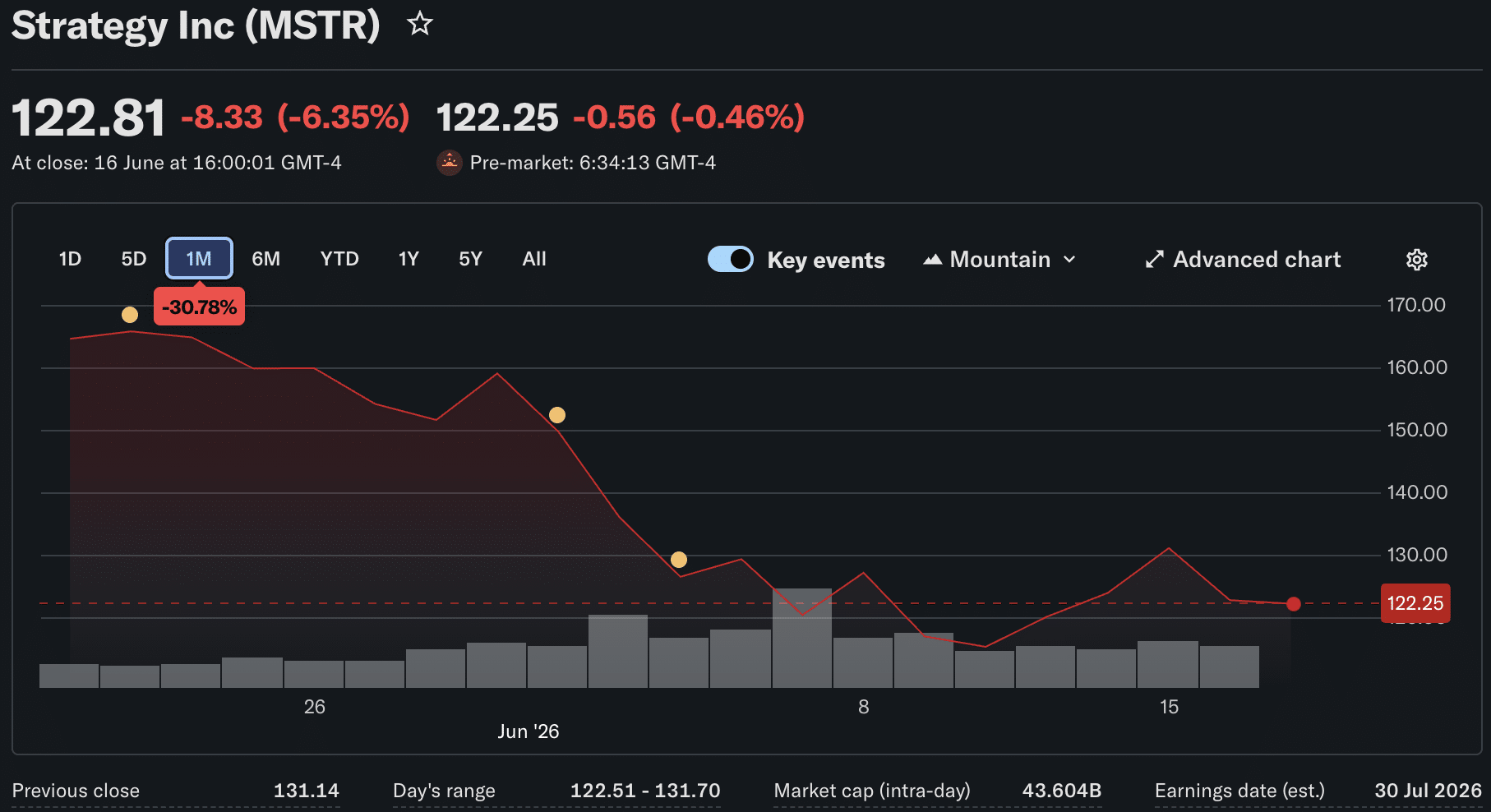
MSTR shares experienced a significant 6.35% drop on Tuesday, closing at $122.81 and marking a 67% decline over the past year. This stark loss contrasts with Bitcoin’s performance, which has not fallen as drastically.
The difference highlights the market’s reevaluation of the premium investors once paid for MSTR as a leveraged Bitcoin investment. At its peak in late 2024, MSTR traded at over 2.4 times its net asset value, but by January 2026, that premium fell to about 1.1 times.
In early June, MSTR executed its first Bitcoin sale since 2022, selling 32 BTC for $2.5M, which challenged the company’s previous narrative of never selling. This sale, while small relative to its total Bitcoin holdings, sent a strong psychological message: the company’s investment model can be conditional.
EXCLUSIVE: Earn $10 USDC Via Binance Sign-Up
SATA Is Winning the Preferred Stock Comparison
The competitive pressure on STRC has a name: SATA. Strive’s perpetual variable-rate preferred shares are currently trading at exactly $100 – their par value – while offering an effective yield of approximately 13%.
That is a cleaner deal than STRC by almost every metric a fixed-income investor would apply: same instrument structure, higher yield, no discount to par, no overhang from a controversial Bitcoin accumulation strategy dominating the headline risk.
When two similar products trade in the same market and one holds par while the other trades at an 8.2% discount, the market is expressing a clear preference.
STRC holders are not just sitting at a lower price; they are holding an instrument that signals funding stress while a competitor sits steady. That comparison is difficult to dismiss.
The wider landscape of Bitcoin-adjacent investment vehicles has also grown more competitive. Yield-bearing Bitcoin ETF structures and other institutional-grade products are expanding the menu of options for investors seeking crypto exposure with an income component, reducing the captive audience that STRC once enjoyed as a relative novelty.
EXPLORE: Best Crypto Presales With Asymmetric Upside in the Current Market
Follow 99Bitcoins on X For the Latest Market Updates and Subscribe on YouTube For Daily Expert Market Analysis.
The post appeared first on 99Bitcoins.
read the full story
The Saylor-led Strategy perpetual preferred stock STRC dropped 3.58% to $91.79 on Tuesday, hitting near-record lows and sitting 8.2% below its $100 par value, and the reason matters beyond one bad session.
The decline signals a direct collision between Michael Saylor’s relentless Bitcoin treasury accumulation playbook and the cash obligations his company has made to preferred shareholders who were promised a reliable 11.5% dividend.
STRATEGY’S “BITCOIN MACHINE” STRC STOCK SLIDES 8% BELOW PAR: WHAT IT MEANS AND HOW COULD IT RECOVER?
x– $STRC closed at $91.79 on June 16, down 3.58% for the day and ~8.2% below its $100 par value; despite the company highlighting ~350% annualized growth in notional scale
— Gk (@gksolanky) June 17, 2026
The structural tension at the heart of this article is that every dollar Strategy deploys into BTC purchases is a dollar not sitting in reserve to service STRC’s dividend, and the market is now pricing that conflict explicitly.
This Strategy data drop came as Bitcoin dropped -2.5% overnight to just under $65,000, after climbing to $67,000 earlier this week before the retracement over the past 24 hours.
What STRC Actually is and Why the Par Level Matters
$BTC failed to reclaim the $67,000-$68,000 zone.
Now, the key level to hold is $64,000-$65,000.
If Bitcoin loses this, it'll end up giving most of its short-term gain back. pic.twitter.com/uI6P5k8oyD
— Ted (@TedPillows) June 17, 2026
STRC is Strategy’s Variable Rate Series A Perpetual Stretch Preferred Stock, sometimes called ‘Stretch’ – Saylor’s attempt to create a high-yield, Bitcoin-adjacent fixed-income product. Think of it like a corporate bond with equity DNA: it pays a variable dividend designed to track around 11.5%, it has a target value of $100 per share, and it has no maturity date, which is what ‘perpetual’ means.
The $100 par level is not just a psychological anchor. When STRC trades at or above par, Strategy can issue new shares efficiently through at-the-market (ATM) programs – essentially selling preferred stock into the open market to raise fresh capital for Bitcoin purchases.
When it trades below par, that engine slows. Selling new shares at $91.79 when the target price is $100 is like a company doing a deeply discounted rights issue: it works, but it dilutes the proposition for existing holders and signals stress to the market.
STRC has now been below par since April 15, according to Cointelegraph, meaning this is not a single-day aberration. It is a month-long structural squeeze on Strategy’s preferred-stock funding mechanism.
DISCOVER: Best Meme Coin ICOs to Invest in 2026
The Dividend vs. Accumulation Strategy Dilemma
Saylor has created a structural bind with STRC, marketed as a ‘digital credit’ alternative to money market funds, which offers yield backed by a major corporate Bitcoin holding.
The security of the dividend hinges on Strategy maintaining cash reserves instead of continuously buying BTC at high prices. STRC holders now view Bitcoin purchases as prioritizing accumulation over dividend security, even though Strategy reportedly has a 21-month cash runway and no margin call triggers.
Nick Ruck from LVRG Research notes that the broader risk-off sentiment in crypto has impacted investor interest. Despite a variable dividend providing over 12% yield, ongoing selling pressure and concerns about Strategy’s growing capital structure are testing its stability.
With around $21Bn in debt obligations, each new preferred share issuance complicates the capital structure, making it challenging for individual instruments to maintain their anchor price.
Strategy (MSTR) Is Feeling the Same Pressure
MSTR shares experienced a significant 6.35% drop on Tuesday, closing at $122.81 and marking a 67% decline over the past year. This stark loss contrasts with Bitcoin’s performance, which has not fallen as drastically.
The difference highlights the market’s reevaluation of the premium investors once paid for MSTR as a leveraged Bitcoin investment. At its peak in late 2024, MSTR traded at over 2.4 times its net asset value, but by January 2026, that premium fell to about 1.1 times.
In early June, MSTR executed its first Bitcoin sale since 2022, selling 32 BTC for $2.5M, which challenged the company’s previous narrative of never selling. This sale, while small relative to its total Bitcoin holdings, sent a strong psychological message: the company’s investment model can be conditional.
EXCLUSIVE: Earn $10 USDC Via Binance Sign-Up
SATA Is Winning the Preferred Stock Comparison
The competitive pressure on STRC has a name: SATA. Strive’s perpetual variable-rate preferred shares are currently trading at exactly $100 – their par value – while offering an effective yield of approximately 13%.
That is a cleaner deal than STRC by almost every metric a fixed-income investor would apply: same instrument structure, higher yield, no discount to par, no overhang from a controversial Bitcoin accumulation strategy dominating the headline risk.
When two similar products trade in the same market and one holds par while the other trades at an 8.2% discount, the market is expressing a clear preference.
STRC holders are not just sitting at a lower price; they are holding an instrument that signals funding stress while a competitor sits steady. That comparison is difficult to dismiss.
The wider landscape of Bitcoin-adjacent investment vehicles has also grown more competitive. Yield-bearing Bitcoin ETF structures and other institutional-grade products are expanding the menu of options for investors seeking crypto exposure with an income component, reducing the captive audience that STRC once enjoyed as a relative novelty.
EXPLORE: Best Crypto Presales With Asymmetric Upside in the Current Market
The post appeared first on 99Bitcoins.
read the full story
Stablecoin Shakedown: Binance, Coinbase And Kraken Restrict USDT In Europe Ahead Of MiCA Deadline
Major exchanges continue reshaping USDT access for EEA users as Europe’s MiCA stablecoin rules…

Trader Garrett Jin Dumps $13.5M in HYPE, Holds $83M BTC and $25M ZEC Longs
A wallet tied to former Bitforex chief Garrett Jin has sold its entire 184,102 HYPE stake, worth…

Bitcoin Dips Below $65K Then Bounces as Warsh Holds Rates at 3.75%
Bitcoin got rattled — briefly — and then shrugged it off. That’s basically the story of…

Bitcoin drops toward $64K after hawkish Fed sparks liquidation cascade
Bitcoin has fallen back toward $64,000 after a hawkish Federal Reserve outlook erased a relief rally…

QCP warns Strategy may sell more Bitcoin to fund dividends
Strategy has returned to the spotlight after QCP estimated its current liquidity runway for dividend…
New Fed Era Begins: Bitcoin Drops as Warsh Emphasizes Price Stability
TL;DR: The Federal Open Market Committee maintained the federal funds rate target range between 3.5%…

$400M Wiped Out in Hours as Bitcoin Crashes After FOMC and Warsh Speech
The asset has slipped by over $2,000 since the meeting concluded.

Bitcoin bottom? BTC builds massive support wall amid ‘one of the largest transfers ever’
Has Bitcoin found a bottom strong enough to withstand the bears?

Fidelity joins Wall Street's race to manage stablecoin reserves
Following State Street, Fidelity is targeting reserve assets that underpin the expanding stablecoin…

Bitcoin capitulation ‘twice as weak’ after spot liquidity turns supportive: Glassnode
Bitcoin’s realized losses fell by 46% as increasing bid-side liquidity points to easing sell…

Kevin Warsh Sends Bitcoin and Gold Lower in First FOMC Press Conference: What Did He Say?
Kevin Warsh delivered his first press conference as Fed chair on Wednesday, June 17, 2026. Gold and…

Blackrock Leads Crypto ETF Inflows as Bitcoin, Ether and XRP All Turn Positive
Crypto ETF flows turned positive across the board on Tuesday, June 16, with bitcoin, ether, HYPE,…
CoinFund, Coinbase Back Stablecoin Payments Startup Trace Finance in $32 Million Raise
Stablecoin infrastructure firm Trace Finance said Wednesday that it raised a $32 million Series A…

Bitcoin layer-2s face a bear-market reality check
Botanix's shutdown has raised an uncomfortable question for Bitcoin builders: Does the market…
Bitcoin Slides as Fed Says It Will 'Deliver Price Stability' Under Kevin Warsh
The first FOMC meeting under new Federal Reserve Chair Kevin Warsh produced the expected result, yet…
Elon Musk’s wealth has now surpassed Bitcoin market cap amid SpaceX’s continued rally
Elon Musk’s personal fortune has surpassed the market value of Bitcoin, a milestone that shows how…

‘Bitcoin Rodney’ Pleads Guilty in $1.8 Billion Crypto Fraud Case
TL;DR: Rodney Burton illegally operated a money transmitting network between June 2020 and January…

Japan’s Three Largest Megabanks Align To Launch Joint Yen-Backed Stablecoin By March 2027
Japan’s largest banking groups are moving toward a joint yen-backed stablecoin framework that…
BTC Price Drops as New Fed Chair Kevin Warsh Holds Rates Steady
The decision was highly anticipated but there are still some fears about potential hikes by the end…