Bitcoin is trading near $64,000, roughly mid-channel in the $57,000-$77,000 range that has defined the market since the Strait of Hormuz shock.
Can-Luca Köymen, investment strategist at Sygnum, called the current setup a catalyst-light regime in a note:
“Absent a decisive catalyst the path of least resistance is range-trading driven by positioning and flows rather than fresh spot demand.”
Angie Malltezi, chief operating officer of Altius, agrees on the mechanics:
“Markets often spend extended periods consolidating before a catalyst emerges, and that catalyst is frequently something investors weren't focused on beforehand.”
Both place the first real inflection point late in the third quarter and cite the same reason. The oil shock that drove energy to account for more than 60% of May's CPI increase has not yet been reflected in the data.
According to Köymen:
“Energy shocks pass through inflation with a lag, so a single softer reading doesn't undo it. A read that genuinely reflects post-MOU normalization realistically only shows up in the August data, which is the print the FOMC weighs in September.”
He added that the genuine inflection “is a late-Q3 story at the earliest.”
The data is still carrying the shock
The May CPI rose 0.5% month over month and 4.2% year over year, with gasoline up 7.0% for the month and 40.5% year over year.
The Fed held its funds rate target range at 3.50%-3.75% in June and described inflation as still running above its 2% goal, partly reflecting supply shocks, including energy.
Its June Summary of Economic Projections moved the 2026 PCE forecast to 3.6% from 2.7% in March, and the core PCE forecast to 3.3% from 2.7%.
Dallas Fed modeling shows the oil shock lifting headline inflation through the third quarter, even in a one-quarter closure scenario, raising quarter-on-quarter headline inflation by 0.6 percentage points and core by 0.2 percentage points.
Köymen's read of the Fed's posture carries direct weight for the calendar:
“This is a print-by-print Fed now, and the number that also matters is core PCE, not just CPI, since that's the Fed's preferred gauge. We should also expect less forward guidance from here onwards, something Chair Warsh signaled clearly at his first meeting.”
A Fed unwilling to pre-commit raises the market's incentive to front-run the data, because investors cannot anchor positioning to forward guidance, each incoming print carries more weight, and the first genuinely clean print does not arrive until August.
OFAC issued Iran General License X on Jun. 22, authorizing Iranian-origin crude and petroleum transactions through Aug. 21, and the sequencing of data releases around that window reinforces the bottleneck.
June CPI lands Jul. 14 and still carries the shock-period imprint. July CPI, due Aug. 12, gives the first cleaner read on whether energy costs are fading. The September FOMC meets on the 15th and 16th, with the August CPI in hand but not the August PCE, which the BEA releases on Sept. 30.
Date
Event
Why it matters for Bitcoin
Jun. 22
OFAC General License X begins
Starts the 60-day oil-flow normalization window
Jul. 14
June CPI
Still reflects the shock period
Aug. 12
July CPI
First cleaner read on whether energy pressure is fading
Aug. 21
OFAC license window expires
Main geopolitical risk node
Aug. 26
July PCE
First cleaner look at the Fed’s preferred inflation gauge
Sept. 11
August CPI
Final major inflation print before the September Fed meeting
Sept. 15–16
FOMC meeting
Fed has August CPI, but not August PCE
Sept. 30
August PCE
Full confirmation arrives after the Fed meeting
Malltezi flagged this:
“September remains the most likely inflection point, but it's not an absolute constraint.”
She added that the Fed retains authority to act between meetings if conditions warrant, though intermeeting moves are rare.
How the oil curve is already pricing the answer
The oil curve has already answered the question CPI will take weeks to confirm, and Köymen reads the futures curve as the signal of where the base case sits:
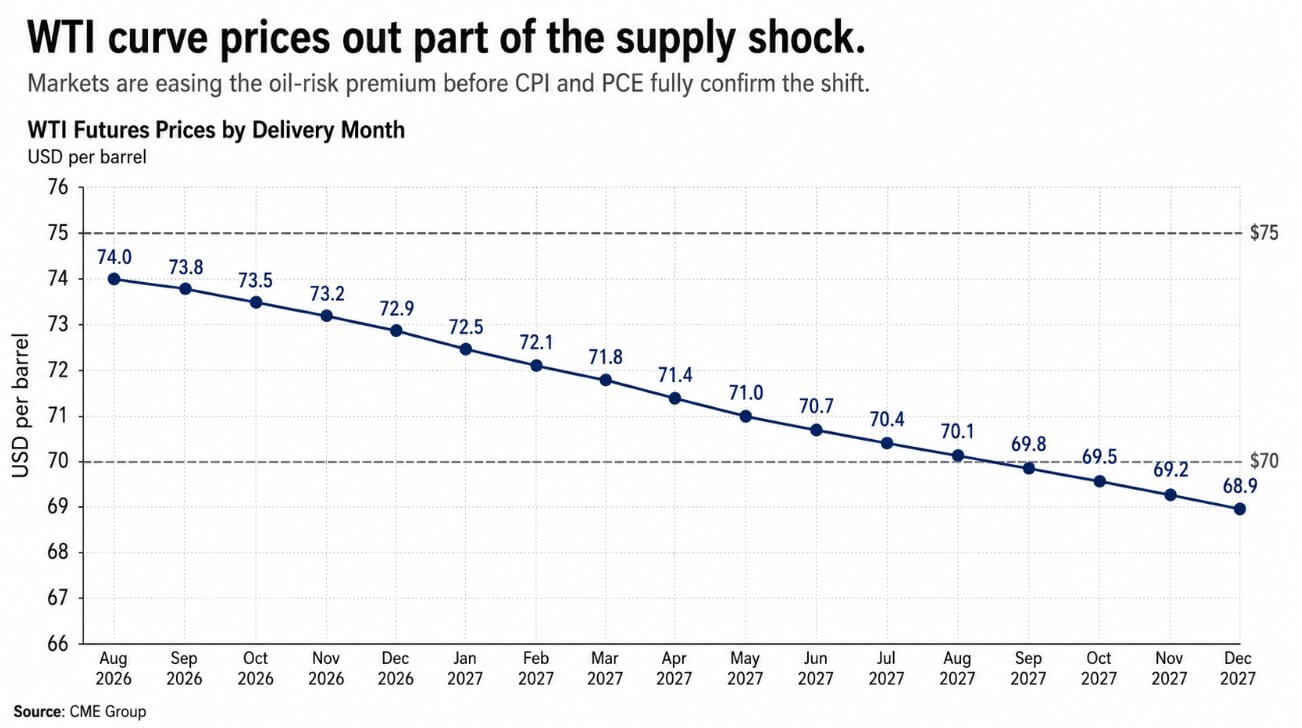
“The futures curve has relaxed significantly, with most dated WTI contracts now below $75 and selected 2027 contracts even below $70. The market is pricing the supply premium out across the whole curve, not just at the front.”
Physical evidence supports the read that several Middle Eastern producers have restarted refineries and oil fields, which Köymen describes as a sign “the parties on the ground are treating this as a durable peace rather than a pause.”
WTI futures prices fall steadily from $74 per barrel in August 2026 to $68.9 by December 2027, pricing out the supply shock premium.
Malltezi reads the broader asset response the same way:
“Oil prices have retraced much of their initial geopolitical risk premium, and broader risk assets have remained resilient, suggesting investors expect the negotiations to continue without a major escalation.”
The relief is already partly reflected in Bitcoin's price, as both sources point to the mid-$60,000s as the base case where the MOU holds.
The Aug. 21 deadline on OFAC's license window is the visible risk node, but Köymen does not treat it as a hard cliff:
“The encouraging part is that the US has signaled willingness to extend the window if there's no clean solution by the deadline, which stops the deadline from becoming a hard cliff. Re-escalation risk is minor, but it isn't zero, and that residual risk is what keeps positioning hedged rather than outright long.”
Malltezi echoes the asymmetry:
“The market is assigning a relatively low probability to a severe disruption while recognizing that a breakdown in talks could quickly reprice energy markets and inflation expectations.”
The structural forces keeping the range intact
Köymen identifies a newer element in Bitcoin income products that reinforces range-bound behavior, even if macro conditions stay benign.
He mentioned BlackRock's recently launched covered-call ETF (BITA), which can reinforce range-bound behavior: it sells call options against its holdings, so it's effectively selling into rallies.
Köymen added:
“That introduces a recurring source of profit-taking on the way up that wasn't present in earlier cycles and, while still small relative to the spot ETF complex, at the margin it dampens upside follow-through.”
BlackRock's own risk disclosures confirm that writing covered calls on IBIT shares limits gains above the option's exercise price while leaving the fund exposed to downside risk.
He also flagged that the market must see meaningful accumulation by professional investors via ETFs at attractive entry levels, so investors should monitor whether demand genuinely returns and whether accumulation in size materializes.
In Köymen's read, recent ETF outflows look more like profit-taking and macro de-risking than a structural exit, and the outflow momentum has subsided at current levels.
Both conditions need to move together before Bitcoin has the fuel to break the range on its own.
Two paths through the data calendar
The bull case runs through the oil curve continuing to normalize, July CPI and PCE showing energy relief contained to headline prices, and September cut odds climbing before the Fed formally moves.
Fed funds futures currently price around a 52% chance of a September cut, per Sygnum's market read. Köymen framed the channel:
“Our base case, if flow continues and even improves through Hormuz, is the Fed holding across the next two to three meetings.”
Yet, he stated that Bitcoin can reprice on the expectation of easing before the Fed delivers it.
The bear case is that the inflation sequence proves stickier than the oil curve alone implies. EIA's June Short-Term Energy Outlook projected Brent at $105 per barrel in June and July, with wholesale gasoline running roughly 50% higher than its pre-conflict baseline.
If gasoline and goods prices keep feeding into core CPI despite easing crude, the Fed holds longer, real rates stay elevated, and Bitcoin retests the lower bound.
Malltezi puts the honest constraint on prediction:
“Identifying the specific trigger in advance is extremely challenging. Whether it's macroeconomic data, monetary policy, ETF flows, regulatory developments, or an unforeseen event — until then, continued range-bound trading remains a reasonable base case.”
Scenario
What has to happen
Fed implication
Bitcoin implication
Bull case: market front-runs normalization
Oil curve keeps easing, July CPI/PCE show energy relief, Aug. 21 risk is extended or defused
Malltezi noted that the bill depends on congressional timelines and bipartisan support, not geopolitical developments, and that an unexpected passage would push the range higher far faster than the oil and PCE sequence could, arriving before most investors have positioned for it.