Congress is moving to fix how the US tax code treats crypto mining and staking rewards, and for validators and their institutional clients, the fix is long overdue.
H.R. 9175, the Tax Clarity for Mining and Staking Act, would let miners and stakers defer tax on newly minted tokens until they sell them, ending a cash-flow penalty that has pushed validation infrastructure and its largest clients toward offshore jurisdictions with clearer rules.
For Bitcoin miners, the bill barely touches the actual competition consisting of land availability, power contracts, permitting timelines, and grid reliability, which determine where the next megawatt gets built.
The staking tax problem
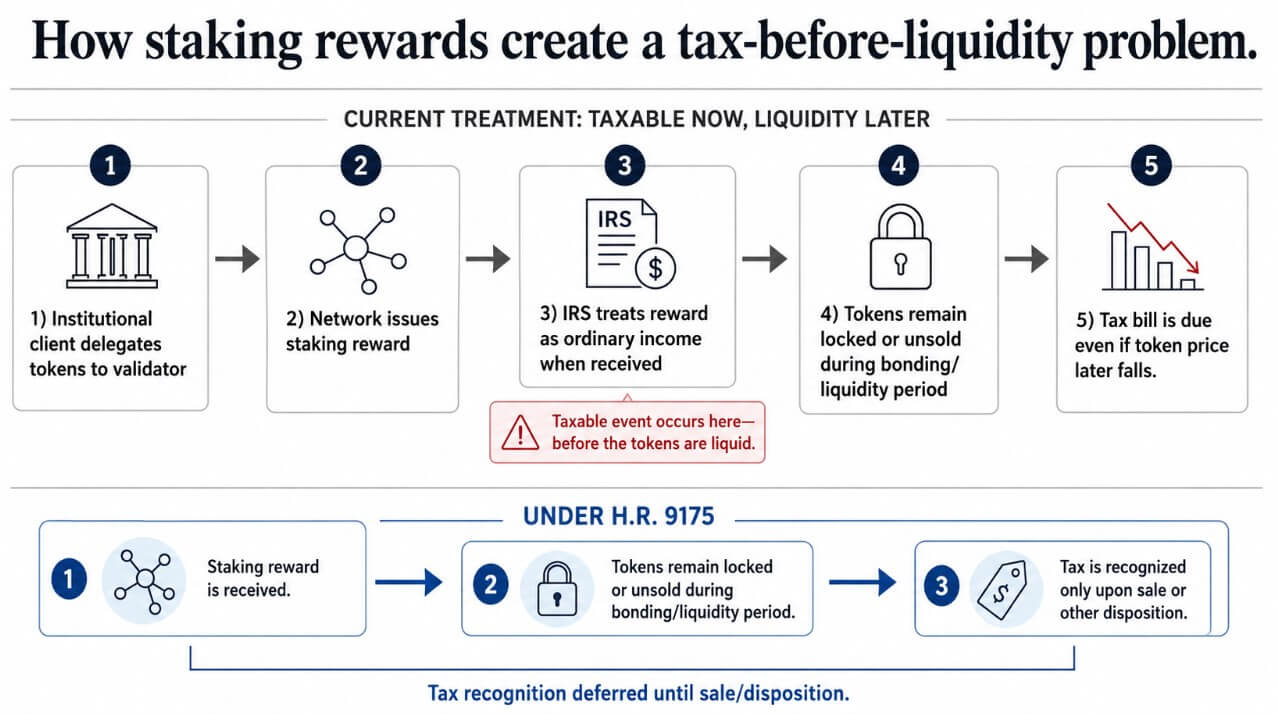
Under IRS Revenue Ruling 2023-14, validators and their clients owe ordinary income tax on staking rewards the moment they are received, at that day's price, whether or not they have sold a single token.
In staking-as-a-service models, where institutional clients delegate tokens to a validator while those tokens are locked during a bonding period, the client owes a cash tax bill on assets they cannot yet liquidate. The infrastructure provider owes tax on the commission it collected from those same illiquid tokens.
Jennie Levin, chief legal and operating officer at the Algorand Foundation and a former staking-as-a-service operator, calls this “a constant cash drag” where every reward on every network must be valued at the moment of receipt. If the price falls before anyone can sell, the liability is already set at the higher number.
That position hardened on June 4, when the US Tax Court issued its first opinion directly addressing the taxation of staking rewards. In Paschall v. Commissioner, T.C. Memo. In 2026-46, the court held that rewards constitute gross income under Section 61 when the taxpayer gains dominion and control over them.
The ruling is non-precedential, and Jarrett v. United States and other pending cases may yet complicate it, but it arrived exactly when Congress is deciding whether to legislate a different answer.
H.R. 9175 gives taxpayers the option to treat newly minted tokens as self-created property, deferring recognition until disposition.
The Blockchain Association, Crypto Council for Innovation, and The Digital Chamber have backed it as a “balanced compromise” that preserves ordinary-income classification while eliminating the tax-before-liquidity penalty that drives staking infrastructure offshore.
If it passes, institutional clients can build US-based validation businesses without treating every reward cycle as a potential cash-flow crisis, a change that becomes most valuable when prices are rising, and phantom tax obligations on locked tokens are at their largest.
A five-step diagram contrasts current IRS treatment of staking rewards as taxable upon receipt with H.R. 9175's proposed deferral of tax recognition until tokens are sold or disposed of.
Switzerland and Singapore have already moved to offer clearer treatment, and they are pulling institutional staking business at the margin as a result.
Levin noted where the bill's reach ends:
“The tax bill takes the US from punitive to viable; securities and custody clarity is what makes it competitive.”
The SEC's Division of Corporation Finance issued a May 2025 statement noting that certain protocol staking activities do not involve securities offerings, and the agency rescinded SAB 121 in January 2025, which had required firms that custody digital assets to account for them as liabilities on their own balance sheets.
Both moves reduced friction, and both remain staff-level guidance that a future Commission can reverse without rulemaking, leaving securities classification, custody rules, and licensing as the barriers between a viable US validation sector and one that is genuinely competitive.
Bitcoin mining follows infrastructure
President Donald Trump's campaign pledge of “Bitcoin made in America” ran into reality: the executives deploying capacity build where power is cheap, land is permitted, and grid contracts hold for a decade.
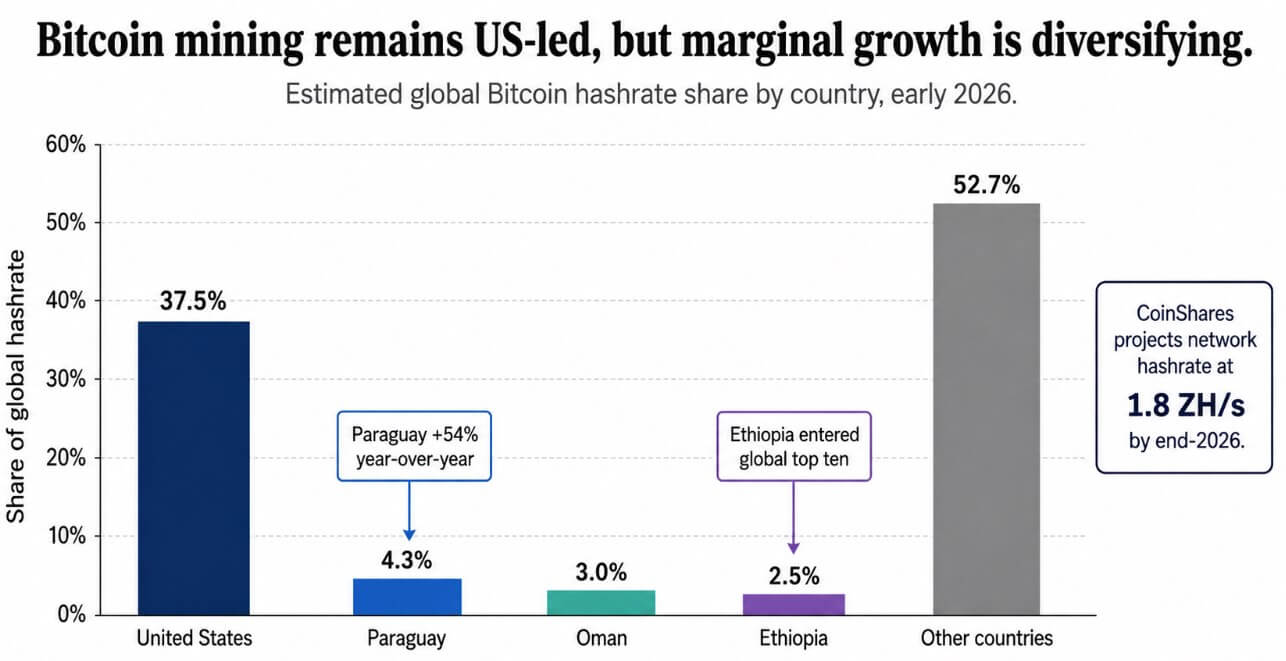
The US held roughly 37.5% of global Bitcoin hashrate as of January 2026, the largest national share, while Paraguay grew 54% year-over-year to reach 4.3%, Ethiopia climbed to 2.5% and eighth globally, and CoinShares projects the network will hit 1.8 ZH/s by end-2026 with Paraguay, Ethiopia, and Oman all in the global top ten.
A bar chart shows the United States holding 37.5% of global Bitcoin hashrate in early 2026, with Paraguay, Oman, and Ethiopia gaining share as marginal capacity diversifies globally.
HIVE Digital Technologies operates with high capacity in Canada, Sweden, Paraguay, and the US, and CEO Aydin Kilic noted that the first question is whether HIVE owns the land and can execute efficiently on-site, then off-taker demand, then long-term power availability and economics.
On US competitiveness specifically, Kilic pointed to permitting and zoning efficiency, reliable power contracts at scale and attractive prices, and long-term grid certainty. The company's Yguazú campus in Paraguay reached 300 MW of ANDE power agreements because the land and utility relationships were already in place.
In Sweden, HIVE signed a non-binding LOI for a potential up to 10-year lease of its Boden facility, covering 25 MW of critical IT load, with planned retrofitting for 10,000 NVIDIA GB300 GPUs, built on a long-term relationship with the national energy provider.
Hashprice dropped to a record low of $27.89 per PH/s per day in the second quarter as Bitcoin fell roughly 50% from its October 2025 peak near $124,000, and CoinShares estimates that older-generation equipment operating at roughly $0.05/kWh ran at negative gross margins.
In Paraguay, Laos, and Finland, operations that paired newer hardware with genuine power cost advantages maintained profitability through the down cycle, with hash prices at a record low of $27.89 per PH/s per day, giving every efficiency advantage an outsized return.
FERC's move to require all six regional grid operators to justify or reform their interconnection rules for large loads, combined with ERCOT's tightening oversight of crypto projects after reliability failures ahead of summer 2026, added costs and timelines to new US buildouts.
Two bottlenecks
The tax-before-liquidity mechanism Levin describes has been a real driver of offshore structuring for institutional clients and the validators serving them, and Paschall confirmed that the courts will enforce current law.
Senator Cynthia Lummis, one of the bill's most consistent advocates in the Senate, departs in January 2027, making the window before the August recess the most realistic opportunity for passage.
Defers tax on newly minted rewards until sale or disposition
Whether staking is treated as a securities activity in every structure; custody and licensing uncertainty
Could make U.S.-based validation more viable, especially for institutional clients
Bitcoin mining
Power cost, land control, grid access, permitting, zoning, uptime
May reduce tax friction around mined tokens
Does not create cheap power, interconnection capacity, permits, or long-term grid certainty
Miners will keep diversifying into jurisdictions with reliable, scalable power
AI / HPC overlap
Competition for powered sites, substations, transformers, and long-term energy contracts
No direct impact
Does not resolve competition between miners and AI data centers for grid capacity
Mining sites with strong power rights become valuable compute infrastructure
For Bitcoin mining, tax clarity is a marginal improvement to a location decision driven by substations, utility contracts, and permitting queues.
Trump's “Bitcoin made in America” pledge implied that federal intent could produce the physical infrastructure those processes require. The mining industry's actual geographic expansion, spanning Paraguay, the Nordics, East Africa, and the Gulf alongside its US base, is the practical answer to that assumption.