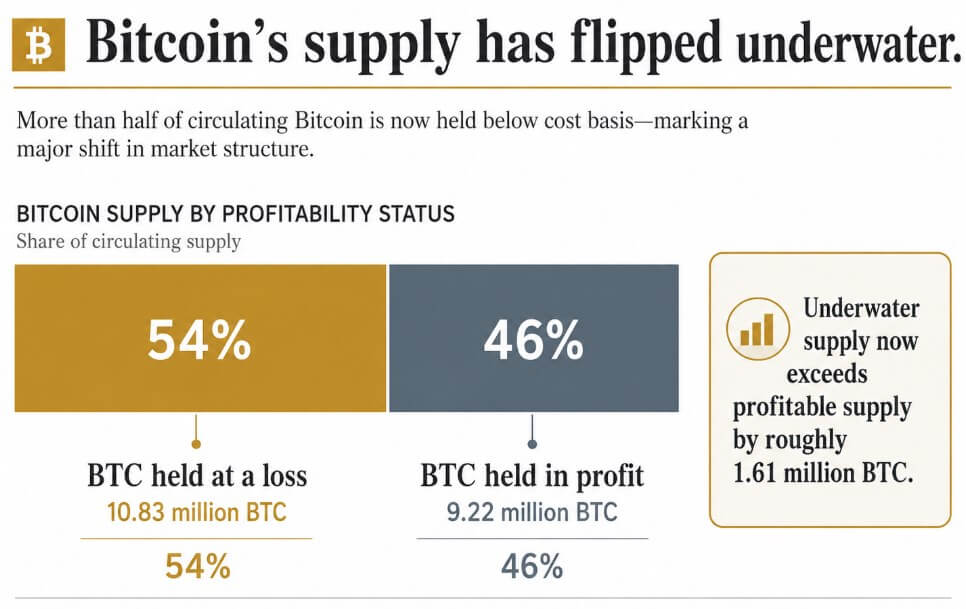
Glassnode's latest Week Onchain report shows that roughly 10.83 million BTC are now in the red, against 9.22 million still in profit.
Loss-making supply now accounts for roughly 54% of the measured total, compared with 46% still in profit, meaning underwater coins exceed profitable coins by about 1.61 million BTC.
Infographic showing 54% of Bitcoin's circulating supply (10.83 million BTC) is held at a loss, exceeding the 46% held in profit by roughly 1.61 million BTC.
Glassnode describes this as one of the sharpest deteriorations in investor profitability since the current bull market began, a threshold with real psychological weight.
Crossing it before has coincided with genuine capitulation among newer buyers, the kind of stress that shapes a structural drawdown.
Yet those same coins can migrate to higher-conviction buyers if patient capital is willing to absorb them, and Glassnode's data shows exactly that kind of buyer has begun to show up.
The seller profile is already changing underneath that stress, as Glassnode says long-term holders have started rebuilding positions, a reversal from an extended stretch of distribution, with net position change back in positive territory.
The pace stays modest, well short of the buying waves seen in prior accumulation cycles, but the direction has turned. The first sign of a bottom often shows up here, in experienced holders deciding a drawdown is worth buying, well before price itself confirms anything.
Glassnode's Accumulation Trend Score climbed across multiple cohorts this week, with the strongest readings among wallets holding less than 1 BTC and entities holding 100 to 1,000 BTC.
Wallets in the 1,000-to-10,000 BTC range also turned net buyers. Bitcoin's quiet bid is spreading across the entire ownership ladder, from the smallest wallets to mid-sized entities.
US-traded spot Bitcoin ETFs remain in sustained net outflow territory, and that selling pressure has persisted even as on-chain conviction builds in the opposite direction. The ETF story explains why the price stays weak, while the on-chain story explains who is taking the other side.
Market layer
Current signal
What it means
Article implication
ETF investors
Sustained net outflows
Regulated wrappers are still de-risking
Explains why price remains weak
Long-term holders
Net position change back in positive territory
Experienced holders are rebuilding exposure
Suggests supply is moving to patient hands
Small wallets
Strong accumulation among sub-1 BTC wallets
Retail-sized holders are buying the drawdown
The bid is not only institutional or whale-driven
Mid-sized entities
Strong buying among 100–1,000 BTC entities
Larger on-chain holders are also absorbing supply
Accumulation is broadening across cohorts
Large wallets
1,000–10,000 BTC wallets turned net buyers
Bigger holders are no longer only distributing
Confirms the seller profile is changing
Spot order books
Coinbase and Binance shifting toward bids
Buyers are placing liquidity below spot
A base can form even while price looks weak
Coinbase and Binance both show books shifting toward the bid, with buyers adding liquidity below spot. That bid looks patient, which is why the price can still look weak even as a base starts to form underneath it.
Hyperliquid traders hold a long bias at the highest level Glassnode has tracked, using leveraged exposure to bet on a bounce before spot conviction is fully confirmed.
The cash market is trying to build a floor, while the derivatives market is trying to get there first.
Options traders are already paying up for protection: the 14-day put-to-call volume ratio climbed above 1.0, its highest reading in a year. Implied volatility is climbing too, up from depressed levels, though Glassnode stops short of calling it a panic reading.
The market carries enough fear to begin bottoming, though the fear needed to confirm a finished capitulation may still be building.
Put together, the pattern looks unusual for a bottoming process, and Bitcoin may be finding a floor through an unusual mechanism: ETF investors are selling while stronger, more patient hands absorb the exit in real time.
Glassnode frames it as an early, still-developing bottoming process and flags that a final capitulation-driven volatility spike stays possible.
Long-term holders buying also trails the scale of prior accumulation waves by a wide margin, keeping the recovery in accumulation fragile.
Bitcoin can probably bottom without ETF inflows returning, as long as outflows slow enough to stop overpowering on-chain accumulation, and the crowded long positioning on Hyperliquid unwinds gradually through price strength.
Scenario
What happens next
Confirmation signal
What it means
Bull case: controlled migration
ETF outflows slow while long-term holders and wallet cohorts keep accumulating
Bid-heavy order books absorb underwater supply; Hyperliquid longs resolve through a bounce
The transfer phase becomes the bottom
Base case: fragile bottoming
Accumulation continues, but ETF outflows and underwater supply keep rallies capped
BTC chops sideways while loss supply stops expanding
Bitcoin builds a base, but recovery stays uneven
Bear case: final capitulation
Crowded Hyperliquid longs get flushed while ETF outflows persist
Implied volatility spikes and underwater holders capitulate lower
Supply still transfers to stronger hands, but through a sharper washout
Failure case: accumulation fades
Long-term holder buying slows and cohort accumulation narrows
Bid-heavy order books disappear; ETF outflows keep dominating
The market was pausing inside a broader drawdown, not bottoming
How this plays out
In the bull case, ETF outflows continue but slow, while long-term holders and broader wallet cohorts continue to accumulate through the summer.
Bid-heavy order books keep absorbing supply from newer, underwater holders, and the aggressive Hyperliquid long positioning resolves through a genuine bounce.
Bitcoin's correction becomes a controlled migration, from ETF sellers and short-term holders into the hands of patient on-chain capital, and the transfer phase becomes the bottom.
In the bear case, the crowded long positioning in Hyperliquid gets flushed, ETF outflows persist, and underwater holders capitulate at lower prices.
Implied volatility spikes toward genuine panic levels, and long-term holder accumulation slows as the drawdown deepens. Bitcoin still ends up transferring to stronger hands, but through one final capitulation event.
Bitcoin's next bottom may begin with an unusual sequence: institutions leaving, weaker holders capitulating, and stronger hands quietly taking the other side. A bottom starts as a turnover in who owns the supply, well before it shows up in price.