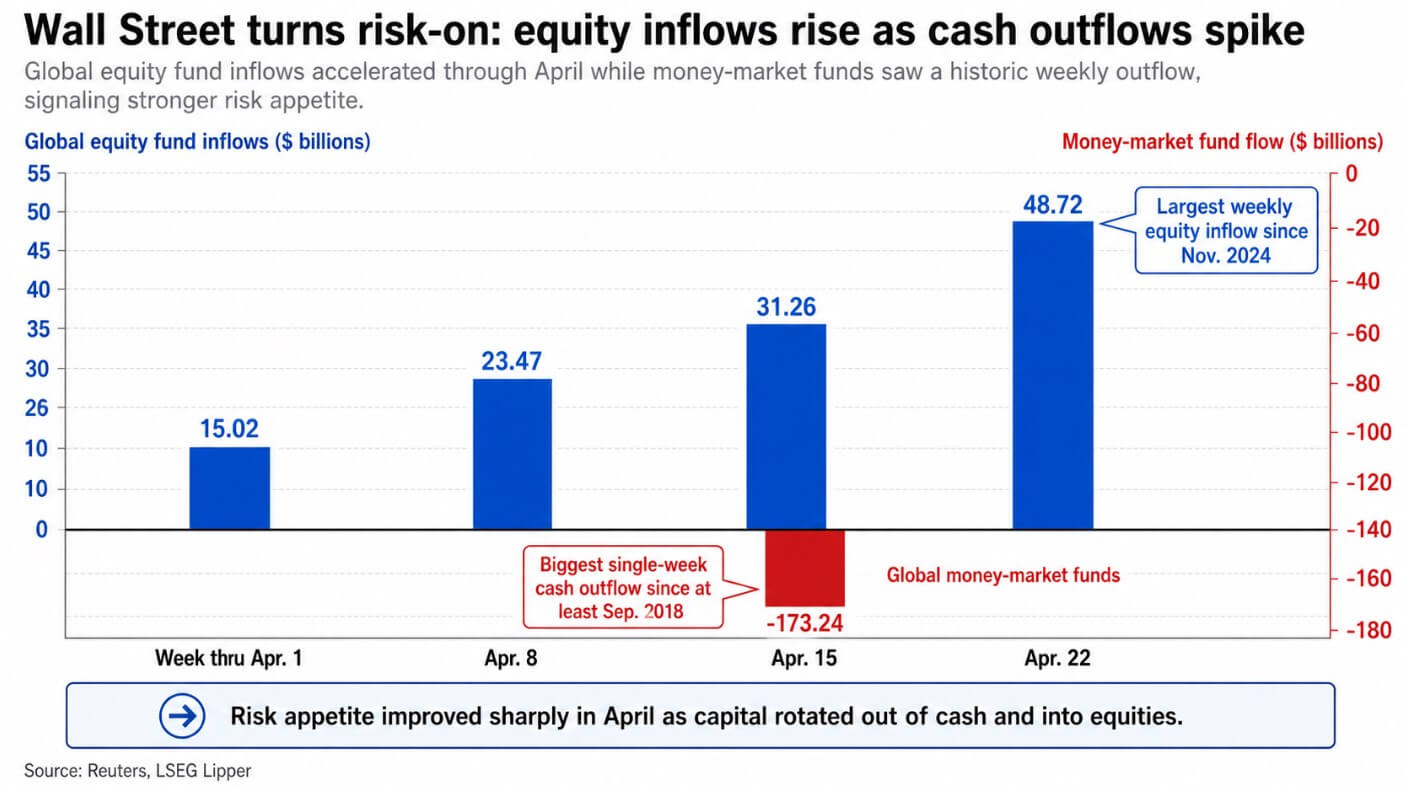
Global equity funds pulled in over $15 billion in the week through Apr. 1, then $23.47 billion, $31.26 billion, and finally $48.72 billion in the week through Apr. 22.
Global money-market funds simultaneously bled a $173.24 billion outflow in the week through Apr. 15, the biggest single-week exit from cash since at least September 2018.
Together, the figures create a roughly $292 billion risk-on signal, combining $118 billion of global equity fund inflows across four weeks with a separate $173 billion weekly exit from cash.
When capital flows toward risk, it flows toward the asset class Bitcoin currently behaves like.
Global equity funds attracted $48.72 billion in the week through April 22 while money-market funds shed a record $173.24 billion the prior week.
The more pointed detail comes from Coinbase's survey of 91 global investors, comprising 29 institutions and 62 non-institutions, conducted between Mar. 16 and Apr. 7.
Among institutional respondents, 75% view Bitcoin as undervalued, while 61% of non-institutional crypto investors hold the same view. Only 7% of institutions and 11% of non-institutions see BTC as overvalued.
Those numbers describe a market where buyers of size still see room to the upside. Capital rotating into risk meets an asset that its most sophisticated holders still consider cheap, held by a market yet to rewire itself for euphoria.
The on-chain picture
BTC supply moved within the last three months fell 37% during the first quarter, while supply that had not moved for more than a year rose 1%.
Speculative holders who bought at higher prices cycled out through the drawdown, and long-duration holders accumulated.
The Puell Multiple fell to 0.7 in the first quarter, implying miner revenue ran about 30% below its one-year baseline, a zone that has historically coincided with accumulation periods.
Long-term holder balances rose while exchange balances fell, and stablecoin supply climbed from $308 billion to $320 billion, meaning dry powder stayed inside the crypto market during the selloff.
Options open interest grew 2.4%, and perpetual futures open interest recovered roughly 8.6%, painting a market that absorbed its deleveraging and rebuilt at a measured pace.
Metric
Reading
Why it matters for the BTC setup
Institutional respondents viewing BTC as undervalued
75%
Large investors still see upside from current levels
Non-institutional respondents viewing BTC as undervalued
61%
Constructive view extends beyond institutions
Institutional respondents viewing BTC as overvalued
7%
Little sign of institutional euphoria
Non-institutional respondents viewing BTC as overvalued
11%
Froth still looks limited
Survey sample
91 global investors
Gives context for how broad the sentiment snapshot is
Institutional share of sample
29 respondents
Shows the institutional result is based on a defined subgroup
Non-institutional share of sample
62 respondents
Balances the institutional view with broader crypto investor sentiment
Survey field dates
Mar. 16 to Apr. 7, 2026
Positions the survey in the run-up to Q2
BTC correlation with S&P 500 (4Q25)
0.58
Supports the idea that BTC still trades like a risk asset
BTC correlation with gold
Negligible
Suggests BTC is not behaving like a defensive hedge in this regime
Read-through for Q2
Undervalued + risk-sensitive
Macro risk-on flows could support BTC without requiring euphoria
The bull case
If April's equity rotation continues to broaden into high-yield credit, private credit, and emerging-market risk, Bitcoin sits in the path of that capital.
EPFR described a “marked increase in risk appetite,” with high-yield bond funds posting their first inflow since mid-February and private credit flows hitting an eight-week high.
In that scenario, institutional conviction in undervaluation and cleaner on-chain positioning create a repricing path with genuine room to run. Coinbase's survey respondents are positioned for caution, which means an improving macro backdrop catches them under-owned.
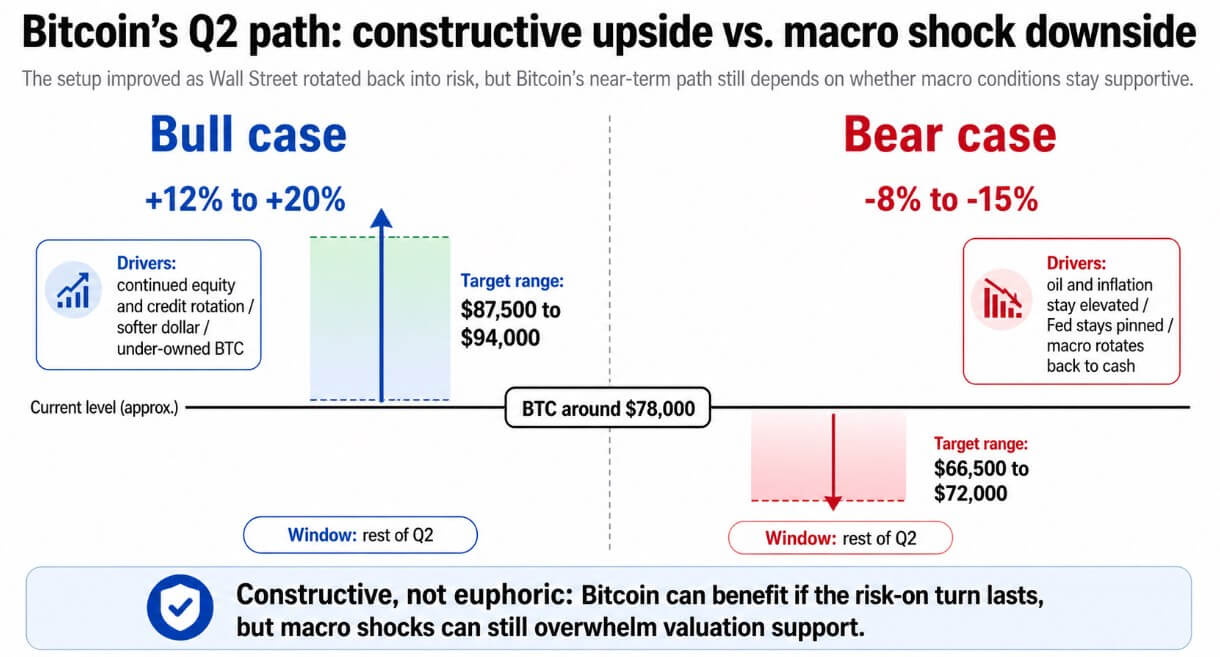
A 12% to 20% gain from current levels over the rest of the second quarter would put BTC in the $87,500 to $94,000 range and could be driven solely by sustained institutional rotation.
The dollar softening, already visible in last week's intervention-driven move, which pushed the dollar index down 0.8%, adds a secondary tailwind.
Bitcoin has tended to track global dollar liquidity closely, and softer financial conditions favor risk assets at the margin.
The bear case
Coinbase's own formal stance for the second quarter stays neutral, and the conditions it would need to see before turning more constructive, such as a definitive end to the Middle East conflict, oil retreating, and inflation easing, have yet to arrive.
Oil staying elevated and the Fed kept pinned by persistent inflation would flip Bitcoin's equity correlation from tailwind to headwind. If macro desks rotate back toward cash, as they did in early March, BTC trades as a liquidity beta on the way down.
In that setup, macro dominance overrides the conviction of institutional undervaluation. Survey respondents may believe BTC is cheap and still sit on the sidelines as geopolitical uncertainty drives their positioning.
The on-chain accumulation data would hold as a longer-term constructive read, but a renewed macro shock would overwhelm those readings in the short run.
A drawdown of 8% to 15% from current levels, to roughly $66,500 to $72,000, is consistent with the scale of prior macro-driven BTC corrections and would require only a return to March's defensive flow pattern.
Bitcoin trades near $78,000, with a bull case targeting $87,500–$94,000 on equity rotation and a bear case of $66,500–$72,000 if macro conditions deteriorate.
The rest of the quarter pivots on whether April's equity and credit rotation proves durable or snaps back on the next geopolitical headline, and whether Bitcoin's correlation with equities stays elevated or drifts toward a more independent path as crypto-specific flows begin to dominate price action.
The constructive case rests on broader markets taking on more risk again, while Bitcoin's most informed holders remain under-owned for a clean recovery.