Bitcoin just slipped below the bear-market line traders cannot ignoreBitcoin's move below the 200-week moving-average area has turned a familiar cycle marker into a live demand test.
On Sunday, June 28, BTC traded at $60,238, down 6.1% over the past 7 days and 18% over the past 30 days. That left the spot below the 200-week weighted moving average, tracked by Newhedge at $62,383, after three heavy ETF redemption sessions.
The line now separates two near-term outcomes. A move back through the low-$62,000 area would suggest forced selling and ETF redemptions temporarily pushed Bitcoin through a level long-term holders watch. More time below it would turn the old stress marker into potential overhead resistance.
The market's focus on the level is visible in other 200-week moving-average dashboards and in social posts that framed the break as a cycle warning. A moving average can organize the test. Flow and time below the line supply the answer.
The Bitcoin price repair level is close
The 200-week weighted average is important because it compresses years of price behavior into a single slow-moving reference. Bitcoin has historically spent limited time below it during severe drawdowns, which is why traders treat it as a cycle-level stress marker.
In this setup, the gap is concrete. Bitcoin sits roughly $2,555 below Newhedge's 200-week weighted moving average. That is close enough for volatility to challenge quickly, yet large enough that hovering near $60,000 leaves the break unresolved.
The 200-day marker is part of a larger repair sequence. Barchart's technical screen showed Bitcoin's 200-day simple moving average at $84,165, far above spot. A 200-week reclaim here would test whether the breakdown is accepted; a 200-day reclaim would signal broader trend repair.
That sequence keeps the signal clean. Bitcoin can recover the 200-week line and remain in a damaged trend, while repeated failures below the 200-week area would keep pressure on the idea that the move is only a liquidation event.
ETF redemptions turned the line into a flow test
The flow backdrop makes the current move harder to dismiss as a pure chart event. Farside Investors' Bitcoin ETF table showed net outflows of $469 million on Jun. 24, $691 million on Jun. 25, and $444 million on Jun. 26.
Together, those sessions represented about $1.61 billion in net redemptions. They show that the break arrived while one of the main institutional demand channels was removing support.
Capitulation would require evidence that sellers are exhausting themselves and that buyers are absorbing supply near the level. Continued ETF redemptions would run counter to this, making a reclaim harder to sustain.
Recent CryptoSlate coverage has already addressed the near-term setup, including the $58,000 weekend exhaustion-versus-acceptance question, the ETF outflow and inflation backdrop, and liquidation pressure around the failed $60,000 rebound.
The fresh issue is whether selling pressure has pushed Bitcoin through a line that longer-cycle traders will defend, or whether the same flows make that line less relevant until demand improves.
Macro conditions add outside pressure. In its Jun. 17 statement, the Federal Reserve held its target range at 3.50% to 3.75% and said inflation remained elevated.
The Fed's June projection materials showed a median 2026 funds rate of 3.8%, while the May employment report showed payrolls rising by 172,000 and unemployment at 4.3%.
A resilient labor market and sticky inflation backdrop can keep rate-cut expectations from becoming an immediate tailwind for risk assets. Under those conditions, Bitcoin needs real demand to reclaim the 200-week area rather than simple relief from the flush of leverage.
A widely circulated X post captured trader psychology around the moving-average break. Social attention explains why the line is visible; price, ETF flows, and macro conditions decide whether visibility becomes support.
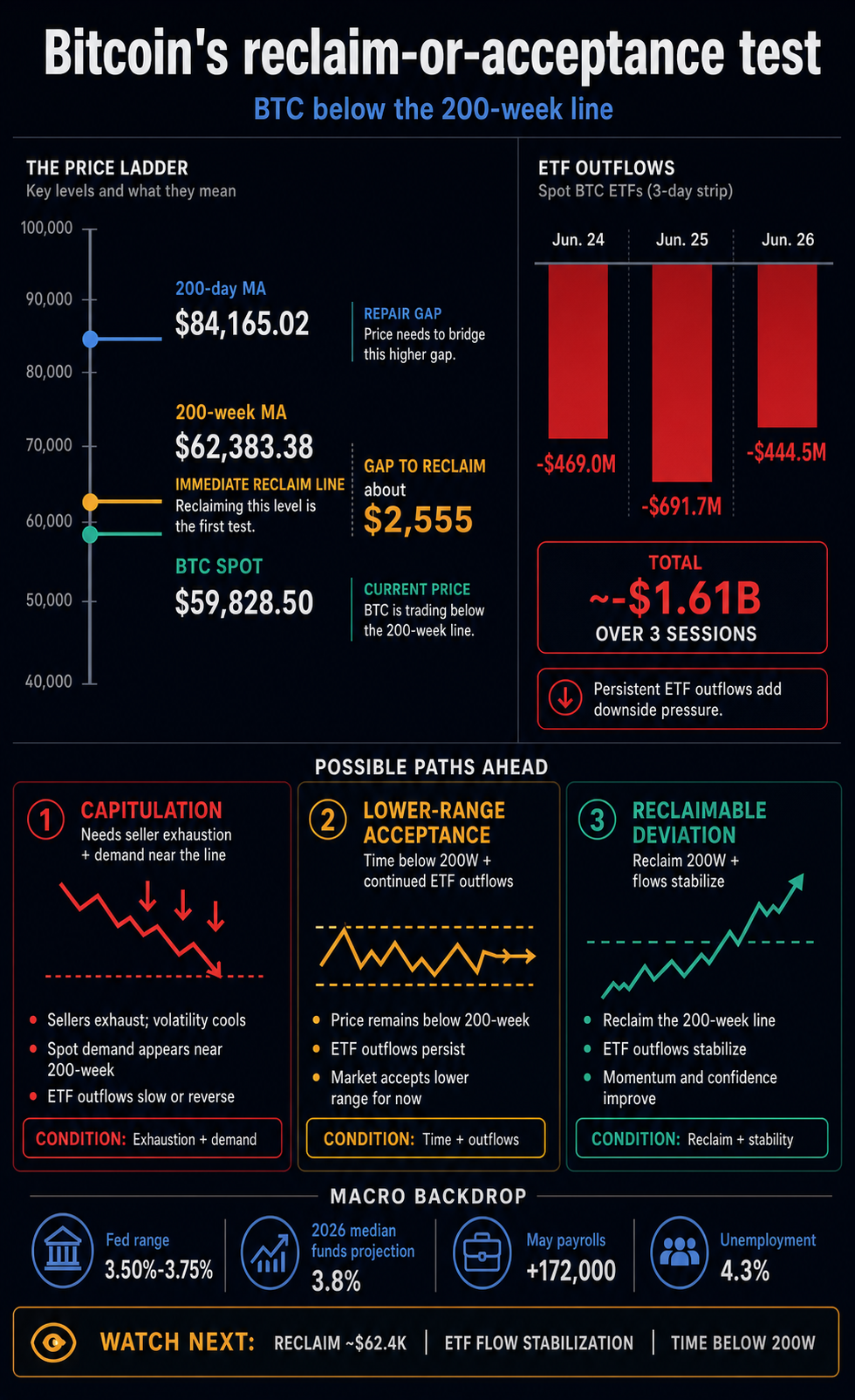
The three outcomes have different confirmations
The cleanest way to track the break is through conditions rather than forecasts. The same price zone can support three different interpretations depending on what happens next.
Scenario
What supports it
What weakens it
Marker to watch
Capitulation
Heavy ETF outflows and a fast drop below a watched long-term line
Persistent redemptions and no durable reclaim
BTC back above the 200-week area with ETF flows stabilizing
Lower-range acceptance
Repeated trading below the 200-week average while ETF outflows continue
A swift reclaim with improving demand
Time spent below roughly $62,383 and the next Farside flow updates
Reclaimable deviation
Spot remains close to the 200-week average and the 200-day marker is a longer repair target
Failure to regain the line despite easing selling pressure
A close back above the 200-week average, then progress toward broader trend repair
The capitulation case starts with the violence of the move: forced selling, ETF redemptions, and a sharp weekly drawdown arrived together. Confirmation would require absorption near the 200-week area and a fast return above it.
Lower-range acceptance strengthens if Bitcoin remains below the 200-week average while ETF flows remain negative. That would show buyers are allowing the old stress line to become resistance.
The reclaimable-deviation case remains viable because spot is still close to the 200-week reference. A push back above the low-$62,000 area, especially alongside smaller ETF outflows or renewed inflows, would make the break look more like a reset than a shift into a lower regime.
Even then, the 200-day average remains far overhead, so a 200-week reclaim would only be the first repair step.
The current evidence indicates that the acceptance test is still in progress. Bitcoin has crossed below the market's bear-market line, but flows and time around the low-$62,000 area will determine whether that line becomes a floor again or the ceiling of a lower range.
The post appeared first on CryptoSlate.
read the full story
Bitcoin's move below the 200-week moving-average area has turned a familiar cycle marker into a live demand test.
On Sunday, June 28, BTC traded at $60,238, down 6.1% over the past 7 days and 18% over the past 30 days. That left the spot below the 200-week weighted moving average, tracked by Newhedge at $62,383, after three heavy ETF redemption sessions.
The line now separates two near-term outcomes. A move back through the low-$62,000 area would suggest forced selling and ETF redemptions temporarily pushed Bitcoin through a level long-term holders watch. More time below it would turn the old stress marker into potential overhead resistance.
The market's focus on the level is visible in other 200-week moving-average dashboards and in social posts that framed the break as a cycle warning. A moving average can organize the test. Flow and time below the line supply the answer.
The Bitcoin price repair level is close
The 200-week weighted average is important because it compresses years of price behavior into a single slow-moving reference. Bitcoin has historically spent limited time below it during severe drawdowns, which is why traders treat it as a cycle-level stress marker.
In this setup, the gap is concrete. Bitcoin sits roughly $2,555 below Newhedge's 200-week weighted moving average. That is close enough for volatility to challenge quickly, yet large enough that hovering near $60,000 leaves the break unresolved.
The 200-day marker is part of a larger repair sequence. Barchart's technical screen showed Bitcoin's 200-day simple moving average at $84,165, far above spot. A 200-week reclaim here would test whether the breakdown is accepted; a 200-day reclaim would signal broader trend repair.
That sequence keeps the signal clean. Bitcoin can recover the 200-week line and remain in a damaged trend, while repeated failures below the 200-week area would keep pressure on the idea that the move is only a liquidation event.
ETF redemptions turned the line into a flow test
The flow backdrop makes the current move harder to dismiss as a pure chart event. Farside Investors' Bitcoin ETF table showed net outflows of $469 million on Jun. 24, $691 million on Jun. 25, and $444 million on Jun. 26.

Together, those sessions represented about $1.61 billion in net redemptions. They show that the break arrived while one of the main institutional demand channels was removing support.
Capitulation would require evidence that sellers are exhausting themselves and that buyers are absorbing supply near the level. Continued ETF redemptions would run counter to this, making a reclaim harder to sustain.
Recent CryptoSlate coverage has already addressed the near-term setup, including the $58,000 weekend exhaustion-versus-acceptance question, the ETF outflow and inflation backdrop, and liquidation pressure around the failed $60,000 rebound.

The fresh issue is whether selling pressure has pushed Bitcoin through a line that longer-cycle traders will defend, or whether the same flows make that line less relevant until demand improves.
Macro conditions add outside pressure. In its Jun. 17 statement, the Federal Reserve held its target range at 3.50% to 3.75% and said inflation remained elevated.
The Fed's June projection materials showed a median 2026 funds rate of 3.8%, while the May employment report showed payrolls rising by 172,000 and unemployment at 4.3%.

A resilient labor market and sticky inflation backdrop can keep rate-cut expectations from becoming an immediate tailwind for risk assets. Under those conditions, Bitcoin needs real demand to reclaim the 200-week area rather than simple relief from the flush of leverage.
A widely circulated X post captured trader psychology around the moving-average break. Social attention explains why the line is visible; price, ETF flows, and macro conditions decide whether visibility becomes support.
The three outcomes have different confirmations
The cleanest way to track the break is through conditions rather than forecasts. The same price zone can support three different interpretations depending on what happens next.
| Scenario | What supports it | What weakens it | Marker to watch |
|---|---|---|---|
| Capitulation | Heavy ETF outflows and a fast drop below a watched long-term line | Persistent redemptions and no durable reclaim | BTC back above the 200-week area with ETF flows stabilizing |
| Lower-range acceptance | Repeated trading below the 200-week average while ETF outflows continue | A swift reclaim with improving demand | Time spent below roughly $62,383 and the next Farside flow updates |
| Reclaimable deviation | Spot remains close to the 200-week average and the 200-day marker is a longer repair target | Failure to regain the line despite easing selling pressure | A close back above the 200-week average, then progress toward broader trend repair |
The capitulation case starts with the violence of the move: forced selling, ETF redemptions, and a sharp weekly drawdown arrived together. Confirmation would require absorption near the 200-week area and a fast return above it.
Lower-range acceptance strengthens if Bitcoin remains below the 200-week average while ETF flows remain negative. That would show buyers are allowing the old stress line to become resistance.
The reclaimable-deviation case remains viable because spot is still close to the 200-week reference. A push back above the low-$62,000 area, especially alongside smaller ETF outflows or renewed inflows, would make the break look more like a reset than a shift into a lower regime.
Even then, the 200-day average remains far overhead, so a 200-week reclaim would only be the first repair step.
The current evidence indicates that the acceptance test is still in progress. Bitcoin has crossed below the market's bear-market line, but flows and time around the low-$62,000 area will determine whether that line becomes a floor again or the ceiling of a lower range.
The post appeared first on CryptoSlate.
read the full story
Grok, Meta AI and Claude Predict Bitcoin’s $100K Comeback as BTC Battles $60K
With bitcoin languishing around the psychologically important $60,000 mark, the race to six figures…

Prediction Market Traders Give Bitcoin 76% Odds of Hitting $50K Before $100K
Prediction market traders are pricing some of the most bearish bitcoin outlooks of 2026, with more…

Will Bitcoin price recover in July?
Bitcoin’s past July gains and heavy short bets point to a rally toward $75,000, but a break below…

Strategy's Saylor Defies Critics With New 'More Charts' Post as Bitcoin Battles for $60,000
Michael Saylor hints at new Bitcoin buys with a new "More Charts" post, but Strategy's own rule may…

Who Actually Pays When MicroStrategy’s $64 Billion Bitcoin Bet Goes Wrong?
MicroStrategy's $64 billion Bitcoin bet is underwater below $60,000. See who actually pays as…

Bitcoin Cheaper Than 90% of Its History Right Now, Says Big Print Author Lawrence Lepard
Lawrence Lepard, investment manager and author of “The Big Print,” told RE:Bitcoin host Chase…
Samson Mow says bitcoin bottom is in despite skepticism from analysts
The bitcoin advocate said his crypto bottom claim is based on the fact that the traditional…

Michael Saylor teases more bitcoin buying even as Strategy stock continues to fall
The crypto bull shrugged off market skepticism by sharing a chart of the company's $50 billion stash…
Bitcoin UTXO Capitulation Pattern Puts Long-Term Holders in Focus
Bitcoin holders aren’t selling. That’s the short version. The longer version is more…

Grayscale Analyst Outlines Strategy Balance Sheet Pressure Around Bitcoin Holdings
Grayscale Analyst Outlines Strategy Balance Sheet Pressure Around Bitcoin Holdings: key Strategy…

CME Puts Dominate Bitcoin Options as Traders Bet Against $60K Floor
Bitcoin’s derivatives markets delivered a pointed message this weekend: the $60,000 level is not…
Saylor hints at new Bitcoin buy as Strategy mNAV falls below 1
Michael Saylor hinted at another Strategy Bitcoin buy as mNAV falls below 1 and investors question…

Bitcoin price holds $60K as Middle East tensions fail to spark panic
Bitcoin trades near $60K as Strategy fears, Middle East tension, and on-chain reset signals leave…
US Spot Bitcoin ETFs Log $1.79 Billion Weekly Net Outflows
US Spot Bitcoin ETFs Log $1.79 Billion Weekly Net Outflows: key Bitcoin ETF outflows context,…
On-Chain Flow: New Wallet Withdraws 1,350 BTC From Binance
On-Chain Flow: New Wallet Withdraws 1,350 BTC From Binance: key Bitcoin whale withdrawal context,…
Short-Term Bitcoin Holders Dump 50,000 BTC at a Loss as Capitulation Fears Mount
Nearly 50,000 Bitcoin hit exchange addresses at a loss. Short-term holders did the dumping — newer…
Michael Saylor Teases Bullish Signal: More Charts May Be Coming as Strategy’s Bitcoin Accumulation Grows
Michael Saylor’s latest orange-dot chart fueled fresh buy anticipation, showing 847,363 BTC and a…
Capitulation Signals: 50,000 BTC Deposited to Exchanges at a Loss
Capitulation Signals: 50,000 BTC Deposited to Exchanges at a Loss: key Bitcoin capitulation context,…