Bitcoin’s drop toward $60,000 last week exposed how quickly a shift in investor appetite can turn into forced selling when leverage has been rebuilt beneath the surface of the crypto market.
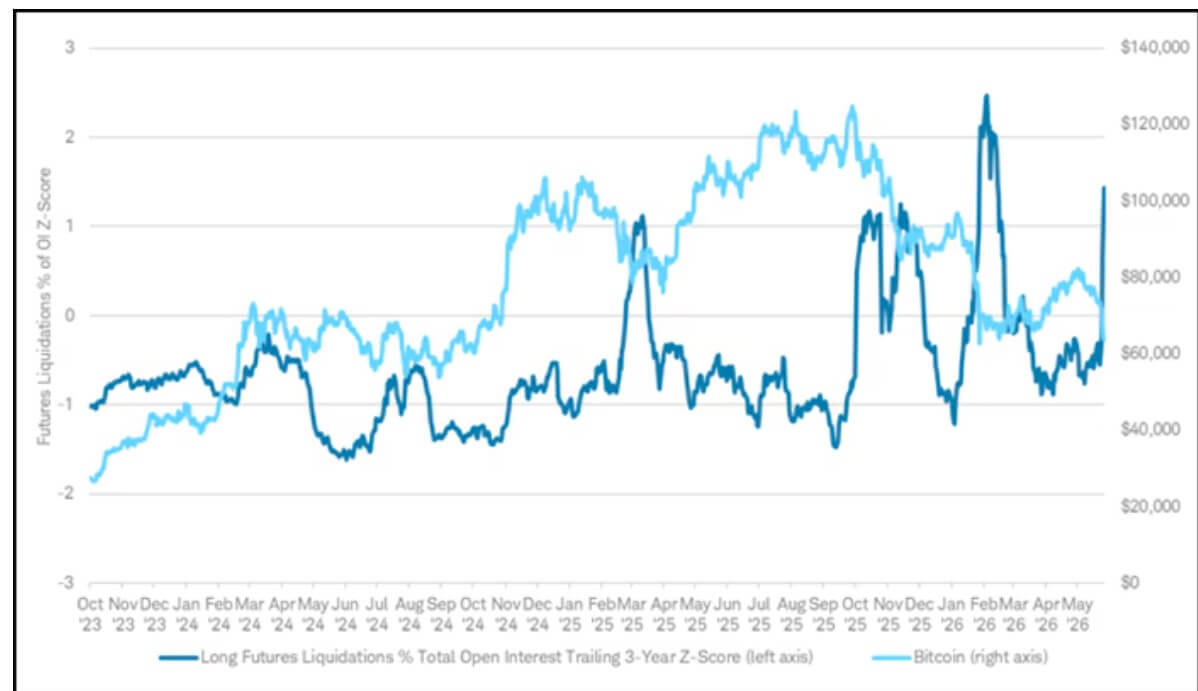
The largest cryptocurrency by market value fell nearly 14% last week, triggering almost $10 billion in liquidations of long futures as traders who had bet on higher prices were pushed out of the market.
Bitcoin later recovered to about $63,000, but the rebound did little to settle the debate over what caused one of the year's sharpest sell-offs.
Market commentary from Charles Schwab and NYDIG points to a broader explanation. Capital has been rotating toward artificial intelligence, private technology deals, and other high-growth trades at the same time that futures positioning in Bitcoin has become more crowded.
AI becomes the rival trade to Bitcoin
Bitcoin’s latest weakness has unfolded as investors reassess where the strongest speculative returns are coming from.
In a note shared with CryptoSlate, Jim Ferraioli, head of crypto research and strategy at Charles Schwab, said crypto investors have repeatedly shifted toward the market’s dominant momentum trade.
In recent months, artificial intelligence has taken that role.
The scale of spending tied to AI has drawn capital across listed equities, data-center infrastructure, and private markets. For investors who once used Bitcoin as a primary way to express a high-growth technology view, AI has become a direct competitor for attention and liquidity.
Strategy Executive Chairman Michael Saylor pointed to that pressure last week after Bitcoin’s decline. He said about $400 billion had flowed into AI infrastructure over the past six months, while US-listed spot Bitcoin ETFs had seen roughly $4 billion in outflows since mid-May.
The contrast underlined the challenge facing Bitcoin. The top crypto is no longer competing only with gold, other digital assets, or macro trades. It is being measured against an AI cycle that has become the main growth story across financial markets.
His argument centered on the overlap between the two investor bases. According to him, both sectors appeal to investors seeking exposure to emerging technologies, large markets, and high return potential.
As AI-linked stocks have continued to outperform, capital has moved toward the stronger trade.
That shift is also visible in private markets. Investors are already positioning for a potential wave of major technology listings, with companies such as SpaceX, OpenAI, and Anthropic viewed as eventual public-market candidates.
These large offerings can prompt institutions to raise cash or reduce existing positions before committing to new allocations.
For Bitcoin, the result is weaker marginal demand at a difficult point in the cycle. The network’s adoption story has not clearly broken down, but price action has softened as investors compare crypto with a technology trade that currently offers stronger momentum.
Ferraioli said the move reflected a market where leverage had returned, even if positioning was still below the excesses seen in earlier periods. He noted that futures open interest had dropped to about $31 billion in February after reaching a high of roughly $70 billion. By May, it had recovered to about $51 billion.
That recovery showed traders had moved back into leveraged exposure as Bitcoin regained ground. Once the market turned lower, those positions became a source of pressure.
According to him, almost $10 billion in long futures positions were liquidated last week as prices fell, forcing traders who had bet on further gains to close out. The decline in open interest during the selloff suggested that exposure was being removed from the market rather than replaced with fresh positions.
Bitcoin Long Futures Liquidation (Source: Charles Schwab)
Funding rates also moved back toward negative territory, showing that the long bias that had built up during the recovery had started to unwind. Ferraioli said liquidations relative to overall open interest pointed to a moderate forced reduction in positioning.
That helped explain why Bitcoin’s decline accelerated. The rotation toward AI-linked assets, ETF outflows, and hedge fund selling weakened demand. Then, BTC traders' derivatives positioning magnified the pressure once prices began moving lower.
In a leveraged market, selling can become automatic. Traders facing margin pressure are forced out of positions regardless of whether they still believe in the longer-term Bitcoin thesis. That process can push prices lower until enough exposure has been cleared.
The shift also showed how quickly Bitcoin’s support structure changed. ETF inflows and improving sentiment had helped the market earlier in the year. By late May, those flows had weakened while futures exposure had expanded.
Ferraioli noted that hedge funds were the main source of selling after Bitcoin peaked in early May. That pullback also aligned with the drop in futures open interest.
By May 31, hedge funds had cut their share of BlackRock’s iShares Bitcoin Trust, or IBIT, to about 19% from around 29%. Investment advisers moved the other way and added exposure during the decline, while retail brokerage accounts also reduced holdings.
The split pointed to a market where longer-term allocators were willing to buy weakness, while more tactical investors moved to reduce risk as momentum broke down.
A flush, Not Yet a Bottom
In view of the above, Ferraioli said the latest price action points to a market clearing out leverage rather than adding a new wave of speculative exposure.
According to him, the market signals are moving in the same direction. Open interest has declined, liquidations have surged, and funding rates have slipped toward negative territory.
Together, those measures suggest traders have been cutting long exposure after positioning became stretched during Bitcoin’s rebound from February levels.
That still leaves the market short of a confirmed bottom as forced liquidations can happen near the end of a selloff, but they can also appear in the middle of a broader decline. However, they do not prove that selling pressure has been exhausted on their own.
Ferraioli said liquidations need to be read alongside open interest and funding rates. A more constructive setup would require open interest to stop falling, funding to stabilize, and forced selling to fade.
If leverage builds again before spot demand recovers, the market could remain exposed to another round of pressure.
Meanwhile, some technical and cost-based levels suggest the BTC decline may be nearing an exhaustion zone.
Ferraioli noted that Bitcoin has returned to areas around its February lows, efficient miner production costs, and the 200-week moving average. Traders often watch those levels for signs that distress selling is slowing and longer-term buyers are beginning to reappear.
The question is whether those support levels can compete with the broader rotation into AI and private technology. Bitcoin’s recovery to about $63,000 showed demand had returned after the liquidation wave, but weaker ETF flows and hedge fund selling continue to weigh on the market.
The next stage will depend on whether fresh capital moves back into crypto. If AI-linked equities, infrastructure deals, and expected technology listings continue to attract the marginal dollar, Bitcoin may struggle to regain momentum even after a major leverage reset.