Charles Schwab is bringing Bitcoin to its 39 million clients – but without the protections they expectCharles Schwab announced this week that it will begin selling Bitcoin and Ethereum directly to its 39 million brokerage clients. They will appear in the same account view as stocks, ETFs, and retirement funds, in the same app, under the same brand, one click from the S&P 500 index fund a customer bought for their IRA.
What makes that arrangement so consequential is that the assets will arrive in one of the most familiar and trusted environments in American finance, while carrying a very different set of protections from what customers are used to seeing there.
Schwab's own disclosures say so plainly: the cryptocurrencies sold on its platform are not deposits, not FDIC-insured, not SIPC-protected, not backed by any central bank, and carry the risk of total loss of principal. That gap, between how crypto will feel to a Schwab customer and what it actually is, is the most consequential thing here. It is also the clearest illustration yet of the way crypto is entering mainstream American finance.
Charles Schwab's crypto rollout, and what it actually changes
The product, called Schwab Crypto, will begin a phased launch in the coming weeks. At launch, it will support only two assets: Bitcoin and Ethereum, which together account for roughly three-quarters of the total crypto market cap.
While a big part of the crypto industry lamented the exclusion of altcoin heavyweights like Solana and XRP, the short list of supported coins is a smart and calculated decision. A company managing $12.2 trillion in client assets has every reason to avoid the headline risk that would come with a more speculative token imploding inside a retirement account.
Trades will cost 75 basis points, or 0.75 percent, which Schwab says is one of the lowest fees available at a major brokerage. That undercuts Fidelity Crypto at $1 and competes with Robinhood and Coinbase, though it remains far above the near-zero commissions Schwab charges on stocks.
A separate crypto account, offered through Charles Schwab Premier Bank, will sit linked to the regular brokerage account. Paxos, a federally regulated blockchain infrastructure provider, will handle execution and sub-custody in the background. Residents of New York and Louisiana will be excluded at launch.
Deposits and withdrawals of outside crypto will be disabled, meaning customers can only trade what they buy through Schwab.
If this were Coinbase or Kraken adding a new feature, it would remain largely contained within the crypto industry. Having a company as large and influential as Schwab do this changes the frame entirely, because Schwab is where ordinary Americans keep retirement money, college savings, and the accumulated capital of a long working life.
Its brand is heavily regulated, familiar, and, in the best sense of the word, boring. That matters more here than the product list or the fee schedule, because the real story is not simply that Schwab is offering crypto, but that it is placing crypto inside an environment customers already associate with steadiness, oversight, and backstops.
When a platform with that kind of customer base adds crypto to its core offering, access becomes part of the default financial experience rather than something users have to actively seek out.
Roughly 20% of all US spot crypto ETP assets are already held by Schwab clients, according to the company's own count, suggesting significant demand for crypto exposure within its customer base. The new offering removes most of the friction that stood between that demand and direct ownership.
That is the most important change here, because the barrier being removed did more than keep crypto out. It also preserved a clearer distinction between assets investors treated as part of the traditional brokerage world and those that sat outside it.
Schwab built its reputation on investor protection. Deposited cash is swept into FDIC-insured programs, and securities sit under SIPC coverage up to statutory limits. The psychological contract a user has with a traditional brokerage like this is that when something breaks, whether a firm failure, a bank collapse, or a fraud, there is an established framework of protections standing behind the account. Crypto does not enter that framework just because it appears in the same interface.
Schwab clearly states this in its disclosures, as regulators require, so the legal distinction is laid out in plain language. The more significant issue is behavioral. An investor opening the app sees a single portfolio, where the Bitcoin tile looks much like the ETF tile and sits beside the same retirement holdings, cash balances, and stock positions they have spent years learning to trust.
The interface makes the assets feel operationally similar even though the protections behind them are categorically different. That is where the real risk begins, because the mismatch lives less in the legal fine print than in the expectations formed by the setting itself.
What mainstream absorption actually means
Schwab is not a first mover when it comes to crypto adoption. The company is joining a wave that began a few years ago and has gathered substantial momentum more recently. Morgan Stanley launched its Bitcoin Trust ETF last week, Goldman Sachs filed for a Bitcoin Premium Income ETF days later, and Fidelity already offers crypto to retail.
Regulators cleared much of the runway in 2025: the SEC rescinded Staff Accounting Bulletin 121, removing the accounting penalty for custodians holding client crypto, and the Office of the Comptroller of the Currency reaffirmed that national banks can handle crypto custody and stablecoin activity.
For a company the size of Schwab, the calculation has shifted. Offering crypto now looks less like an expression of institutional conviction and more like a competitive response to demand that has already established itself elsewhere.
Clients who want Bitcoin and Ethereum can already get them through Robinhood, Coinbase, or a competitor's ETF. Declining to offer direct access in that environment starts to look less like caution and more like strategic delay.
This is what crypto's mainstreaming actually looks like from inside a large company like Schwab. Bitcoin treasuries and crypto ETPs were once products associated with firms willing to signal conviction in a relatively narrow market. Now, crypto exposure is moving into the large, regulated platforms that define ordinary investing for millions of people.
What changes under those conditions is not just the number of buyers, but the terms under which the asset is encountered. Crypto starts to arrive wrapped in the visual language and institutional setting of traditional finance, even though the old protections do not automatically travel with it.
That change has consequences beyond convenience. A consolidated brokerage interface makes it easier to rotate among stocks, ETFs, and Bitcoin within a single account structure and familiar brand environment.
Over time, that kind of access is likely to draw crypto even further into the same portfolio behavior that governs the rest of retail investing, especially around rate decisions, jobs reports, geopolitical shocks, and broad risk-off moves. In calm conditions, that may look like greater efficiency and deeper integration. In a selloff, it means the same investors can trim equities, sell ETFs, and dump crypto from one unified portfolio in a single bout of stress.
What is being normalized here, then, is not simply ownership but expectation. Schwab is helping move spot crypto deeper into the retail plumbing of American finance, into the same screens, habits, and mental categories that customers already use for protected savings and conventional investments.
The launch will likely be celebrated as another milestone for adoption, and in one sense it is. In a more important sense, it marks the moment when uninsured, fully loss-bearing crypto begins to appear within one of the most trusted brokerage environments in the country, alongside assets customers have been taught for decades to regard as part of a safer, more regulated system.
That distinction may not matter much on launch day, and it may remain easy to overlook while markets are stable and enthusiasm is high.
It becomes far more important in the next period of stress, when customers look at one account holding retirement funds, ETF positions, cash programs, and direct crypto, all under the same brand, and discover that the protections they associate with the account stop at the edge of the Bitcoin allocation.
Schwab is giving its customers direct access to Bitcoin and Ethereum in the coming weeks, but the larger significance of that decision lies in the expectations that access will reshape. The question is not whether crypto has arrived inside mainstream American finance, because it clearly has.
The question is how that new familiarity will hold up when the first real downturn forces investors, under pressure, to learn which parts of the modern portfolio were never protected in the same way to begin with.
The post appeared first on CryptoSlate.
read the full storyMore from CryptoSlate
Charles Schwab announced this week that it will begin selling Bitcoin and Ethereum directly to its 39 million brokerage clients. They will appear in the same account view as stocks, ETFs, and retirement funds, in the same app, under the same brand, one click from the S&P 500 index fund a customer bought for their IRA.
What makes that arrangement so consequential is that the assets will arrive in one of the most familiar and trusted environments in American finance, while carrying a very different set of protections from what customers are used to seeing there.
Schwab's own disclosures say so plainly: the cryptocurrencies sold on its platform are not deposits, not FDIC-insured, not SIPC-protected, not backed by any central bank, and carry the risk of total loss of principal. That gap, between how crypto will feel to a Schwab customer and what it actually is, is the most consequential thing here. It is also the clearest illustration yet of the way crypto is entering mainstream American finance.

Charles Schwab's crypto rollout, and what it actually changes
The product, called Schwab Crypto, will begin a phased launch in the coming weeks. At launch, it will support only two assets: Bitcoin and Ethereum, which together account for roughly three-quarters of the total crypto market cap.
While a big part of the crypto industry lamented the exclusion of altcoin heavyweights like Solana and XRP, the short list of supported coins is a smart and calculated decision. A company managing $12.2 trillion in client assets has every reason to avoid the headline risk that would come with a more speculative token imploding inside a retirement account.
Trades will cost 75 basis points, or 0.75 percent, which Schwab says is one of the lowest fees available at a major brokerage. That undercuts Fidelity Crypto at $1 and competes with Robinhood and Coinbase, though it remains far above the near-zero commissions Schwab charges on stocks.
A separate crypto account, offered through Charles Schwab Premier Bank, will sit linked to the regular brokerage account. Paxos, a federally regulated blockchain infrastructure provider, will handle execution and sub-custody in the background. Residents of New York and Louisiana will be excluded at launch.
Deposits and withdrawals of outside crypto will be disabled, meaning customers can only trade what they buy through Schwab.
If this were Coinbase or Kraken adding a new feature, it would remain largely contained within the crypto industry. Having a company as large and influential as Schwab do this changes the frame entirely, because Schwab is where ordinary Americans keep retirement money, college savings, and the accumulated capital of a long working life.
Its brand is heavily regulated, familiar, and, in the best sense of the word, boring. That matters more here than the product list or the fee schedule, because the real story is not simply that Schwab is offering crypto, but that it is placing crypto inside an environment customers already associate with steadiness, oversight, and backstops.
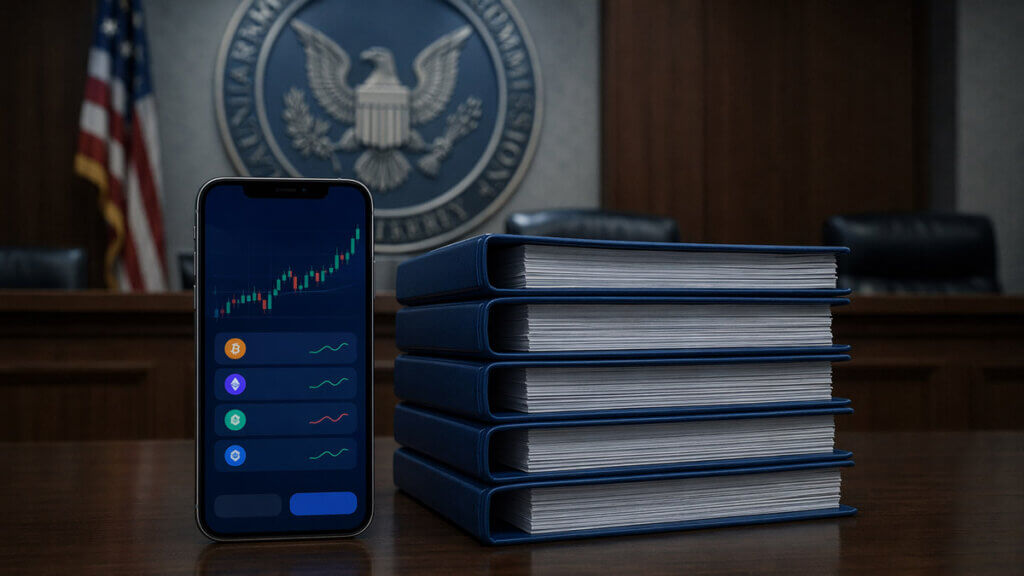
When a platform with that kind of customer base adds crypto to its core offering, access becomes part of the default financial experience rather than something users have to actively seek out.
Roughly 20% of all US spot crypto ETP assets are already held by Schwab clients, according to the company's own count, suggesting significant demand for crypto exposure within its customer base. The new offering removes most of the friction that stood between that demand and direct ownership.
That is the most important change here, because the barrier being removed did more than keep crypto out. It also preserved a clearer distinction between assets investors treated as part of the traditional brokerage world and those that sat outside it.
Schwab built its reputation on investor protection. Deposited cash is swept into FDIC-insured programs, and securities sit under SIPC coverage up to statutory limits. The psychological contract a user has with a traditional brokerage like this is that when something breaks, whether a firm failure, a bank collapse, or a fraud, there is an established framework of protections standing behind the account. Crypto does not enter that framework just because it appears in the same interface.
Schwab clearly states this in its disclosures, as regulators require, so the legal distinction is laid out in plain language. The more significant issue is behavioral. An investor opening the app sees a single portfolio, where the Bitcoin tile looks much like the ETF tile and sits beside the same retirement holdings, cash balances, and stock positions they have spent years learning to trust.
The interface makes the assets feel operationally similar even though the protections behind them are categorically different. That is where the real risk begins, because the mismatch lives less in the legal fine print than in the expectations formed by the setting itself.
What mainstream absorption actually means
Schwab is not a first mover when it comes to crypto adoption. The company is joining a wave that began a few years ago and has gathered substantial momentum more recently. Morgan Stanley launched its Bitcoin Trust ETF last week, Goldman Sachs filed for a Bitcoin Premium Income ETF days later, and Fidelity already offers crypto to retail.
Regulators cleared much of the runway in 2025: the SEC rescinded Staff Accounting Bulletin 121, removing the accounting penalty for custodians holding client crypto, and the Office of the Comptroller of the Currency reaffirmed that national banks can handle crypto custody and stablecoin activity.
For a company the size of Schwab, the calculation has shifted. Offering crypto now looks less like an expression of institutional conviction and more like a competitive response to demand that has already established itself elsewhere.
Clients who want Bitcoin and Ethereum can already get them through Robinhood, Coinbase, or a competitor's ETF. Declining to offer direct access in that environment starts to look less like caution and more like strategic delay.
This is what crypto's mainstreaming actually looks like from inside a large company like Schwab. Bitcoin treasuries and crypto ETPs were once products associated with firms willing to signal conviction in a relatively narrow market. Now, crypto exposure is moving into the large, regulated platforms that define ordinary investing for millions of people.
What changes under those conditions is not just the number of buyers, but the terms under which the asset is encountered. Crypto starts to arrive wrapped in the visual language and institutional setting of traditional finance, even though the old protections do not automatically travel with it.
That change has consequences beyond convenience. A consolidated brokerage interface makes it easier to rotate among stocks, ETFs, and Bitcoin within a single account structure and familiar brand environment.
Over time, that kind of access is likely to draw crypto even further into the same portfolio behavior that governs the rest of retail investing, especially around rate decisions, jobs reports, geopolitical shocks, and broad risk-off moves. In calm conditions, that may look like greater efficiency and deeper integration. In a selloff, it means the same investors can trim equities, sell ETFs, and dump crypto from one unified portfolio in a single bout of stress.
What is being normalized here, then, is not simply ownership but expectation. Schwab is helping move spot crypto deeper into the retail plumbing of American finance, into the same screens, habits, and mental categories that customers already use for protected savings and conventional investments.
The launch will likely be celebrated as another milestone for adoption, and in one sense it is. In a more important sense, it marks the moment when uninsured, fully loss-bearing crypto begins to appear within one of the most trusted brokerage environments in the country, alongside assets customers have been taught for decades to regard as part of a safer, more regulated system.
That distinction may not matter much on launch day, and it may remain easy to overlook while markets are stable and enthusiasm is high.
It becomes far more important in the next period of stress, when customers look at one account holding retirement funds, ETF positions, cash programs, and direct crypto, all under the same brand, and discover that the protections they associate with the account stop at the edge of the Bitcoin allocation.
Schwab is giving its customers direct access to Bitcoin and Ethereum in the coming weeks, but the larger significance of that decision lies in the expectations that access will reshape. The question is not whether crypto has arrived inside mainstream American finance, because it clearly has.
The question is how that new familiarity will hold up when the first real downturn forces investors, under pressure, to learn which parts of the modern portfolio were never protected in the same way to begin with.
The post appeared first on CryptoSlate.
read the full story| More from CryptoSlate |
|---|

Strategy Raises $1.76B War Chest As Saylor Signals Bigger Bitcoin Buy
Michael Saylor’s company has already lined up the money. Now the question is how much Bitcoin…

‘Facing Deception’: Bitcoin Dumps Below $75K as US-Iran Tensions Threaten to Escalate
Iranian officials blamed Trump for being deceptive and inconsistent with what is actually happening.

Weekly ETF recap: How Bitcoin, Ethereum, Solana & XRP funds stacked up?
The overall sentiment of the ETF market was optimistic, with the price action of all four tokens…

Alcoa Offloads Idle New York Smelter to Bitcoin Miner NYDIG
Alcoa just sold its shuttered Massena East smelter to NYDIG, a Bitcoin mining outfit that’s…

The 10 Public Companies With the Biggest Bitcoin Portfolios
Companies like Strategy, Twenty One, and Metaplanet hold billions of dollars' worth of Bitcoin.…

TIm Draper’s $250,000 BTC Call, New Whale Data, and More – Week In Review
Bitcoin’s latest rebound is running into resistance as whale deposits to exchanges surge, while…

US-Based Bitcoin ETFs Post Roughly $1B Inflows In Past Week: Report
The price of Bitcoin saw a rise in bullish momentum over the past week, as the initially improving…

Bitcoin Drops to $75K as Hormuz Strait Shuts Down
Bitcoin hit $75,000 on Tuesday. The Strait of Hormuz closed, and traders panicked. The strait…
Crypto ETF inflows rise as Bitcoin, Ethereum, and XRP attract fresh capital
Crypto ETFs saw strong inflows with Bitcoin nearing $1B, while Ethereum and XRP funds also posted…

Stablecoins can help businesses turn costs into revenue, Paxos Labs cofounder says
Firms using stablecoins can reshape margins by cutting costs, unlock credit and earn yield, but not…

Morgan Stanley’s $116M Bitcoin ETF debut is tiny next to $1.9T, and that’s why Wall Street will notice
Morgan Stanley launched its spot Bitcoin ETF on Apr. 8 on NYSE Arca, calling MSBT the first…
Bitcoin Mining Giants Sold More BTC in Q1 Than Entire 2025 Combined
MARA, Riot, CleanSpark, and others led record-breaking Bitcoin sell-offs as mining profits collapsed…
Bitcoin faces resistance near $75K as on-chain data signals profit-taking
Bitcoin nears $75K as Binance inflow spike signals profit-taking, while NUPL shows rising investor…
Tether CEO Issues Bullish Bitcoin Post as Price Stabilizes at $75,000
Bitcoin continues to gain momentum after its recent rally, which has fueled investors' confidence,…

'Think Even Bigger': Michael Saylor Teases Strategy's 800,000 BTC Milestone After $2 Billion Bitcoin Buy This Week
Michael Saylor has teased a new "even bigger" era for Strategy as on-chain data reveals a massive $2…
Bitcoin Miner Pain Reaches Critical Threshold — Impact On Price
According to data from a recent on-chain evaluation, the Bitcoin mining sector is once again…
Bitcoin Network Eases as Difficulty Slides 2.43% and Hashprice Rises 13.65%
Bitcoin’s mining difficulty eased this week, declining 2.43% from the prior target and settling at…
President Trump accuses Iran of ceasefire breach as Bitcoin reacts to market uncertainty
Bitcoin dips as Trump accuses Iran of ceasefire violation, while Iran denies claims, adding…
Bitcoin network activity just hit an 8-year low — has Wall Street replaced retail in the market?
Bitcoin's network just recorded its lowest activity in eight years, and the price has barely…
Is Demand for BTC, ETH, and XRP ETFs Back as Funds Record 3-Month Inflow High?
Roughly $1 billion went into the spot Bitcoin ETFs last week, but what's next?