Instant Bitcoin checkout arrives, but risk now shifts to settlement controlGoMining's GoBTC Pay Bitcoin checkout system now has a live integration surface for its biggest claim: BTC payments that feel instant when settlement is routed through the miner running the rails.
The company said its Gen1 SDK and API are live on June 19, giving merchants and wallet providers a path for Bitcoin checkout through a miner-operated settlement system.
The design keeps BTC as the payment asset at the point of sale while routing acceptance and settlement through GoMining's mining infrastructure. The Lightning Network, wrapped BTC, sidechains, and forced fiat conversion sit outside the path GoMining describes.
The tradeoff is concentration. Merchants can get instant confirmation, users can spend BTC without a direct transaction fee, and wallet providers can plug into an open API.
The first version also asks participants to rely on a payment rail where the miner behind the product helps control the route from checkout to final Bitcoin settlement.
GoMining says the rollout starts with up to 10 merchants and ecosystem partners, with thousands on the waiting list. That makes Gen1 an early controlled deployment built to measure whether miner-run settlement can attract wallets, merchants, and shoppers into a Bitcoin checkout loop.
GoBTC Pay Bitcoin checkout opens the integration path
GoBTC Pay's product page frames the system as a Bitcoin payment protocol for merchants and wallets, with early access open, merchant onboarding forms, a wallet and platform request flow, and access to API documentation.
The roadmap on the same page lays out a staged path for merchant POS, a dashboard, SDK support, merchant discovery, broader e-commerce support, P2P payments, fiat off-ramp tools, and spending controls, from wallet features to open payment rails.
Developers, wallets, and merchants can now evaluate the GoBTC Pay SDK and API rather than only the product concept.
The product page says payments are confirmed instantly at checkout, settle in Bitcoin, charge zero direct user fees, and avoid payment channels, wrapped tokens, sidechains, and fiat conversion at the point of sale.
Its FAQ says a customer payment is broadcast to GoMining's dedicated pool, which prioritizes it for inclusion in a block.
That setup creates a split experience. The merchant sees the transaction immediately enough to finish the sale. Final settlement follows later on Bitcoin, with GoBTC targeting an average on-chain settlement time of about 12 hours through GoMining's pool.
Merchant acceptance can feel instant while final settlement remains tied to the miner-operated route.
GoBTC claim
Mechanism
Disclosure still needed
Instant checkout confirmation
GoBTC routes the transaction through GoMining's payment and pool infrastructure.
How merchants price the gap between checkout acceptance and final Bitcoin settlement.
On-chain Bitcoin settlement
Transactions are targeted for settlement through GoMining's dedicated pool.
Pool hashpower, block-production variance, and real performance under merchant volume.
Low merchant fee
GoBTC lists a 0.2% merchant fee split between pool miners and the initiating wallet provider.
Whether wallet providers and merchants see enough value in the 0.1%/0.1% split.
Non-custodial design
GoBTC describes a 2-of-3 multisig model involving the user, GoMining, and an independent recovery custodian.
The custodian's identity, recovery process, and third-party wallet implementation details.
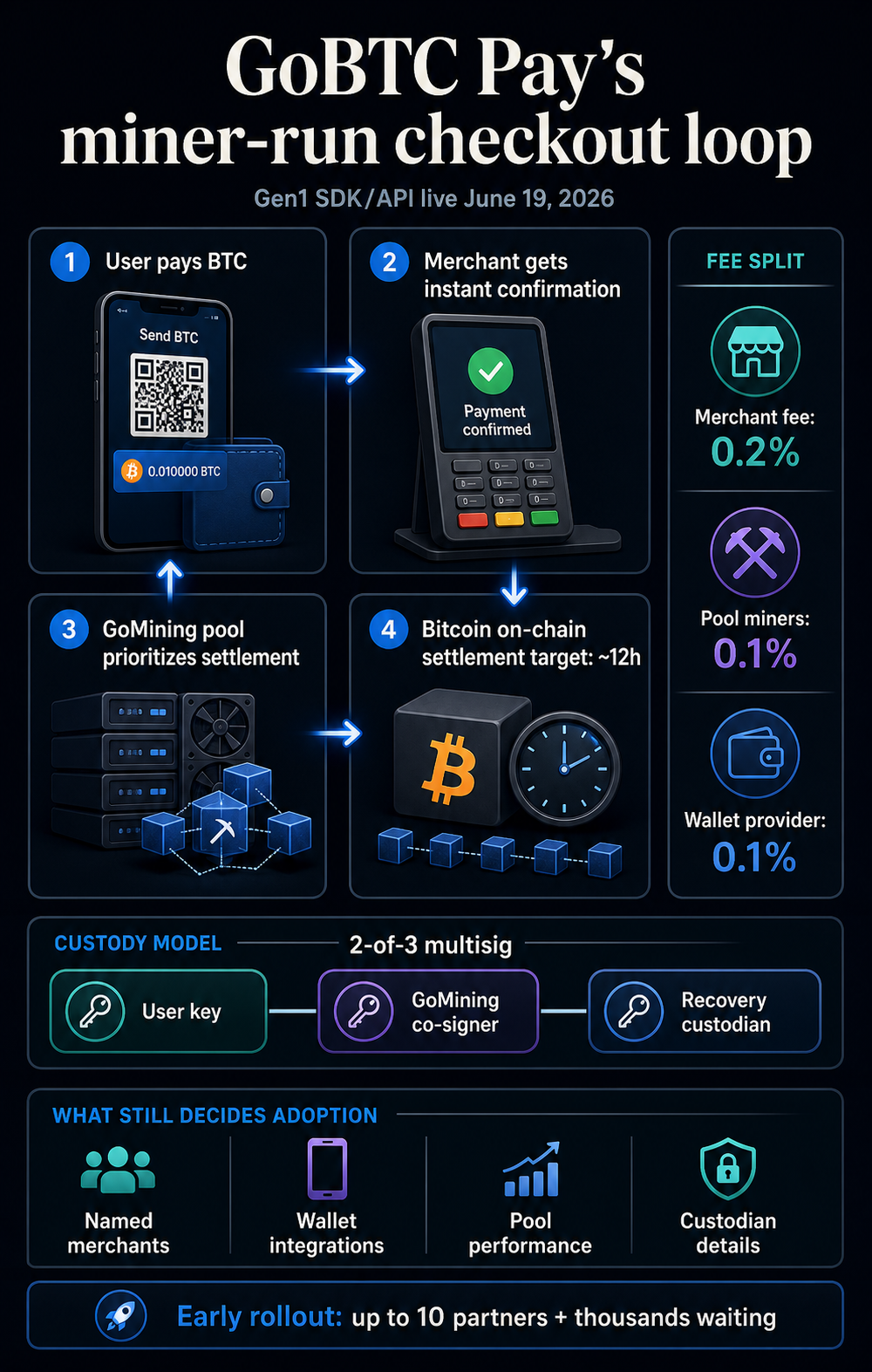
Bitcoin checkout economics are built around miners and wallets
GoBTC's fee design is the clearest sign that GoMining is trying to solve payments through incentives as well as user experience. The company says users pay no direct transaction fee, while merchants pay 0.2%.
For third-party transactions, GoMining says half of that fee goes to miners in the GoBTC pool, and the other half goes to the wallet provider that initiated the payment.
That fee split turns each transaction into a small distribution event. Miners receive a reason to support settlement, and wallets receive a reason to bring users and merchants into the network.
GoMining says it does not charge a fee on third-party transactions, framing the model as a way to drive adoption rather than lock every payment in its own app.
GoBTC also compares its merchant pitch with card-payment costs and settlement windows. That comparison should stay attributed to GoBTC, but the broader merchant backdrop is real: Visa's 2024 merchant settlement release shows that interchange rates and point-of-sale flexibility remain active pressure points for card networks.
Recent Bitcoin payment coverage has also framed lower-fee checkout as a merchant adoption pitch.
GoBTC is competing for attention with instant checkout acceptance, BTC-denominated settlement, and a fee split that rewards the wallets and miners needed to make the system useful.
Adoption remains unproven. GoMining says the first rollout will begin with up to 10 merchants and ecosystem partners, though the company has not named those initial participants.
A waiting list in the thousands shows interest. Merchant willingness to hold BTC from checkout sales, wallet provider integration priority, and real shopper spending volume will determine whether the rail moves beyond early access.
That makes the payment economics useful as a framing device rather than as evidence that the rail has already found product-market fit.
A merchant may like a 0.2% fee and faster checkout feedback, but the model still needs actual checkout volume, wallet distribution, and BTC treasury tolerance. Those operating decisions will determine whether the fee split becomes meaningful.
Pool control carries the settlement risk
The same design that makes GoBTC different also creates a main operating risk. GoMining says most Bitcoin payment companies rely on external mining pools, whereas it can prioritize GoBTC transactions because it mines blocks itself.
For merchants, that can sound practical: checkout feels fast, and final settlement still moves through Bitcoin.
For Bitcoin users, the architecture concentrates responsibility. A payment rail built around a miner-operated pool reduces one type of friction by placing more weight on GoMining's pool operation, transaction prioritization, settlement performance, and recovery design.
Miner-run settlement then becomes the central due diligence question for any wallet or merchant considering the rail.
The Stratum V2 mining protocol specification describes mining work that can be distributed by a pool or coordinated with job declaration and template distribution mechanisms.
Bitcoin Optech's pooled-mining background treats Stratum V2 as part of the broader architecture for coordinating miners. The impact of decentralization depends on implementation: who selects transactions, who controls block templates, and how much influence the pool operator retains.
GoBTC Pay's public page states that payments are routed through GoMining's private or dedicated pool. That mechanism supports a simpler merchant experience while concentrating due diligence on pool governance, transaction selection, and settlement authority.
The custody model adds another layer. GoBTC describes a 2-of-3 multisig setup in which one key is with the user, one is held by GoMining as a co-signer, and one is held by an independent recovery custodian.
The company says GoMining cannot move funds unilaterally and that the custodian provides a recovery path if a user loses access.
That model sits between custodial wallet convenience and pure self-custody. The missing disclosures are practical: the custodian's identity, the recovery process, third-party wallet implementation, outage handling, and how merchants account for the roughly 12-hour settlement target while accepting payments instantly.
Those are integration details with operational consequences. Merchants need predictable checkout confirmation, custody handling, recovery procedures, and settlement timing for daily operations.
Wallets need sufficient fee share and customer demand to justify routing users into a payment flow tied to a single miner-operated settlement path.
Wallet and merchant uptake will define the rollout
GoBTC Pay's Gen1 launch gives Bitcoin payments a path built around direct BTC settlement through GoMining's pool. The protocol now includes SDK and API access, merchant onboarding, wallet-platform requests, and an early-access funnel for a first group of partners.
External participation is the main adoption hurdle. If outside wallets integrate, named merchants go live, and settlement performance holds up through real payment volume, GoBTC Pay could become evidence that mining infrastructure can play a direct role in Bitcoin commerce.
If adoption remains within GoMining's own ecosystem, or if merchants hesitate due to delayed settlement and dependence on pools, the product will look more like a miner-controlled shortcut around Bitcoin's old point-of-sale problem than a broadly adopted payment rail.
The June 19 launch makes that tradeoff concrete: Bitcoin payments that feel simpler at checkout, paired with new reliance on the miner running the rail.
The post appeared first on CryptoSlate.
read the full story
GoMining's GoBTC Pay Bitcoin checkout system now has a live integration surface for its biggest claim: BTC payments that feel instant when settlement is routed through the miner running the rails.
The company said its Gen1 SDK and API are live on June 19, giving merchants and wallet providers a path for Bitcoin checkout through a miner-operated settlement system.
The design keeps BTC as the payment asset at the point of sale while routing acceptance and settlement through GoMining's mining infrastructure. The Lightning Network, wrapped BTC, sidechains, and forced fiat conversion sit outside the path GoMining describes.
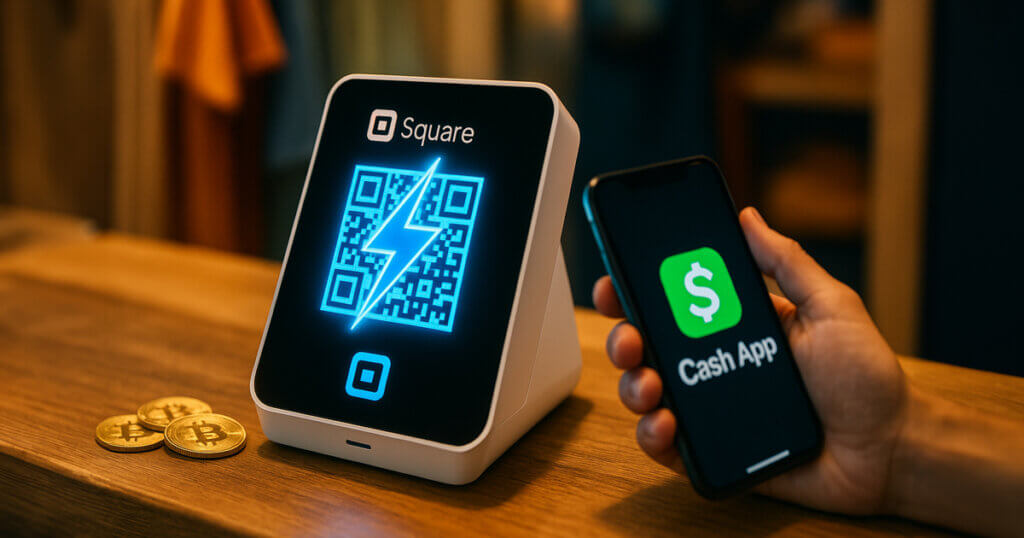
The tradeoff is concentration. Merchants can get instant confirmation, users can spend BTC without a direct transaction fee, and wallet providers can plug into an open API.
The first version also asks participants to rely on a payment rail where the miner behind the product helps control the route from checkout to final Bitcoin settlement.
GoMining says the rollout starts with up to 10 merchants and ecosystem partners, with thousands on the waiting list. That makes Gen1 an early controlled deployment built to measure whether miner-run settlement can attract wallets, merchants, and shoppers into a Bitcoin checkout loop.
GoBTC Pay Bitcoin checkout opens the integration path
GoBTC Pay's product page frames the system as a Bitcoin payment protocol for merchants and wallets, with early access open, merchant onboarding forms, a wallet and platform request flow, and access to API documentation.
The roadmap on the same page lays out a staged path for merchant POS, a dashboard, SDK support, merchant discovery, broader e-commerce support, P2P payments, fiat off-ramp tools, and spending controls, from wallet features to open payment rails.
Developers, wallets, and merchants can now evaluate the GoBTC Pay SDK and API rather than only the product concept.
The product page says payments are confirmed instantly at checkout, settle in Bitcoin, charge zero direct user fees, and avoid payment channels, wrapped tokens, sidechains, and fiat conversion at the point of sale.
Its FAQ says a customer payment is broadcast to GoMining's dedicated pool, which prioritizes it for inclusion in a block.
That setup creates a split experience. The merchant sees the transaction immediately enough to finish the sale. Final settlement follows later on Bitcoin, with GoBTC targeting an average on-chain settlement time of about 12 hours through GoMining's pool.
Merchant acceptance can feel instant while final settlement remains tied to the miner-operated route.
| GoBTC claim | Mechanism | Disclosure still needed |
|---|---|---|
| Instant checkout confirmation | GoBTC routes the transaction through GoMining's payment and pool infrastructure. | How merchants price the gap between checkout acceptance and final Bitcoin settlement. |
| On-chain Bitcoin settlement | Transactions are targeted for settlement through GoMining's dedicated pool. | Pool hashpower, block-production variance, and real performance under merchant volume. |
| Low merchant fee | GoBTC lists a 0.2% merchant fee split between pool miners and the initiating wallet provider. | Whether wallet providers and merchants see enough value in the 0.1%/0.1% split. |
| Non-custodial design | GoBTC describes a 2-of-3 multisig model involving the user, GoMining, and an independent recovery custodian. | The custodian's identity, recovery process, and third-party wallet implementation details. |
Bitcoin checkout economics are built around miners and wallets
GoBTC's fee design is the clearest sign that GoMining is trying to solve payments through incentives as well as user experience. The company says users pay no direct transaction fee, while merchants pay 0.2%.
For third-party transactions, GoMining says half of that fee goes to miners in the GoBTC pool, and the other half goes to the wallet provider that initiated the payment.
That fee split turns each transaction into a small distribution event. Miners receive a reason to support settlement, and wallets receive a reason to bring users and merchants into the network.
GoMining says it does not charge a fee on third-party transactions, framing the model as a way to drive adoption rather than lock every payment in its own app.
GoBTC also compares its merchant pitch with card-payment costs and settlement windows. That comparison should stay attributed to GoBTC, but the broader merchant backdrop is real: Visa's 2024 merchant settlement release shows that interchange rates and point-of-sale flexibility remain active pressure points for card networks.
Recent Bitcoin payment coverage has also framed lower-fee checkout as a merchant adoption pitch.
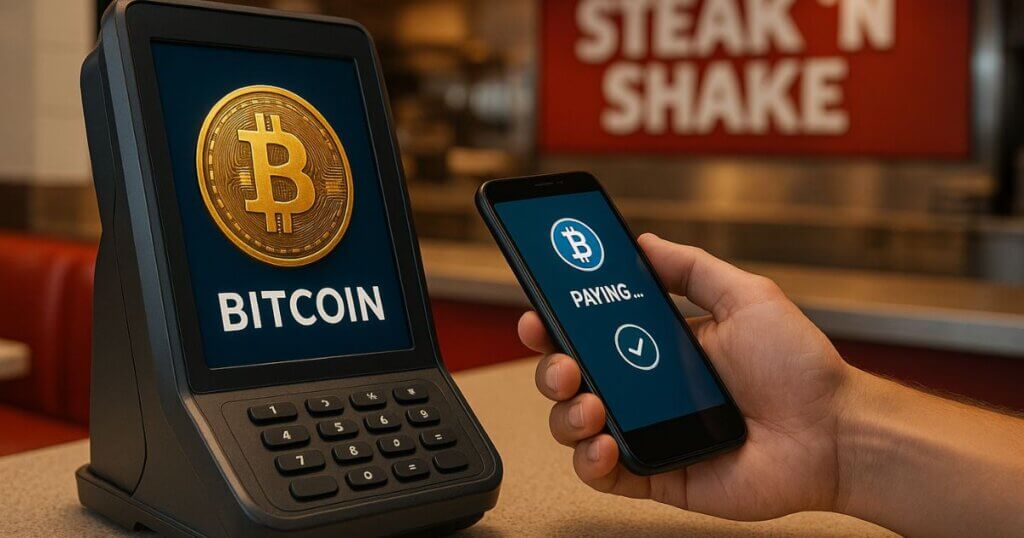
GoBTC is competing for attention with instant checkout acceptance, BTC-denominated settlement, and a fee split that rewards the wallets and miners needed to make the system useful.
Adoption remains unproven. GoMining says the first rollout will begin with up to 10 merchants and ecosystem partners, though the company has not named those initial participants.
A waiting list in the thousands shows interest. Merchant willingness to hold BTC from checkout sales, wallet provider integration priority, and real shopper spending volume will determine whether the rail moves beyond early access.
That makes the payment economics useful as a framing device rather than as evidence that the rail has already found product-market fit.
A merchant may like a 0.2% fee and faster checkout feedback, but the model still needs actual checkout volume, wallet distribution, and BTC treasury tolerance. Those operating decisions will determine whether the fee split becomes meaningful.
Pool control carries the settlement risk
The same design that makes GoBTC different also creates a main operating risk. GoMining says most Bitcoin payment companies rely on external mining pools, whereas it can prioritize GoBTC transactions because it mines blocks itself.
For merchants, that can sound practical: checkout feels fast, and final settlement still moves through Bitcoin.
For Bitcoin users, the architecture concentrates responsibility. A payment rail built around a miner-operated pool reduces one type of friction by placing more weight on GoMining's pool operation, transaction prioritization, settlement performance, and recovery design.
Miner-run settlement then becomes the central due diligence question for any wallet or merchant considering the rail.
The Stratum V2 mining protocol specification describes mining work that can be distributed by a pool or coordinated with job declaration and template distribution mechanisms.
Bitcoin Optech's pooled-mining background treats Stratum V2 as part of the broader architecture for coordinating miners. The impact of decentralization depends on implementation: who selects transactions, who controls block templates, and how much influence the pool operator retains.
GoBTC Pay's public page states that payments are routed through GoMining's private or dedicated pool. That mechanism supports a simpler merchant experience while concentrating due diligence on pool governance, transaction selection, and settlement authority.
The custody model adds another layer. GoBTC describes a 2-of-3 multisig setup in which one key is with the user, one is held by GoMining as a co-signer, and one is held by an independent recovery custodian.
The company says GoMining cannot move funds unilaterally and that the custodian provides a recovery path if a user loses access.
That model sits between custodial wallet convenience and pure self-custody. The missing disclosures are practical: the custodian's identity, the recovery process, third-party wallet implementation, outage handling, and how merchants account for the roughly 12-hour settlement target while accepting payments instantly.
Those are integration details with operational consequences. Merchants need predictable checkout confirmation, custody handling, recovery procedures, and settlement timing for daily operations.
Wallets need sufficient fee share and customer demand to justify routing users into a payment flow tied to a single miner-operated settlement path.
Wallet and merchant uptake will define the rollout
GoBTC Pay's Gen1 launch gives Bitcoin payments a path built around direct BTC settlement through GoMining's pool. The protocol now includes SDK and API access, merchant onboarding, wallet-platform requests, and an early-access funnel for a first group of partners.
External participation is the main adoption hurdle. If outside wallets integrate, named merchants go live, and settlement performance holds up through real payment volume, GoBTC Pay could become evidence that mining infrastructure can play a direct role in Bitcoin commerce.
If adoption remains within GoMining's own ecosystem, or if merchants hesitate due to delayed settlement and dependence on pools, the product will look more like a miner-controlled shortcut around Bitcoin's old point-of-sale problem than a broadly adopted payment rail.
The June 19 launch makes that tradeoff concrete: Bitcoin payments that feel simpler at checkout, paired with new reliance on the miner running the rail.
The post appeared first on CryptoSlate.
read the full story
Crypto Markets Erase $120B as Bitcoin Tanks to $58K Amid Growing Strategy FUD: Weekly Recap
It was another paiful weeks for the crypto bulls but the worst might still not be over.

Bitcoin ETFs Lose $696 Million as Blackrock and Fidelity Lead Broad Crypto Selloff
Crypto ETF flows deteriorated sharply on Thursday, June 25, as bitcoin ETFs posted a sixth straight…

Strategy's Saylor Acknowledges 'Volatility Test' as STRC Hits New Low on Bitcoin Weakness
Strategy’s flagship preferred stock tumbled again when U.S. markets opened, setting another record…

BitGo Cuts Nearly 15% of Staff Six Months After IPO, Refocuses on Stablecoins and AI
Crypto custodian BitGo is cutting approximately 15% of its workforce, CEO Mike Belshe announced…

Bitcoin Tests $59K as ETFs Shed $692M, Options Expiry Looms
Bitcoin fell to around $59,400 as $691 million fled spot ETFs, the most since May, ahead of Friday's…
Bitcoin 25-Delta Put-Call Skew Widens Amid Market Consolidation
Bitcoin options skew points to defensive trader positioning as put demand rises and the market…

Bitcoin Price Analysis: Is Another Leg Lower Coming After the $58K Drop?
Bitcoin remains under pressure despite another strong reaction from the $58K to $60K demand zone.…

Bitcoin Drops to $58,570, Lowest Level Since September 2024
Bitcoin fell below $60,000 this Friday, hitting $58,570 — a level not seen since September 2024.…

$696 Million in 24 Hours: Bitcoin ETFs Record Highest Inflow Since May
Bitcoin records highest daily outflow seen in the last month after its price dropped to a level not…

Oman Launches Mandatory National Bitcoin Mining Pool In State-Backed Push
Oman has launched Omanhash.om, a mandatory national Bitcoin mining pool for licensed miners, with…
Bitcoin Clings to Crucial Support After Rebounding From Its Weakest Level Since 2024
TL;DR: Bitcoin hit its lowest level since September 2024, dropping to $58,100, before bouncing back…


Bitcoin bounces from $58,000 as derivatives signal more pain in the pipeline
BTC touched its lowest level since September 2024 before rebounding to $59,770, while ETH slipped…
Michael Saylor Reaffirms Bitcoin Bet Amid Strategy Legal Pressure
Saylor reaffirms Strategy's Bitcoin focus on X as Rosen Law Firm probes MSTR and preferred…

Tether’s USDT Flips Ether in Market Cap as Stablecoin Climbs to $186 Billion
Tether’s USDT stablecoin briefly overtook ether to become the second-largest cryptocurrency by…
Bitcoin nearly loses $58K as ETF outflows decide whether inflation relief holds
Bitcoin registered an intraday low of $58,189 on June 25 before clawing back toward $60,100 as of…
Bitcoin’s Supply-in-Loss Hits an All-Time High: Why That Might Not Mean a Bottom?
Bitcoin’s Total Supply in Loss has climbed to a record 10.7 million coins, even as a sharp…
Strategy’s Bitcoin bet sinks $12 billion underwater as STRC traders brace for more pain
Strategy’s Bitcoin holdings have fallen roughly $12 billion below their purchase cost, placing the…